
We read your photo as:
What is the annual temperature range at station Q, and what type of climate does it have based on the provided data?
ScanSolve AI Answer
Answer
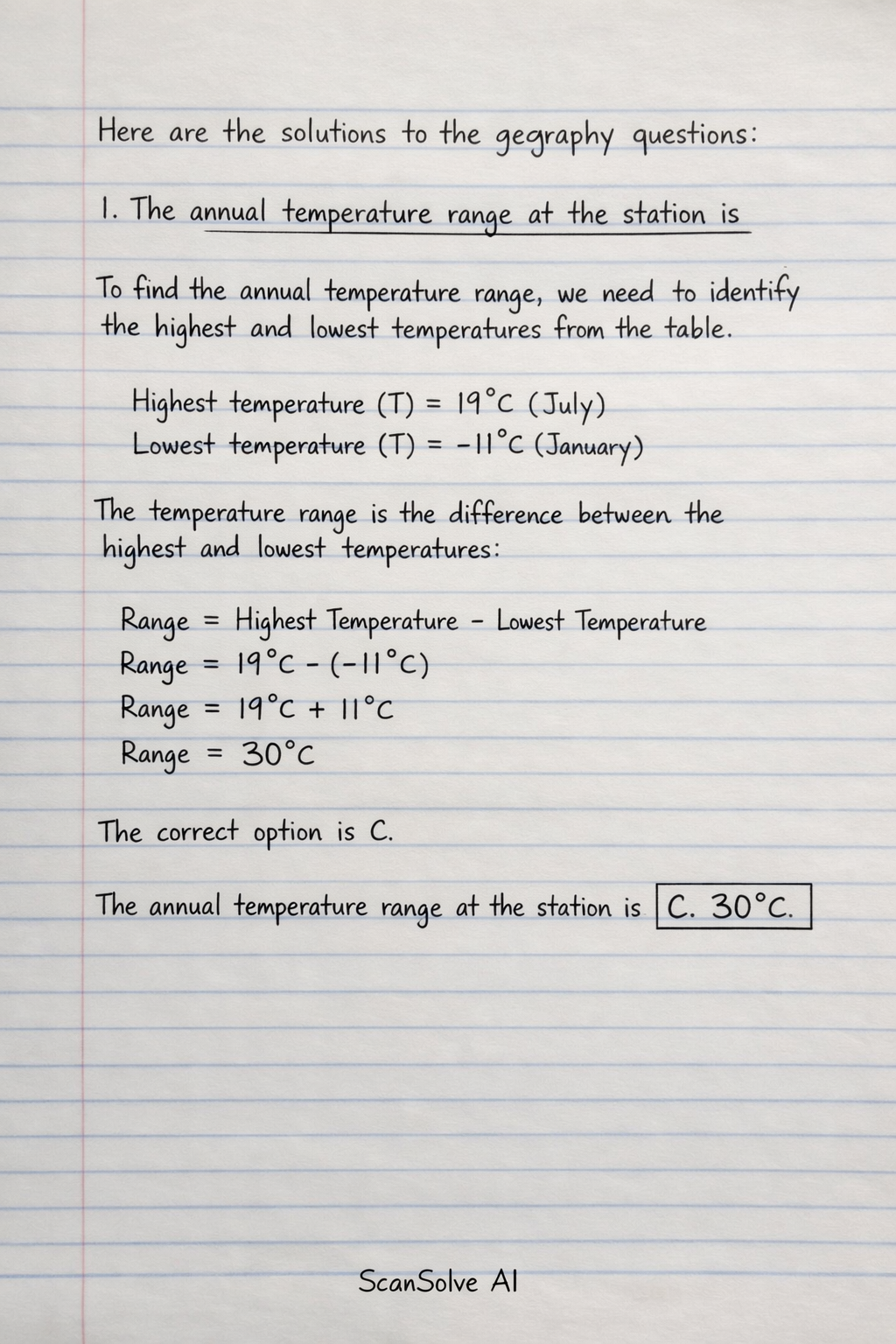
Here are the solutions to the geography questions:
1. The annual temperature range at the station is
To find the annual temperature range, we need to identify the highest and lowest temperatures from the table.
- Highest temperature (T) = (July)
- Lowest temperature (T) = (January)
The temperature range is the difference between the highest and lowest temperatures:
The correct option is C.
The annual temperature range at the station is .
2. This station belongs to which type climate?
Let's analyze the temperature and precipitation data for station Q:
- Temperature (T): The temperatures range from in winter months (January, February, November, December) to in summer months (July). This indicates cold winters and mild summers.
- Precipitation (P): Precipitation occurs throughout the year, with higher amounts during the summer months (e.g., July , August ).
This pattern of cold winters, mild summers, and year-round precipitation (often with a summer maximum) is characteristic of a Cool temperate climate.
- Mediterranean climates have dry summers.
- Warm temperate climates have milder winters (usually above ).
- Cold temperate climates also have cold winters but might have different precipitation patterns or more extreme temperatures. "Cool temperate" best describes the given conditions. The correct option is C. This station belongs to the climate type: .
3. The tropical rainforest differs in structure from the savannah in that
Let's evaluate each option:
- A. Both never occur in the same continent. This is incorrect. For example, both tropical rainforests and savannahs are found in Africa and South America.
- B. The savannah is a natural vegetation while the rainforest is a derived one. This is incorrect. Both tropical rainforests and savannahs are natural vegetation types.
- C. The savannah grows in layers while the rainforest does not. This is incorrect. Tropical rainforests are famous for their distinct vertical layers (emergent, canopy, understory, forest floor), while savannahs have a much simpler structure, primarily consisting of a grass layer and a scattered tree layer.
- D. The savannah has less species diversity than the rainforest. This is correct. Tropical rainforests are known for their exceptionally high species diversity, which contributes to their complex and multi-layered structure. Savannahs generally have lower species diversity. While species diversity is not "structure" itself, it is a fundamental characteristic that leads to and defines the structural complexity of an ecosystem. Given that the other options are factually incorrect regarding structural differences, this is the best answer. The correct option is D. The tropical rainforest differs in structure from the savannah in that .
4. The main source of tropical hardwood for timber is the
Tropical hardwoods are dense, durable woods primarily sourced from trees that grow in tropical regions.
- A. Montane forest: These are forests found in mountainous regions, not the primary source of general tropical hardwood.
- B. Rainforest: Tropical rainforests are characterized by an immense variety and abundance of hardwood tree species, making them the main source of tropical hardwood timber.
- C. Mangrove forest: These are coastal forests adapted to saline conditions, providing specific types of wood but not the main source of tropical hardwood in general.
- D. Coniferous forest: These forests are typically found in temperate and boreal regions and are known for producing softwood, not hardwood. The correct option is B. The main source of tropical hardwood for timber is the .
Try one yourself
A new problem that tests the same skill.
Still stuck on this one?
Ask a follow-up, and the answer starts from this question.
More Geography Questions
Handwritten Step-by-Step Solution
Get this as a handwritten image on WhatsApp — like a tutor wrote it for you.
Try on WhatsApp