
We read your photo as:
What are the answers to the following objective questions about census, overpopulation, and family planning?
ScanSolve AI Answer
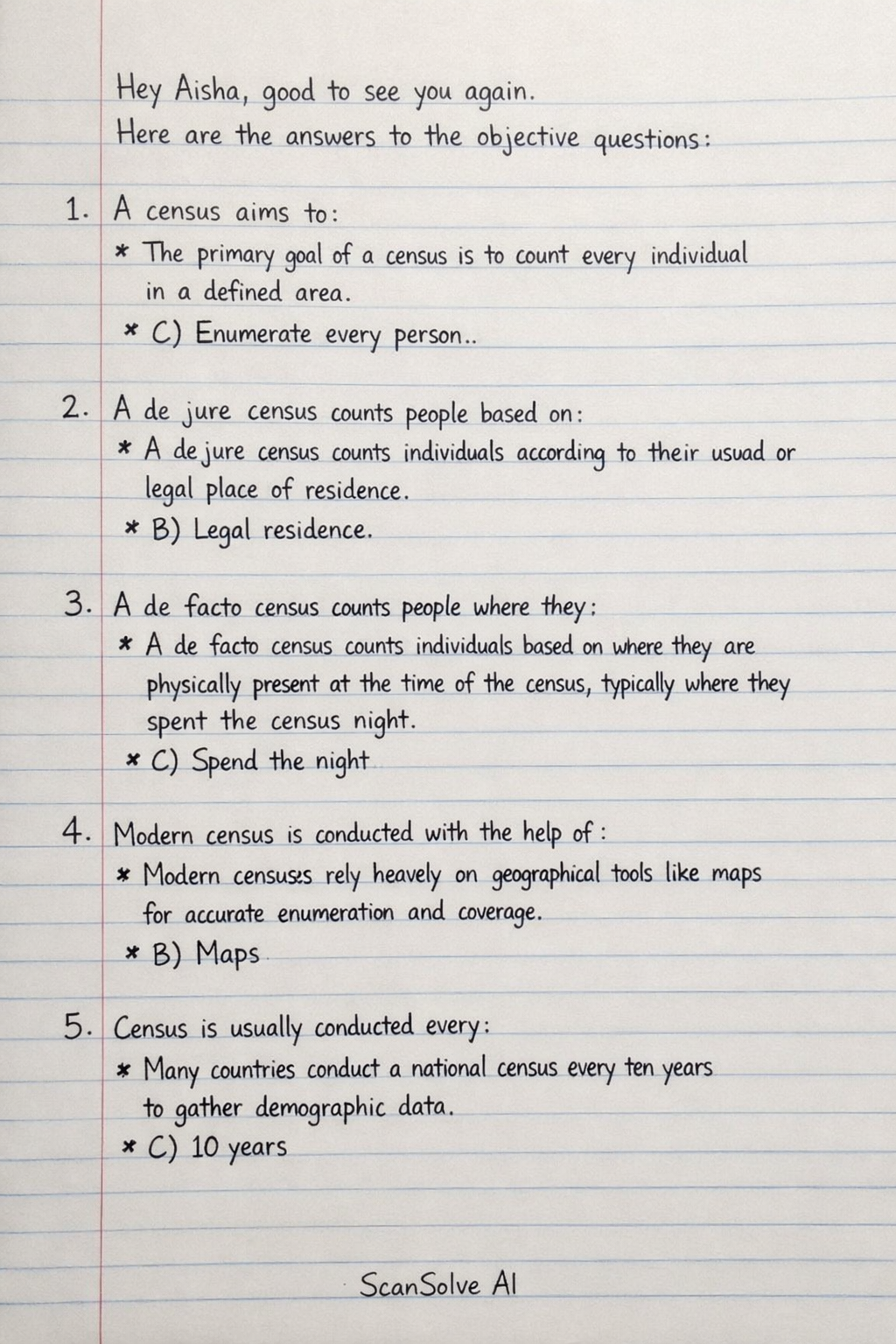
Here are the answers to the objective questions:
-
A census aims to:
- The primary goal of a census is to count every individual in a defined area.
- C) Enumerate every person
-
A de jure census counts people based on:
- A de jure census counts individuals according to their usual or legal place of residence.
- B) Legal residence
-
A de facto census counts people where they:
- A de facto census counts individuals based on where they are physically present at the time of the census, typically where they spent the census night.
- C) Spend the night
-
Modern census is conducted with the help of:
- Modern censuses rely heavily on geographical tools like maps for accurate enumeration and coverage.
- B) Maps
-
Census is usually conducted every:
- Many countries conduct a national census every ten years to gather demographic data.
- C) 10 years
-
One effect of overpopulation is:
- Overpopulation leads to increased consumption and strain on available natural resources.
- B) Depletion of resources
-
Overpopulation leads to:
- With more people, the demand for resources often outstrips supply, leading to shortages.
- B) Shortage of resources
-
Family planning helps to:
- Family planning allows individuals and couples to make informed decisions about family size, contributing to population management.
- B) Control population
-
Illiteracy contributes to:
- Lower literacy rates are often associated with higher birth rates and less access to information about family planning, which can contribute to overpopulation.
- B) Overpopulation
-
Early marriage leads to:
- Early marriage, especially for women, often results in a longer reproductive period and, consequently, a higher number of children.
- B) More children
-
Census data includes information on:
- Census data collects various demographic characteristics of individuals, with age being a fundamental one.
- B) Age
-
Literacy level is a:
- Literacy directly pertains to a person's educational attainment and capabilities.
- A) Educational factor
-
Occupation belongs to:
- Occupation describes a person's economic activity and their role in the workforce.
- B) Economic data
-
Citizenship is a:
- Citizenship defines a person's legal and political affiliation with a country, impacting their social status and rights.
- A) Social/political characteristic
-
Census is conducted by:
- A national census is a large-scale official undertaking typically managed and executed by the government of a country.
- A) Government
-
A household is treated as a:
- In census methodology, a household is considered a fundamental unit for data collection.
- B) Unit
-
Census data is analyzed by:
- Specialized government bodies, often called Census Commissions or national statistical offices, are responsible for processing and analyzing census data.
- B) Census Commission
-
Census data is useful for:
- Census data provides essential information for governments to plan policies, allocate resources, and develop infrastructure.
- B) Planning
-
Census helps in:
- The detailed demographic information collected during a census is crucial for making accurate estimates of future population trends.
- B) Population projection
-
Census data is used by:
- The Election Commission uses population data to define electoral districts and manage voter registration processes.
- A) Election Commission
Still stuck on this one?
Ask a follow-up, and the answer starts from this question.
More Geography Questions
Handwritten Step-by-Step Solution
Get this as a handwritten image on WhatsApp — like a tutor wrote it for you.
Try on WhatsApp