
We read your photo as:
The enthalpy changes H1, H2, and H₃ cannot be identified without a reaction diagram or further context.
ScanSolve AI Answer
Step-by-step solution
11 steps(a) (i)
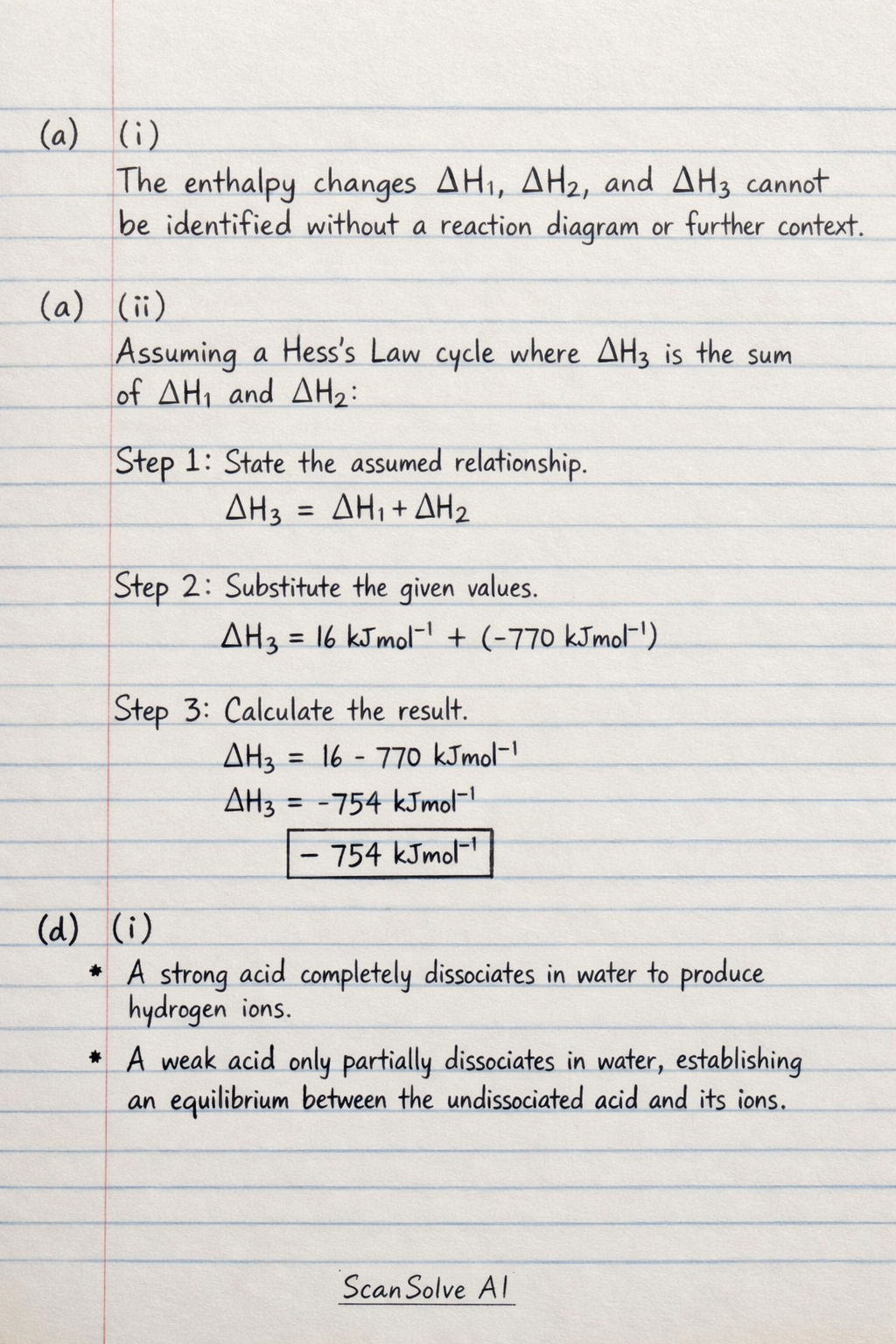
The enthalpy changes , , and cannot be identified without a reaction diagram or further context.
(a) (ii)
Assuming a Hess's Law cycle where is the sum of and :
State the assumed relationship.
Substitute the given values.
Calculate the result.
(d) (i)
- A strong acid completely dissociates in water to produce hydrogen ions.
- A weak acid only partially dissociates in water, establishing an equilibrium between the undissociated acid and its ions.
(d) (ii)
Write the dissociation equation for sulphuric acid.
Sulphuric acid () is a strong acid and is assumed to fully dissociate both protons in dilute solutions for pH calculations.
Determine the concentration of hydrogen ions.
Since 1 mole of produces 2 moles of ions:
Calculate the pH.
(d) (iii)
- Maintaining a stable pH in biological systems, such as blood.
- Controlling the pH of solutions in chemical reactions or industrial processes.
(e) (i)
Write the equilibrium constant expression () for the given reaction.
The reaction is:
Substitute the given equilibrium concentrations.
Calculate the value of .
(e) (ii)
Determine the number of moles of gaseous reactants and products.
Reactants: moles of gas.
Products: moles of gas.Apply Le Chatelier's principle.
A decrease in pressure will shift the equilibrium to the side with a greater number of moles of gas to counteract the change. Since the reactant side has 3 moles of gas and the product side has 2 moles of gas, the equilibrium will shift towards the reactants.
The equilibrium position will shift to the left, favoring the formation of reactants ( and ).
Still stuck on this one?
Ask a follow-up, and the answer starts from this question.
More Geography Questions
Handwritten Step-by-Step Solution
Get this as a handwritten image on WhatsApp — like a tutor wrote it for you.
Try on WhatsApp