
We read your photo as:
Write this question for geography
Geography
ScanSolve AI Answer
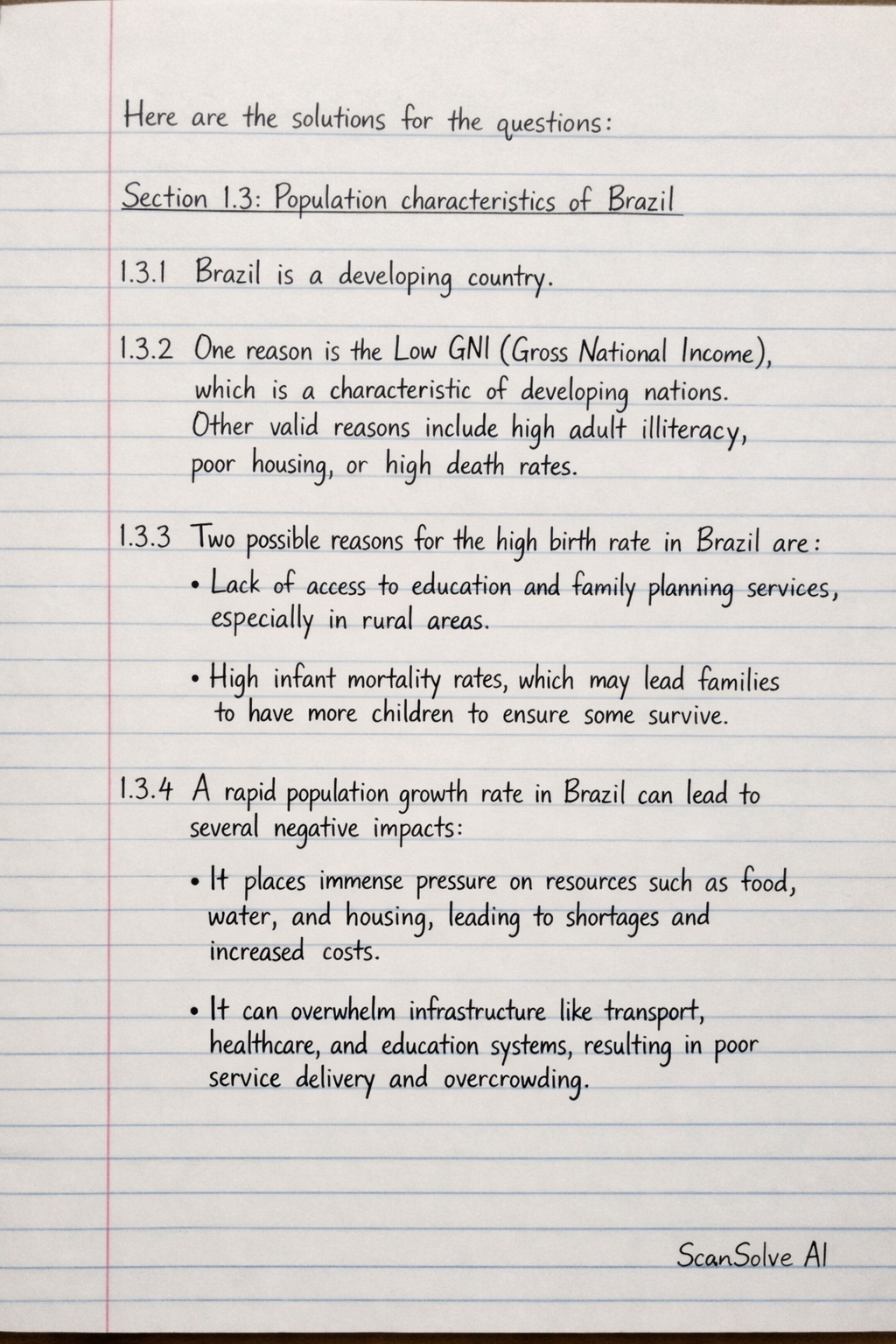
Here are the solutions for the questions:
Section 1.3: Population characteristics of Brazil
- 1.3.1 Brazil is a developing country.
- 1.3.2 One reason is the Low GNI (Gross National Income), which is a characteristic of developing nations. Other valid reasons include high adult illiteracy, poor housing, or high death rates.
- 1.3.3 Two possible reasons for the high birth rate in Brazil are:
- Lack of access to education and family planning services, especially in rural areas.
- High infant mortality rates, which may lead families to have more children to ensure some survive.
- 1.3.4 A rapid population growth rate in Brazil can lead to several negative impacts:
- It places immense pressure on resources such as food, water, and housing, leading to shortages and increased costs.
- It can overwhelm infrastructure like transport, healthcare, and education systems, resulting in poor service delivery and overcrowding.
- It often leads to increased unemployment as the job market cannot absorb the growing workforce, contributing to poverty and social instability.
- 1.3.5 Two methods Brazil can use to reduce rapid population growth are:
- Investing in education, particularly for women, which is strongly linked to lower fertility rates and increased awareness of family planning.
- Expanding access to family planning services and contraception across the country, making it easier for individuals to make informed choices about family size.
Section 1.4: Xenophobic attacks in South Africa
- 1.4.1 A refugee is a person who has been forced to leave their country in order to escape war, persecution, or natural disaster.
- 1.4.2 Two reasons from the extract why Brian left his country of birth are:
- He left to try and support his family, indicating economic hardship or a search for better opportunities.
- He faced a situation where it was "better to starve at home than to die here," implying he was fleeing violence or life-threatening conditions.
- 1.4.3 Two possible reasons why South Africans do not like foreigners, as implied by the extract, are:
- The perception that foreigners are taking their jobs, leading to competition for employment.
- The belief that foreigners are enjoying a better standard of living in South Africa, potentially at the expense of locals.
- 1.4.4 One effect of xenophobic attacks on foreign nationals, as seen from the extract, is displacement, where people are forced to leave their homes and businesses. Other effects include being killed or severely injured.
- 1.4.5 South Africans can assist refugees by providing safe shelter and basic necessities like food and medical care. They can also offer legal assistance to help refugees navigate asylum processes and integrate into society.
- 1.4.6 South Africa can benefit from the influx of refugees in several ways:
- Refugees can fill labor shortages in certain sectors, contributing to the economy.
- They often bring diverse skills, knowledge, and entrepreneurial spirit, which can stimulate economic growth and innovation by starting businesses and creating jobs.
- Refugees can also enrich the cultural landscape of the country, fostering diversity and new perspectives.
Was this helpful?
Still stuck on this one?
Ask a follow-up, and the answer starts from this question.
Got a different question?Ask your own question
More Geography Questions
Handwritten Step-by-Step Solution
Get this as a handwritten image on WhatsApp — like a tutor wrote it for you.
Try on WhatsApp