
We read your photo as:
This solution is for Section B of a homework assignment. It answers questions about rocks, minerals, and coral growth conditions.
ScanSolve AI Answer
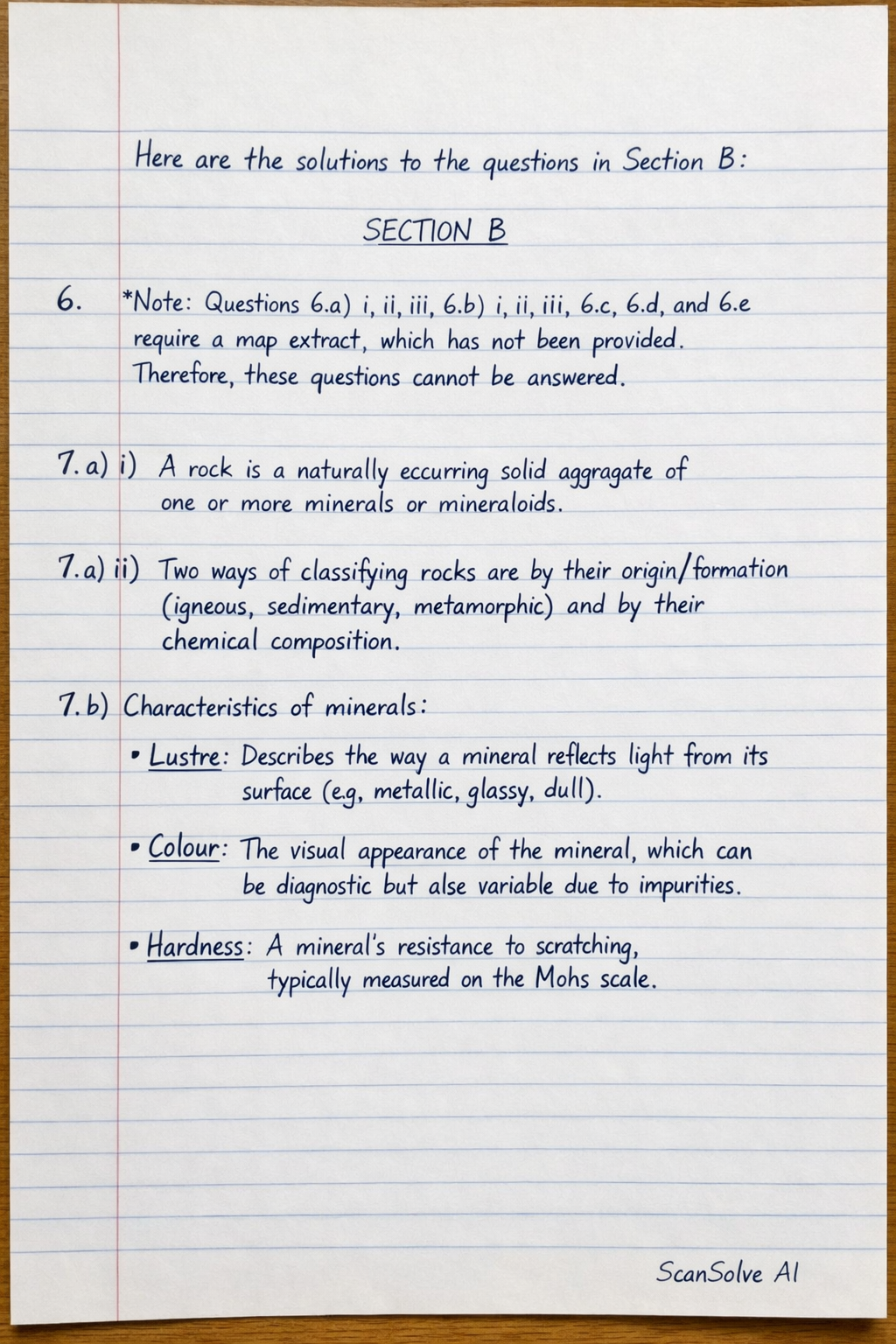
Here are the solutions to the questions in Section B:
SECTION B
6.
- Note: Questions 6.a) i, ii, iii, 6.b) i, ii, iii, 6.c, 6.d, and 6.e require a map extract, which has not been provided. Therefore, these questions cannot be answered.
7. a) i) A rock is a naturally occurring solid aggregate of one or more minerals or mineraloids.
7. a) ii) Two ways of classifying rocks are by their origin/formation (igneous, sedimentary, metamorphic) and by their chemical composition.
7. b) Characteristics of minerals:
- Lustre: Describes the way a mineral reflects light from its surface (e.g., metallic, glassy, dull).
- Colour: The visual appearance of the mineral, which can be diagnostic but also variable due to impurities.
- Hardness: A mineral's resistance to scratching, typically measured on the Mohs scale.
7. c) When sedimentary rocks are subjected to intensive heat and pressure, they undergo metamorphism. This process causes the original minerals to recrystallize or form new minerals, and the rock's texture and structure change, transforming it into a metamorphic rock.
7. d) i) Conditions necessary for the growth of coral:
- Warm water (typically to )
- Clear, shallow water (for sunlight penetration for symbiotic algae)
- Saline water
- Firm base for attachment
7. d) ii) Coral rocks are formed from the accumulation of calcium carbonate skeletons secreted by tiny marine organisms called coral polyps. These polyps live in colonies and build hard, stony exoskeletons. Over long periods, these accumulated skeletons form large structures known as coral reefs. When these reefs are uplifted or exposed above sea level, they solidify into coral rock.
7. e) i) Two methods of recording data during a field study on rocks:
- Note-taking (recording observations, measurements, and descriptions)
- Photography (capturing visual evidence of rock types, structures, and features)
7. e) ii) Two follow-up activities of a field study:
- Data analysis (interpreting collected information, identifying patterns)
- Report writing (documenting findings, methodology, and conclusions)
8. a) Vulcanicity is the process by which molten rock (magma), gases, and solid materials are forced out from the Earth's interior onto the surface or intrude into the Earth's crust.
8. b) i) Other intrusive volcanic features apart from a sill:
- Dyke
- Laccolith
- Batholith
8. b) ii) Formation of features:
- A sill: A sill is formed when magma intrudes horizontally between existing layers of sedimentary rock. The magma then cools and solidifies in this parallel, sheet-like orientation.
- Hot spring: Hot springs are formed when groundwater seeps into the Earth's crust and is heated by contact with hot rocks or magma. The heated water, being less dense, rises back to the surface through cracks and fissures, emerging as a hot spring.
8. b) iii) Magma is molten rock found beneath the Earth's surface, within the crust or mantle. Lava is molten rock that has erupted onto the Earth's surface.
8. b) iv) Four negative effects of vulcanicity:
- Destruction of property and infrastructure (e.g., buildings, roads, farmlands).
- Loss of life (human and animal) due to eruptions, ash falls, or lahars.
- Disruption of air travel due to volcanic ash clouds, which can damage aircraft engines.
- Climate change (short-term cooling due to ash blocking sunlight, or long-term warming from greenhouse gas emissions).
9. a) i) Weathering is the in-situ breakdown and decomposition of rocks, soil, and minerals at or near the Earth's surface through direct contact with the atmosphere, biota, and water.
9. a) ii) Three factors (apart from plants) that influence the rate of weathering:
- Climate (e.g., temperature, precipitation levels)
- Rock type and composition (e.g., mineralogy, solubility, resistance)
- Rock structure (e.g., presence of joints, cracks, bedding planes)
9. a) iii) Two ways in which plants cause weathering:
- Root wedging: Plant roots grow into existing cracks and fissures in rocks. As the roots grow larger, they exert pressure, widening the cracks and eventually breaking the rock apart.
- Chemical action: Plants release organic acids (e.g., humic acids from decaying vegetation or root exudates) that can dissolve minerals in rocks, leading to their chemical decomposition.
9. b) Processes of weathering:
- i) Block disintegration: This is a form of physical weathering common in areas with large diurnal temperature ranges. Rocks with pre-existing joints or cracks expand when heated and contract when cooled. Differential expansion and contraction between the outer and inner layers, or along different mineral grains, cause stress that eventually breaks the rock into angular blocks along its joints.
- ii) Carbonation: This is a form of chemical weathering where carbon dioxide dissolves in rainwater to form a weak carbonic acid (). This carbonic acid then reacts with carbonate minerals, particularly calcite in limestone, to form soluble bicarbonates, which are easily carried away in solution, leading to the dissolution of the rock.
9. c) Four effects of mass wasting on the environment:
- Destruction of vegetation and habitats, leading to ecological disruption.
- Damage to infrastructure such as roads, railways, buildings, and pipelines.
- Loss of fertile soil, reducing agricultural productivity and land value.
- Blocking of rivers, which can create temporary lakes and increase the risk of flash floods downstream.
10. a) i) Two other processes in the hydrological cycle (apart from surface runoff):
- Evaporation
- Precipitation
10. a) ii) Three factors that determine the amount of surface runoff:
- Intensity and duration of rainfall
- Permeability or infiltration capacity of the soil
- Slope or gradient of the land
**10.
Still stuck on this one?
Ask a follow-up, and the answer starts from this question.
More Geography Questions
Handwritten Step-by-Step Solution
Get this as a handwritten image on WhatsApp — like a tutor wrote it for you.
Try on WhatsApp