
We read your photo as:
Describe the three stages of river development and explain how river features benefit communities.
ScanSolve AI Answer
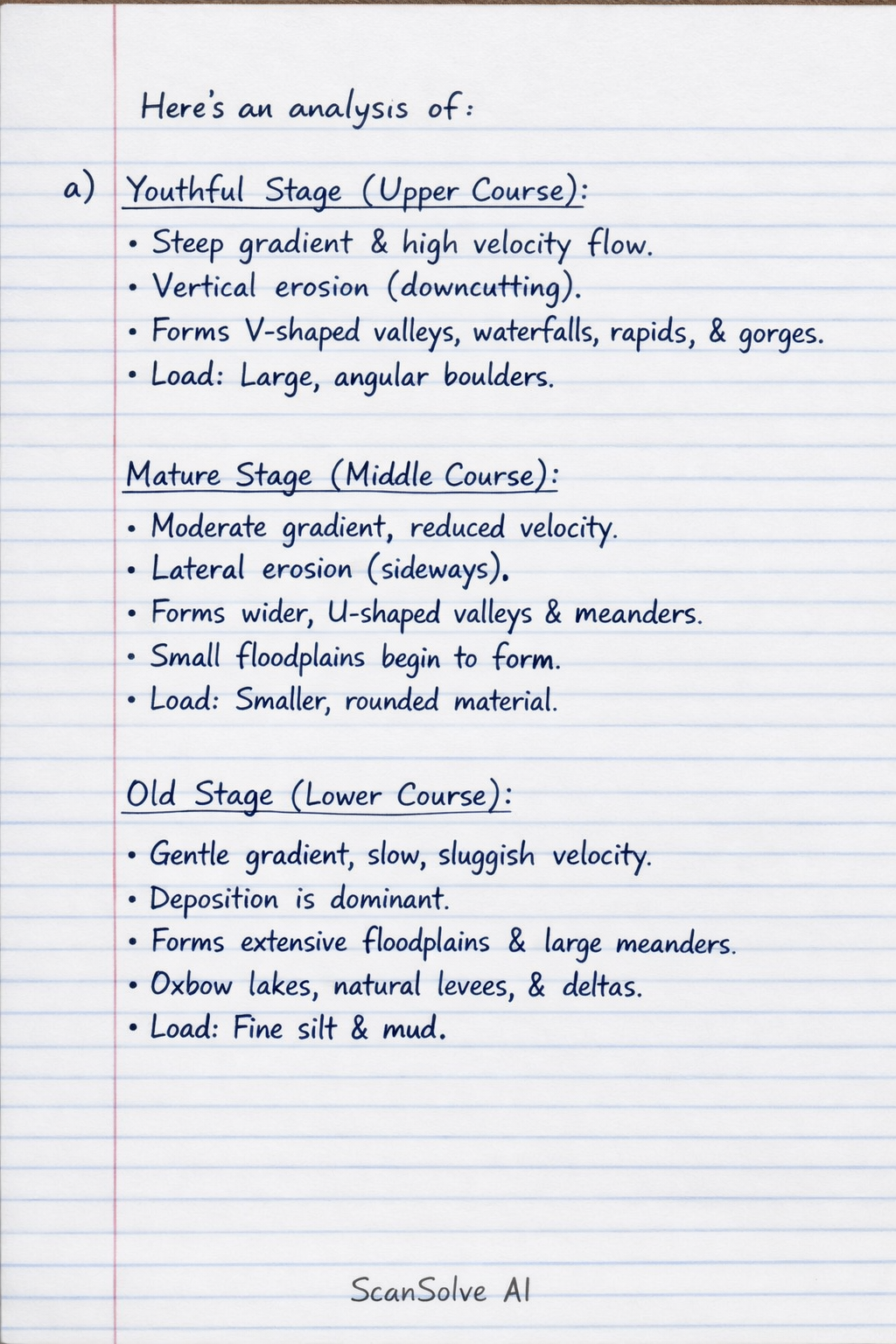
a) Rivers develop through three main stages, each with distinct characteristics:
-
Youthful Stage (Upper Course): Characterized by a steep gradient and high velocity flow. The dominant process is vertical erosion (downcutting), forming V-shaped valleys, waterfalls, rapids, and gorges. The river's load consists of large, angular boulders.
-
Mature Stage (Middle Course): The gradient becomes moderate, and the river's velocity is reduced. Lateral erosion (sideways) becomes more prominent than vertical erosion, leading to the formation of wider, U-shaped valleys and the development of meanders. Small floodplains may begin to form. The load is smaller and more rounded.
-
Old Stage (Lower Course): The river flows over a gentle gradient with a slow, sluggish velocity. Deposition is the dominant process, creating extensive floodplains, large meanders, oxbow lakes, natural levees, and eventually deltas or estuaries at the mouth. The river's load consists of fine silt and mud.
b) The features formed by the river in these stages benefit communities in several ways:
- Hydroelectric Power: The steep gradients, waterfalls, and rapids in the youthful stage provide significant potential for generating hydroelectric power, supplying electricity to communities.
- Fertile Agricultural Land: The floodplains and deltas formed in the mature and old stages are composed of highly fertile alluvial soils, ideal for intensive agriculture, supporting food production and livelihoods.
- Water Supply and Irrigation: Rivers in all stages provide a continuous source of fresh water for domestic use, livestock, and irrigation of crops, which is essential for sustaining human settlements and agriculture.
- Navigation and Trade: The wider, deeper channels and slower flow in the mature and old stages facilitate river navigation, enabling transportation of goods and people, and supporting trade and economic activities.
- Fisheries and Biodiversity: Rivers and their associated features like oxbow lakes and estuaries support diverse aquatic ecosystems, providing fishing grounds for local communities and contributing to biodiversity.
Still stuck on this one?
Ask a follow-up, and the answer starts from this question.
More Geography Questions
Handwritten Step-by-Step Solution
Get this as a handwritten image on WhatsApp — like a tutor wrote it for you.
Try on WhatsApp