
We read your photo as:
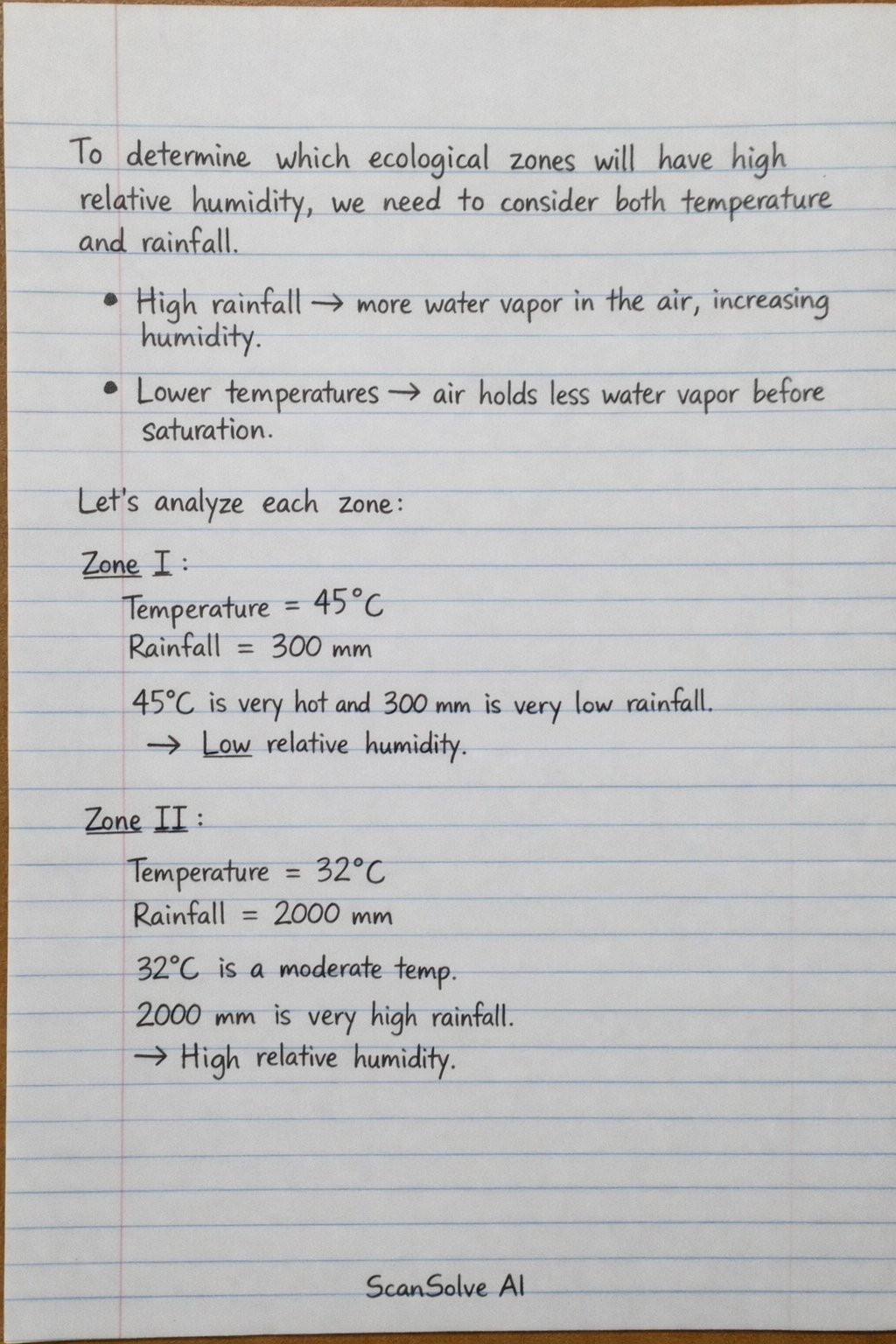
To determine which ecological zones will have high relative humidity, we need to consider both temperature and rainfall.
ScanSolve AI Answer
Answer
To determine which ecological zones will have high relative humidity, we need to consider both temperature and rainfall.
- High rainfall contributes to a higher amount of water vapor in the air, which increases humidity.
- Lower temperatures mean the air can hold less water vapor before becoming saturated. If there's a significant amount of water vapor (due to rainfall) and the temperature is not excessively high, the relative humidity will be high.
Let's analyze each zone:
-
Zone I: Temperature = , Rainfall = .
- This zone has a very high temperature and very low rainfall. This combination suggests low relative humidity.
-
Zone II: Temperature = , Rainfall = .
- This zone has a moderate temperature and very high rainfall. The high rainfall will lead to a large amount of water vapor, resulting in high relative humidity.
-
Zone III: Temperature = , Rainfall = .
- This zone has a moderate temperature (slightly lower than Zone II) and the highest rainfall. This combination is ideal for very high relative humidity.
-
Zone IV: Temperature = , Rainfall = .
- This zone has the lowest temperature, but its rainfall is moderate, significantly less than Zones II and III. While the low temperature helps increase relative humidity, the amount of water vapor from rainfall is not as high as in Zones II and III.
Comparing the zones, Zones II and III have the highest rainfall, indicating the greatest amount of water vapor in the atmosphere. Their moderate temperatures allow for this water vapor to contribute significantly to high relative humidity.
Therefore, high relative humidity will be expected in Zones II and III.
The final answer is .
Try one yourself
A new problem that tests the same skill.
Still stuck on this one?
Ask a follow-up, and the answer starts from this question.
More Geography Questions
Handwritten Step-by-Step Solution
Get this as a handwritten image on WhatsApp — like a tutor wrote it for you.
Try on WhatsApp