
We read your photo as:
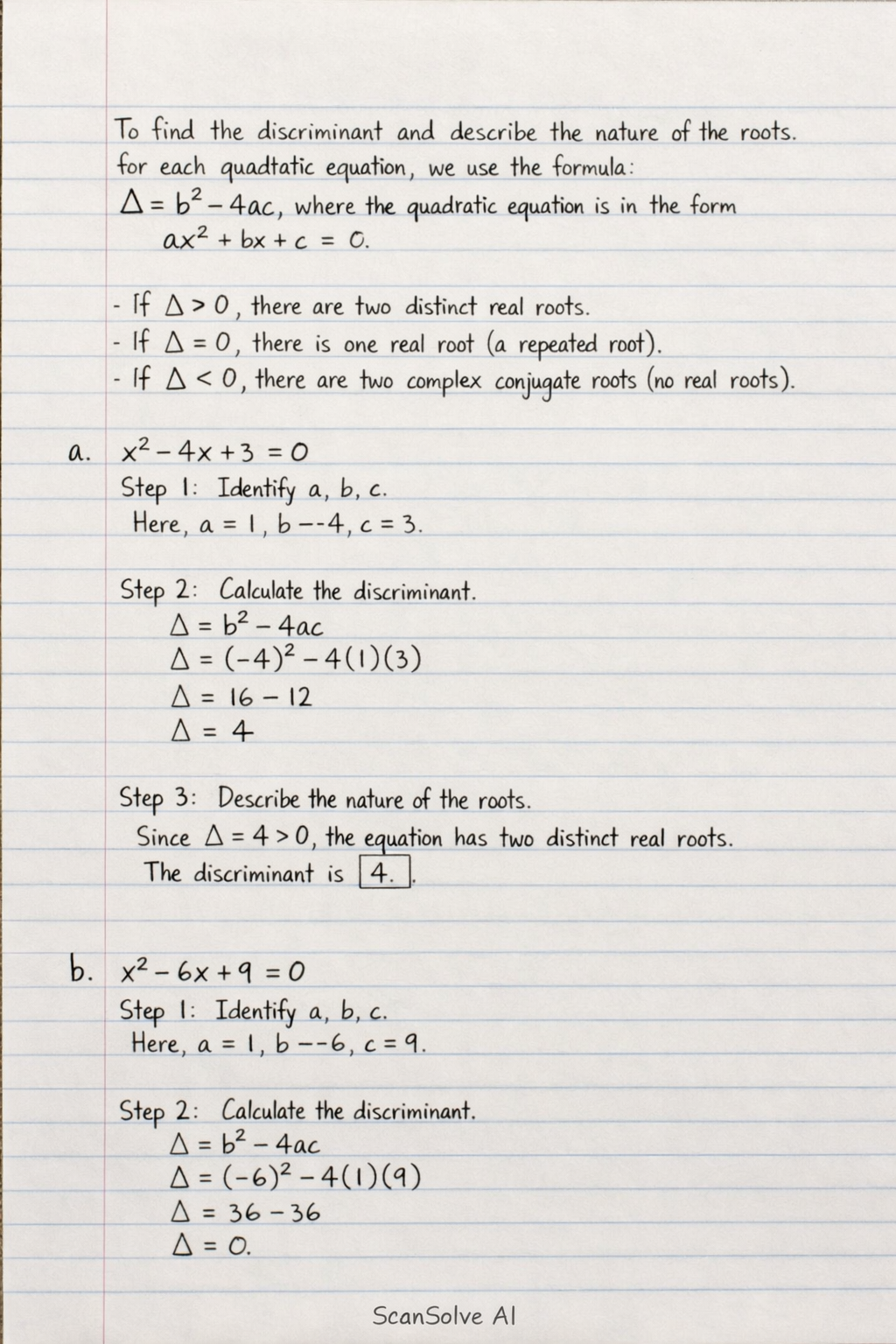
To find the discriminant and describe the nature of the roots for each quadratic equation, we use the formula for the discriminant = b² − 4ac, where the quadratic equation is in the form $ax
ScanSolve AI Answer
Answers
5 partsStep-by-step solution
15 stepsTo find the discriminant and describe the nature of the roots for each quadratic equation, we use the formula for the discriminant , where the quadratic equation is in the form .
The nature of the roots is determined as follows:
- If , there are two distinct real roots.
- If , there is one real root (a repeated root).
- If , there are two complex conjugate roots (no real roots).
Part a· 3 steps
Identify $a, b, c$.
Here, , , .
Calculate the discriminant.
Describe the nature of the roots.
Since , the equation has two distinct real roots.
The discriminant is .
Part b0
Identify $a, b, c$.
Here, , , .
Calculate the discriminant.
Describe the nature of the roots.
Since , the equation has one real root (a repeated root).
The discriminant is .
Part c-16
Identify $a, b, c$.
Here, , , .
Calculate the discriminant.
Describe the nature of the roots.
Since , the equation has two complex conjugate roots (no real roots).
The discriminant is .
Part d0
Identify $a, b, c$.
Here, , , .
Calculate the discriminant.
Describe the nature of the roots.
Since , the equation has one real root (a repeated root).
The discriminant is .
Part e9
Identify $a, b, c$.
Here, , , .
Calculate the discriminant.
Describe the nature of the roots.
Since , the equation has two distinct real roots.
The discriminant is .
Try one yourself
A new problem that tests the same skill.
Still stuck on this one?
Ask a follow-up, and the answer starts from this question.
More Geography Questions
Handwritten Step-by-Step Solution
Get this as a handwritten image on WhatsApp — like a tutor wrote it for you.
Try on WhatsApp