

This geography problem is solved step by step below, with detailed explanations to help you understand the method and arrive at the correct answer.
ScanSolve AI Answer
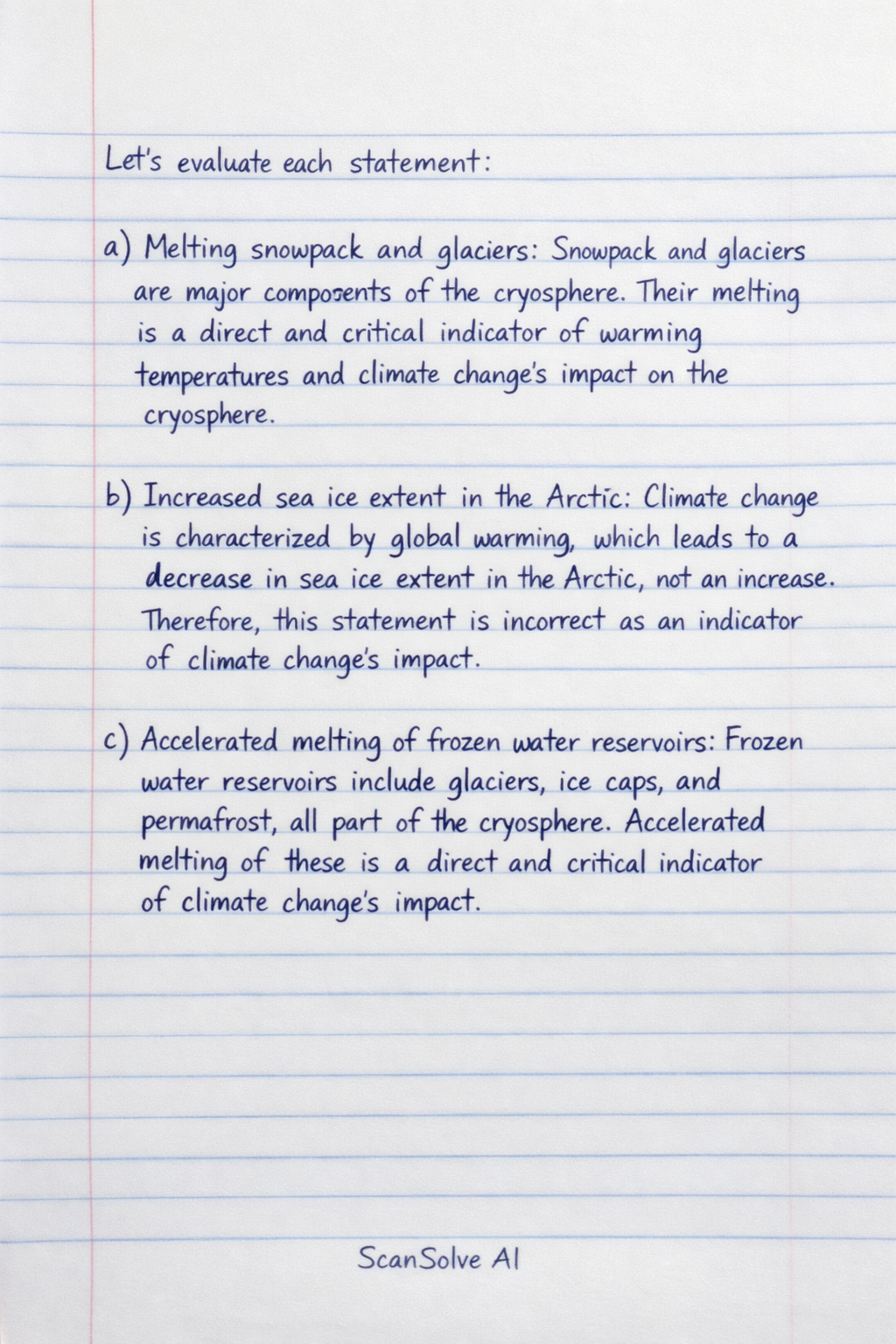
The question asks to identify critical indicators of climate change's impact on the cryosphere. The cryosphere includes all frozen water on Earth, such as snow, glaciers, ice sheets, and sea ice. Let's evaluate each statement: a) Melting snowpack and glaciers: Snowpack and glaciers are major components of the cryosphere. Their melting is a direct and critical indicator of warming temperatures and climate change's impact on the cryosphere. b) Increased sea ice extent in the Arctic: Climate change is characterized by global warming, which leads to a decrease* in sea ice extent in the Arctic, not an increase. Therefore, this statement is incorrect as an indicator of climate change's impact. c) Accelerated melting of frozen water reservoirs: Frozen water reservoirs include glaciers, ice caps, and permafrost, all of which are part of the cryosphere. Accelerated melting of these is a direct and critical indicator of climate change's impact. d) Disruption of water supply for local communities: While this is an impact on human systems, it is a direct consequence of changes in the cryosphere (e.g., reduced snowpack or glacier meltwater affecting water availability). The cryosphere serves as a natural water reservoir, and its changes critically affect water supply. Therefore, the disruption of water supply is a critical indicator of the broader implications and significance of the impact on the cryosphere. Based on this analysis: Statements 'a' and 'c' are direct indicators of changes within the cryosphere. Statement 'b' is incorrect. Statement 'd' is a critical consequence directly linked to changes in the cryosphere. Now let's look at the given options: 1. a, b, and d 2. a, b, and c 3. a, b, c, and d 4. a, c, and d Since statement 'b' is incorrect, any option that includes 'b' must be wrong. This eliminates options 1, 2, and 3. The only remaining option is 4, which includes a, c, and d. This implies that 'd' is considered a critical indicator in the context of this question, representing a significant downstream impact of cryospheric changes. The final answer is 4