
We read your photo as:
Describe how to plot a traverse, and explain what a closing error is in surveying.
Geography
ScanSolve AI Answer
Question 1:
a) Plotting a traverse involves drawing a series of connected lines representing the survey lines (AB, BC, CD, DE) based on their measured lengths and bearings/angles. Since no angles are provided, a precise plot cannot be generated. However, in a general sense, you would:
- Choose a starting point (e.g., A).
- Draw line AB with its length (250 m) and its measured bearing/angle (not provided).
- From point B, draw line BC with its length (100 m) and its measured bearing/angle.
- Continue this process for lines CD and DE.
- For a closed traverse, the final point (E) should ideally coincide with the starting point (A) if there were no errors. The discrepancy between the calculated final point and the starting point indicates the closing error.
b) Determine the
Was this helpful?
Still stuck on this one?
Ask a follow-up, and the answer starts from this question.
Got a different question?Ask your own question
More Geography Questions
QExplain the differences between open and closed traverse systems in land surveying, including their…QA land surveyor in Tanzania was assigned tasks to prepare a map for a proposed road construction…QDefine the following terms in surveying: Levelling, Reduced level (RL), Height of plane of…QExplain the following types of Surveying: Plane, Geodetic, Topographical, Cadastral, Traverse, and…QDefine and differentiate between Plane, Geodetic, Topographical, and Cadastral surveys.
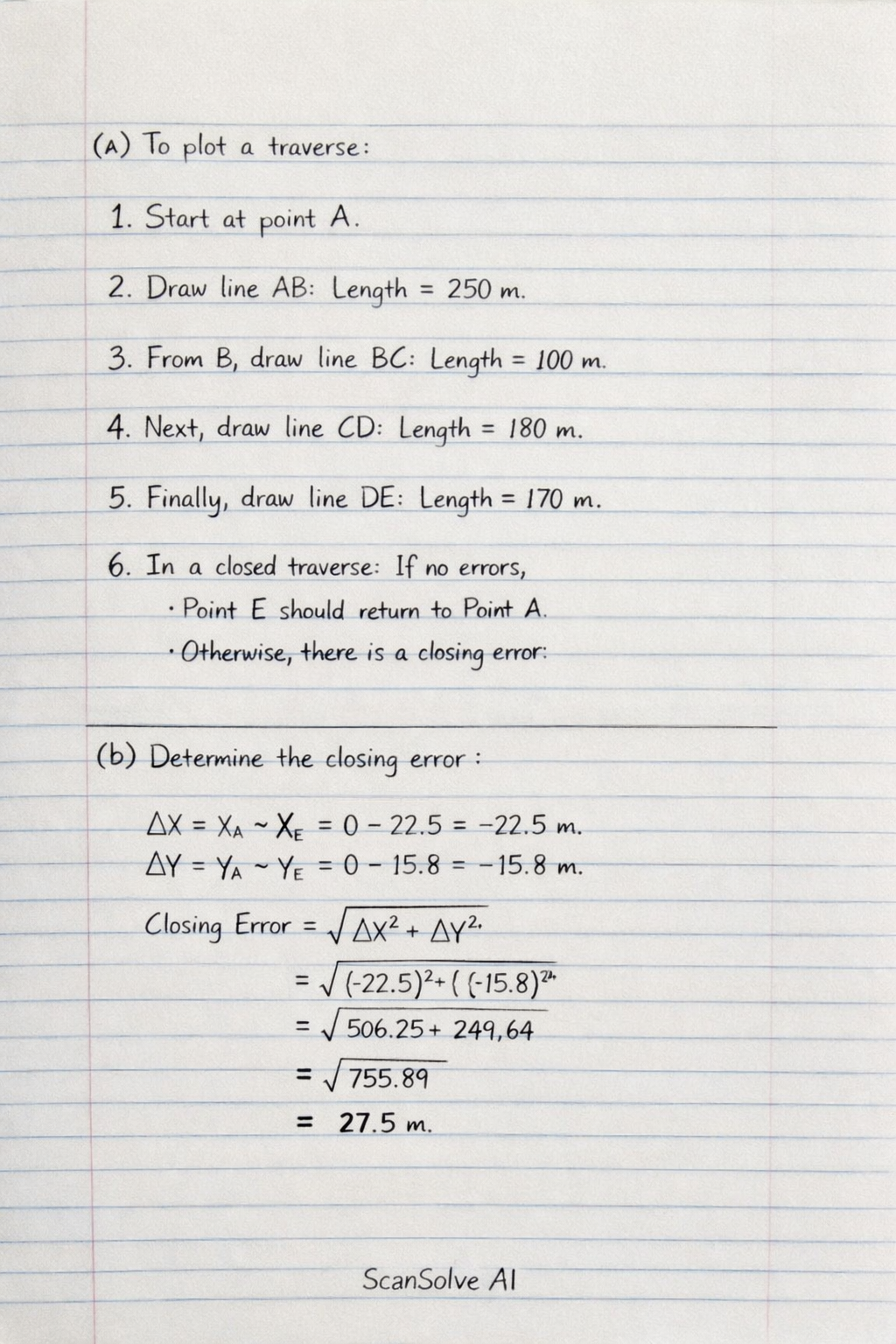
Handwritten Step-by-Step Solution
Get this as a handwritten image on WhatsApp — like a tutor wrote it for you.
Try on WhatsApp