
We read your photo as:
Using the years as the base of the graph and a scale of 2 cm to represent 10,000 tonnes of palm oil on the vertical axis, construct a grouped bar graph to represent the data
Geography
ScanSolve AI Answer
Step-by-step solution
4 stepsI have the data from Table Y (from your previous message) and the questions from the current image.
Here are the answers to Question 2:
Part a· 4 steps
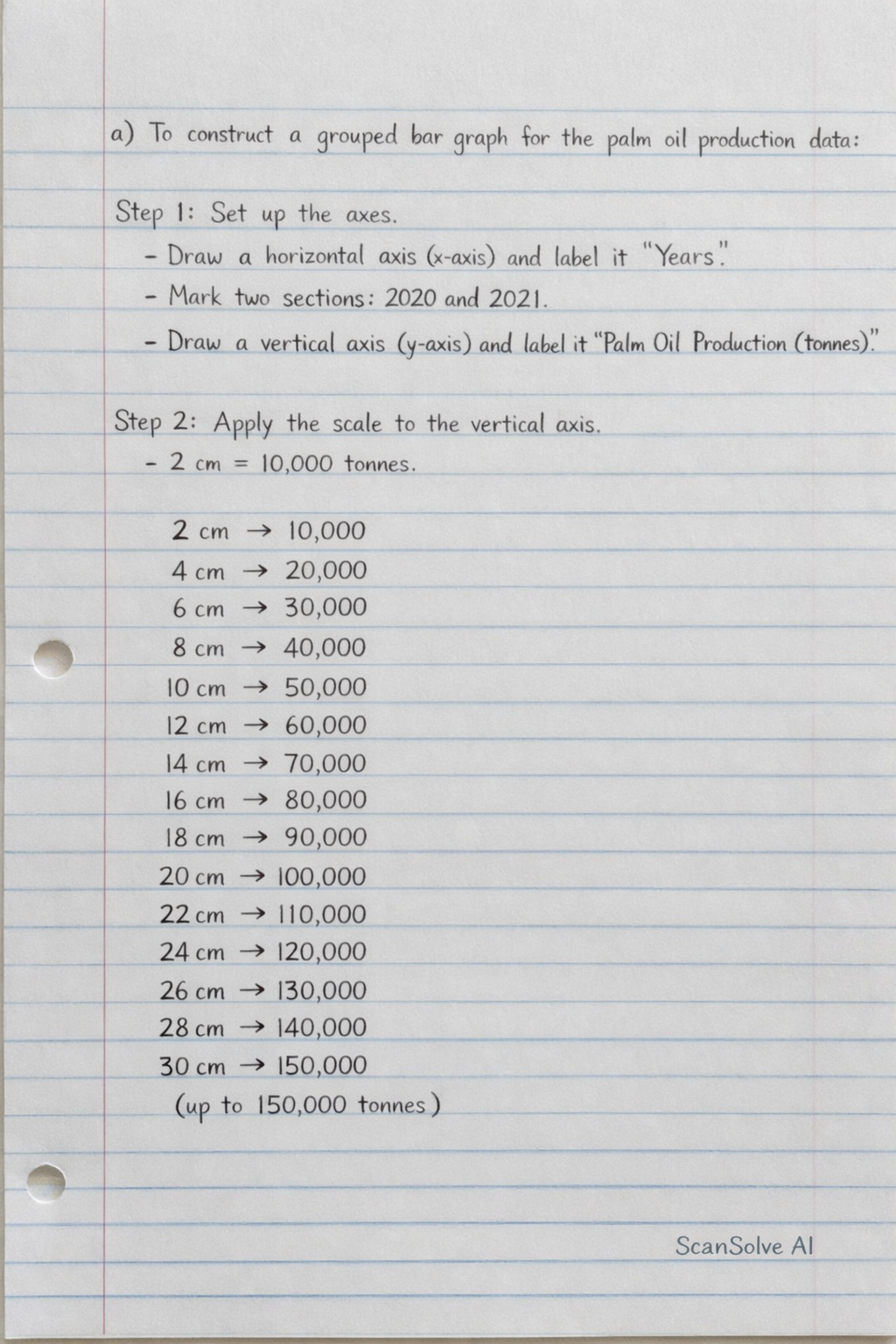
To construct a grouped bar graph for the palm oil production data
Set up the axes.
- Draw a horizontal axis (x-axis) and label it "Years". Mark two distinct sections for the years 2020 and 2021.
- Draw a vertical axis (y-axis) and label it "Palm Oil Production (tonnes)".
Apply the scale to the vertical axis.
- Using the given scale of 2 cm to represent 10,000 tonnes, mark intervals on the vertical axis. For example, 2 cm for 10,000 tonnes, 4 cm for 20,000 tonnes, and so on, extending up to at least 150,000 tonnes (the highest production value).
Draw the grouped bars.
- For each year (2020 and 2021), draw three adjacent bars representing the production for Region X, Region Y, and Region Z.
- The heights of the bars should correspond to the following values based on the vertical scale:
- For 2020: Region X (120,000 tonnes), Region Y (100,000 tonnes), Region Z (80,000 tonnes).
- For 2021: Region X (150,000 tonnes), Region Y (110,000 tonnes), Region Z (90,000 tonnes).
- Use different shading or colors for each region (X, Y, Z) to distinguish them clearly.
Add a legend and title.
- Include a legend to identify which shading/color corresponds to which region.
- Give the graph a clear and descriptive title, such as "Palm Oil Production by Region (2020-2021)".
Part b
Three advantages of using a grouped bar graph (a cartographic method) to represent the data are
- Easy Comparison: It allows for straightforward visual comparison of palm oil production between different regions within the same year, and also for comparing a single region's production across the two years.
- Clarity and Simplicity: The data is presented in a clear, simple, and easily understandable format, making it accessible even to those without a technical background.
- Highlighting Trends: It effectively highlights trends, patterns, and significant differences in production values over time and across different regions.
Was this helpful?
Still stuck on this one?
Ask a follow-up, and the answer starts from this question.
Got a different question?Ask your own question
More Geography Questions
QUsing the provided data, calculate cumulative production for each year and describe how to draw a…QRepresent this information on the double bar graph.QPart i: Plot a bar graph representing the information.QDraw a neat, fully labelled SINGLE BAR GRAPH to represent this information. Your graph must have a…QShow the percentages on the vertical scale. Use the scale 1cm=5% of land uses on the horizontal…
Handwritten Step-by-Step Solution
Get this as a handwritten image on WhatsApp — like a tutor wrote it for you.
Try on WhatsApp