
WASSCE 2026 INTEGRATED SCIENCE HOT EXAM THEORY QUESTIONS PREPARED BY MR.SHOOTER Answer any four questions from this section. 〽️. (a) Describe the process of respiration in living organisms. (8 marks) State four differences between aerobic and anaerobic respiration. (8 marks) (16 marks total) 〽️. (a) Describe the carbon cycle. (Use a labelled diagram in your answer). (10 marks) State three human activities that increase the amount of carbon dioxide in the atmosphere. (6 marks) (16 marks total)
ScanSolve AI Answer
Step-by-step solution
4 stepsDescribe the process of respiration in living organisms.
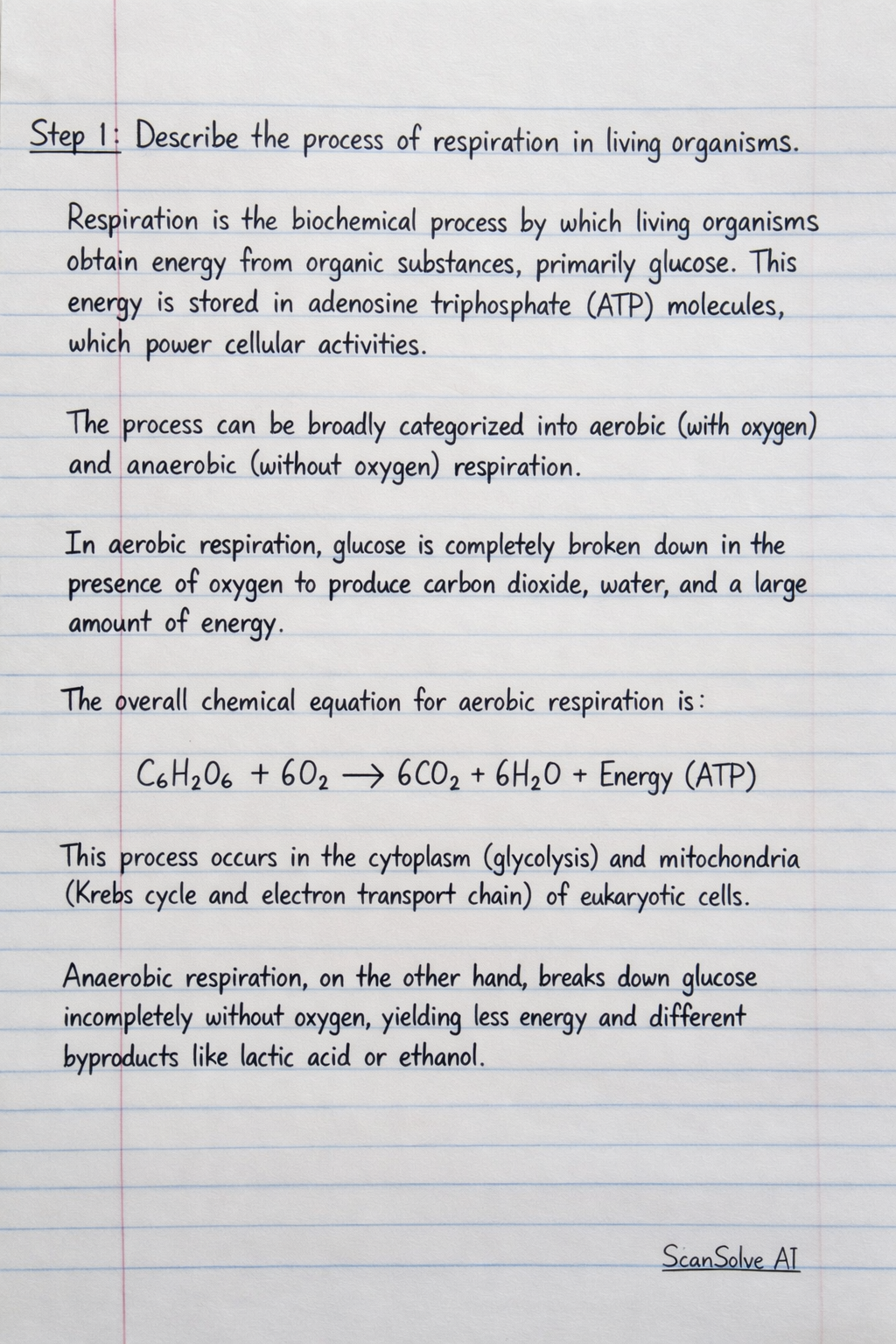
Respiration is the biochemical process by which living organisms obtain energy from organic substances, primarily glucose. This energy is stored in adenosine triphosphate (ATP) molecules, which power cellular activities. The process can be broadly categorized into aerobic (with oxygen) and anaerobic (without oxygen) respiration. In aerobic respiration, glucose is completely broken down in the presence of oxygen to produce carbon dioxide, water, and a large amount of energy. The overall chemical equation for aerobic respiration is:
This process occurs in the cytoplasm (glycolysis) and mitochondria (Krebs cycle and electron transport chain) of eukaryotic cells. Anaerobic respiration, on the other hand, breaks down glucose incompletely without oxygen, yielding less energy and different byproducts like lactic acid or ethanol.
State four differences between aerobic and anaerobic respiration.
Here are four differences between aerobic and anaerobic respiration:
- Oxygen requirement: Aerobic respiration requires oxygen, while anaerobic respiration does not.
- Energy yield: Aerobic respiration produces a large amount of energy (approximately 36-38 ATP molecules per glucose), whereas anaerobic respiration produces a small amount of energy (2 ATP molecules per glucose).
- End products: The end products of aerobic respiration are carbon dioxide and water. The end products of anaerobic respiration are typically lactic acid (in animals) or ethanol and carbon dioxide (in plants and yeast).
- Location: Aerobic respiration occurs in the cytoplasm and mitochondria. Anaerobic respiration occurs only in the cytoplasm.
Describe the carbon cycle.
The carbon cycle is the biogeochemical cycle by which carbon is exchanged among the biosphere, pedosphere, geosphere, hydrosphere, and atmosphere of the Earth. It is crucial for regulating the Earth's climate and for the availability of carbon, a fundamental element for all life.
- Atmospheric carbon: Carbon exists in the atmosphere primarily as carbon dioxide ().
- Photosynthesis: Plants absorb atmospheric during photosynthesis to produce organic compounds (glucose).
- Consumption: Animals obtain carbon by consuming plants or other animals.
- Respiration: Both plants and animals release back into the atmosphere through respiration.
- Decomposition: When organisms die, decomposers break down organic matter, releasing into the atmosphere and carbon into the soil.
- Combustion: The burning of fossil fuels (coal, oil, natural gas) and biomass releases large amounts of into the atmosphere.
- Oceanic processes: dissolves in ocean water, forming carbonic acid, and is used by marine organisms to form shells and skeletons. Carbon can also be stored in ocean sediments.
A labelled diagram should be included, showing:
- Atmosphere (with )
- Plants (taking in via photosynthesis, releasing via respiration)
- Animals (consuming plants, releasing via respiration)
- Decomposers (acting on dead organisms, releasing )
- Fossil fuels (formed from dead organic matter over millions of years)
- Factories/Vehicles (releasing from combustion of fossil fuels)
- Oceans (absorbing and releasing , marine life)
- Arrows indicating the flow of carbon between these reservoirs.
State three human activities that increase the amount of carbon dioxide in the atmosphere.
Here are three human activities that increase the amount of carbon dioxide in the atmosphere:
- Burning of fossil fuels: The combustion of coal, oil, and natural gas for energy production (electricity, transportation, industry) releases large quantities of stored carbon as .
- Deforestation: The clearing of forests reduces the number of trees available to absorb through photosynthesis. When trees are burned or decompose, they also release stored carbon.
- Industrial processes: Activities such as cement production and various chemical manufacturing processes release as a byproduct.
Still stuck on this one?
Ask a follow-up, and the answer starts from this question.
More Geography Questions
Handwritten Step-by-Step Solution
Get this as a handwritten image on WhatsApp — like a tutor wrote it for you.
Try on WhatsApp