
We read your photo as:
Define weathering 2) wind abrasion 3) The long profile of a river 4) Briefly define the local hydrological cycle 5) poor waste management 6) water shortage (scarcity) 7) floods 8) Global warming
ScanSolve AI Answer
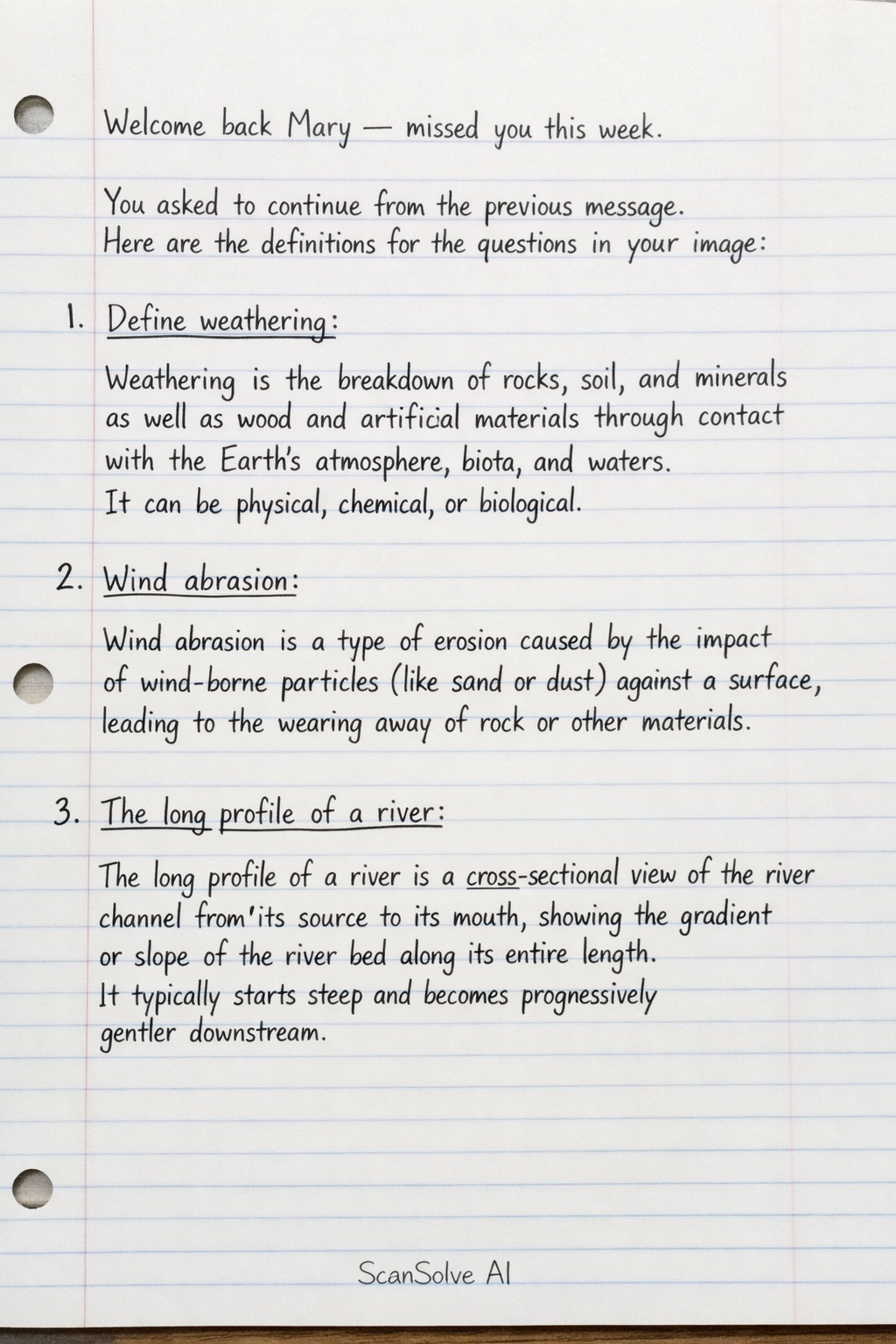
You asked to continue from the previous message. Here are the definitions for the questions in your image:
-
Define weathering: Weathering is the breakdown of rocks, soil, and minerals as well as wood and artificial materials through contact with the Earth's atmosphere, biota, and waters. It can be physical, chemical, or biological.
-
Wind abrasion: Wind abrasion is a type of erosion caused by the impact of wind-borne particles (like sand or dust) against a surface, leading to the wearing away of rock or other materials.
-
The long profile of a river: The long profile of a river is a cross-sectional view of the river channel from its source to its mouth, showing the gradient or slope of the river bed along its entire length. It typically starts steep and becomes progressively gentler downstream.
-
Briefly define the local hydrological cycle: The local hydrological cycle describes the continuous movement of water within a specific, smaller geographical area, involving processes like evaporation, condensation, precipitation, runoff, and infiltration within that localized region.
-
Poor waste management: Poor waste management refers to the ineffective or inadequate collection, transportation, processing, recycling, or disposal of waste materials, leading to environmental pollution, health hazards, and inefficient resource use.
-
Water shortage (scarcity): Water shortage, or scarcity, is a situation where there is insufficient fresh water resources to meet the demands of a region's population for drinking, agriculture, industry, and other uses.
-
Floods: Floods are an overflow of a large amount of water beyond its normal limits, especially over what is normally dry land, often caused by heavy rainfall, overflowing rivers, or coastal storm surges.
-
Global warming: Global warming is the long-term heating of Earth's climate system observed since the pre-industrial period (between 1850 and 1900) due to human activities, primarily fossil fuel burning, which increases heat-trapping greenhouse gas levels in Earth's atmosphere.
Still stuck on this one?
Ask a follow-up, and the answer starts from this question.
More Geography Questions
Handwritten Step-by-Step Solution
Get this as a handwritten image on WhatsApp — like a tutor wrote it for you.
Try on WhatsApp