
Welcome back Megastar — missed you this week. Analytical methods are techniques used to determine the chemical composition or physical properties of a sample. They can be qualitative (identifying what is present) or quantitative (measuring how much is present). Examples include spectroscopy (e.g., UV-Vis, Atomic Absorption Spectroscopy) which measures the interaction of light with matter, chromatography (e.g., Gas Chromatography, High-Performance Liquid Chromatography) which separates components of a mixture, and electroanalytical methods (e.g., potentiometry) which measure electrical properties. The analytical method that can be used to separate a mixture of palm oil and water is liquid-liquid extraction using a separating funnel. Step 1: Pour the mixture into a separating funnel and allow it to stand. Step 2: Since palm oil and water are immiscible and have different densities, they will form two distinct layers, with the less dense palm oil floating on top of the water. Step 3: Carefully open the stopcock at the bottom of the separating funnel to drain the denser water layer into a separate beaker. Step 4: Close the stopcock once the interface between the two liquids reaches the bottom, leaving the palm oil in the funnel. To sample a river for heavy metal contamination analysis exhaustively, follow these steps: Step 1: Planning and Site Selection - Identify representative sampling points along the river, considering potential pollution sources (e.g., industrial discharge, agricultural runoff) and varying flow conditions. Include upstream (control) and downstream locations. Step 2: Equipment Preparation - Use clean, acid-washed, non-metallic containers (e.g., polyethylene or polypropylene bottles) to prevent contamination. Avoid glass containers as metals can adsorb to glass surfaces. Step 3: Sample Collection - Collect samples from various depths and locations across the river's width to ensure representativeness. Submerge the bottle opening facing upstream, avoiding disturbance of bottom sediments. Rinse the bottle three times with river water before filling. Step 4: Sample Preservation - Immediately after collection, acidify the water samples to a pH of less than 2 using ultrapure concentrated nitric acid (HNO₃). This prevents metal precipitation, adsorption to container walls, and microbial activity. Step 5: Labeling - Clearly label each sample bottle with indelible ink, including the sampling site ID, date, time, depth, and any relevant field observations (e.g., weather, water appearance). Step 6: Transport and Storage - Transport samples in a cooler with ice to maintain a temperature of approximately 4°C. Store them in a dark, cool place until analysis, typically within 6 months for preserved samples. Step 7: Quality Control - Include field blanks (bottles filled with deionized water and treated identically to samples), duplicate samples (two samples collected at the same time and location), and spiked samples to monitor for contamination and assess analytical precision and accuracy. Step 8: Documentation - Maintain a detailed field logbook recording all sampling activities, including GPS coordinates, environmental conditions, equipment used, and any deviations from the sampling plan. Send me the next one 📸 minimize please
ScanSolve AI Answer
Step-by-step solution
10 steps-
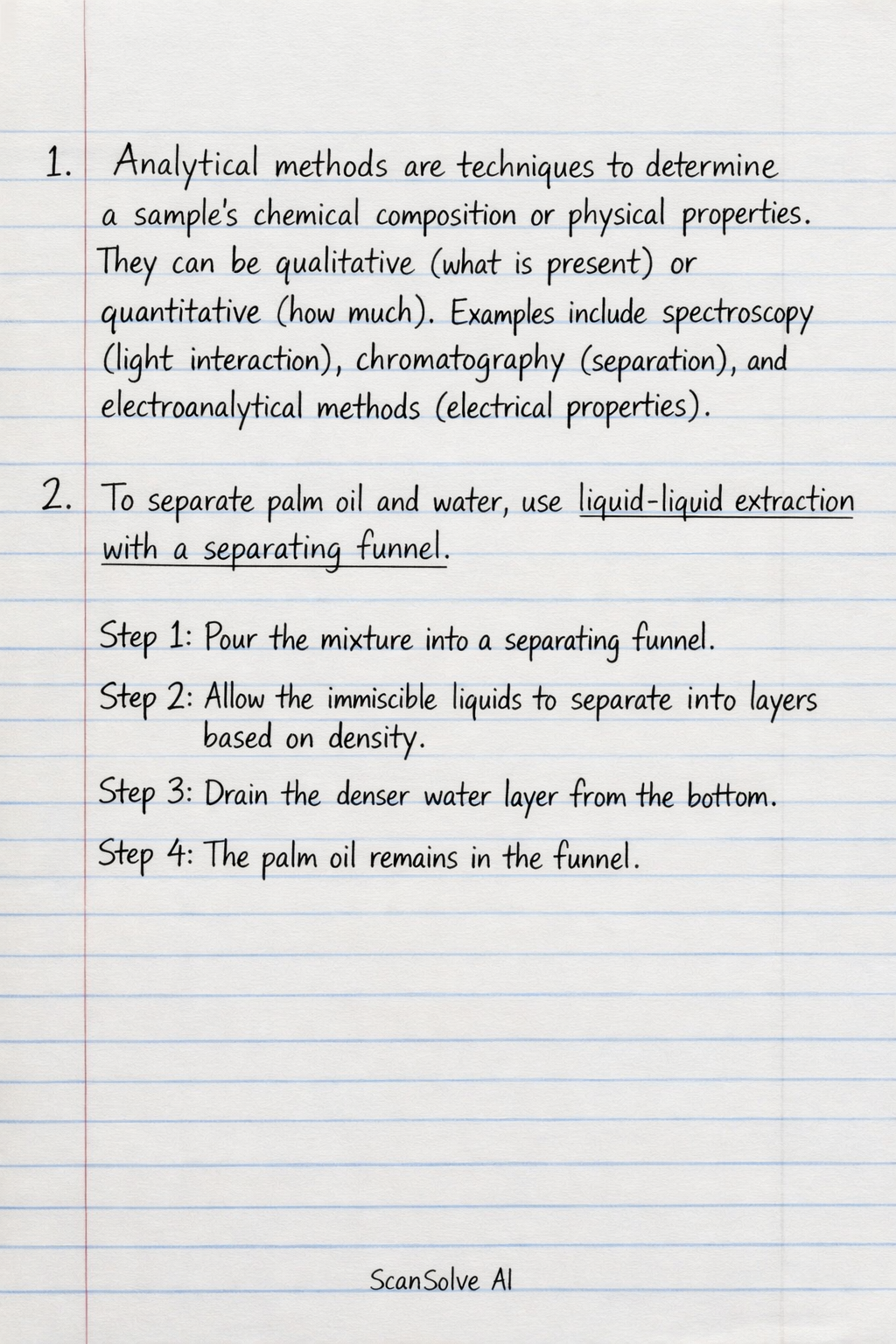
Analytical methods are techniques to determine a sample's chemical composition or physical properties. They can be qualitative (what is present) or quantitative (how much). Examples include spectroscopy (light interaction), chromatography (separation), and electroanalytical methods (electrical properties).
-
To separate palm oil and water, use liquid-liquid extraction with a separating funnel.
Pour the mixture into a separating funnel.
Allow the immiscible liquids to separate into layers based on density.
Drain the denser water layer from the bottom.
The palm oil remains in the funnel.
- To sample a river for heavy metal contamination:
Select sites* (upstream/downstream) and use acid-washed plastic bottles.
Collect samples* from various depths, avoiding sediment.
Preserve samples* immediately by acidifying to pH < 2 with HNO₃.
Label* bottles with site, date, and time.
Transport and store* samples at 4°C.
Include quality control (blanks, duplicates) and document all activities.
Send me the next one 📸
Still stuck on this one?
Ask a follow-up, and the answer starts from this question.
More Geography Questions
Handwritten Step-by-Step Solution
Get this as a handwritten image on WhatsApp — like a tutor wrote it for you.
Try on WhatsApp