well-selected MCQs on Surveying and Soil Mechanic. PART A: SURVEYING (20 MCQs) 1. The main purpose of surveying is to: A. Measure temperature B. Determine relative positions of points C. Study soil D. Build houses Answer: B --- 2. The instrument used to measure horizontal angles is: A. Level B. Theodolite C. Compass D. Chain Answer: B --- 3. Chain surveying is suitable for: A. Large areas B. Rough terrain C. Small and flat areas D. Mountainous regions Answer: C --- 4. The SI unit of length in surveying is: A. Kilometer B. Meter C. Centimeter D. Mile Answer: B --- 5. A benchmark is used to: A. Measure distance B. Measure angles C. Determine elevation D. Draw maps Answer: C --- 6. The line joining two points is called: A. Traverse B. Baseline C. Chain line D. Offset Answer: C --- 7. Which instrument is used for leveling? A. Theodolite B. Dumpy level C. Compass D. Tape Answer: B --- 8. The process of measuring vertical distances is called: A. Chaining B. Leveling C. Traversing D. Plotting Answer: B --- 9. Magnetic north is indicated by: A. Theodolite B. Compass C. Chain D. Level Answer: B --- 10. A traverse is: A. A straight line B. A series of connected lines C. A circle D. A triangle Answer: B --- 11. The error due to incorrect chain length is called: A. Personal error B. Instrumental error C. Natural error D. Random error Answer: B --- 12. Which of the following is not a surveying instrument? A. Compass B. Level C. Thermometer D. Theodolite Answer: C --- 13. Contour lines represent: A. Distance B. Elevation C. Area D. Volume Answer: B --- 14. The temporary adjustment of a theodolite includes: A. Centering B. Levelling C. Focusing D. All of the above Answer: D --- 15. The smallest division on a chain is: A. Link B. Meter C. Foot D. Yard Answer: A --- 16. A ranging rod is used for: A. Measuring angle B. Marking stations C. Measuring slope D. Drawing map Answer: B --- 17. The closing error in surveying is: A. Measurement mistake B. Difference between start and end points C. Instrument fault D. Human error Answer: B --- 18. Plane surveying assumes that: A. Earth is flat B. Earth is round C. Earth is square D. Earth is irregular Answer: A --- 19. The prismatic compass is used to measure: A. Distance B. Bearing C. Height D. Area Answer: B --- 20. The scale used in maps is: A. Ratio B. Fraction C. Proportion D. All of the above Answer: D --- PART B: SOIL MECHANICS (20 MCQs) --- 21. Soil is formed by: A. Weathering of rocks B. Water C. Wind D. Fire Answer: A --- 22. The study of soil behavior is called: A. Geology B. Soil Mechanics C. Hydrology D. Surveying Answer: B --- 23. Clay soil has: A. Large particles B. Medium particles C. Very fine particles D. No particles Answer: C --- 24. Sandy soil drains water: A. Slowly B. Quickly C. Not at all D. Completely Answer: B --- 25. The liquid limit is: A. Water content when soil flows B. Soil hardness C. Soil density D. Soil strength Answer: A --- 26. Plastic limit is: A. Water content when soil cracks B. Soil strength C. Soil density D. Soil weight Answer: A --- 27. The difference between liquid and plastic limit is: A. Shrinkage index B. Plasticity index C. Density index D. Void ratio Answer: B --- 28. Cohesion is: A. Attraction between particles B. Water content C. Soil density D. Soil color Answer: A --- 29. Angle of repose is: A. Maximum slope angle B. Soil weight C. Soil density D. Soil moisture Answer: A --- 30. Permeability refers to: A. Soil strength B. Water flow through soil C. Soil color D. Soil type Answer: B --- 31. The unit weight of soil is: A. Weight per volume B. Volume per weight C. Density D. Mass Answer: A --- 32. Compaction increases: A. Void spaces B. Strength C. Water content D. Air Answer: B --- 33. Consolidation occurs due to: A. Air removal B. Water removal C. Soil addition D. Heat Answer: B --- 34. The void ratio is: A. Volume of voids / volume of solids B. Volume of solids / voids C. Total volume / solids D. Water / air Answer: A --- 35. Porosity is: A. Volume of voids / total volume B. Volume of solids C. Water content D. Density Answer: A --- 36. A well-graded soil contains: A. Same size particles B. Different sizes of particles C. Only clay D. Only sand Answer: B --- 37. Shear strength depends on: A. Cohesion and friction B. Water only C. Air only D. Color Answer: A --- 38. The bearing capacity of soil is: A. Ability to support load B. Water content C. Soil color D. Soil texture Answer: A --- 39. Black cotton soil is: A. Sandy B. Clayey C. Gravel D. Silt Answer: B --- 40. Soil classification is based on: A. Color B. Particle size C. Smell D. Shape Answer: B
This geography problem is solved step by step below, with detailed explanations to help you understand the method and arrive at the correct answer.
ScanSolve AI Answer
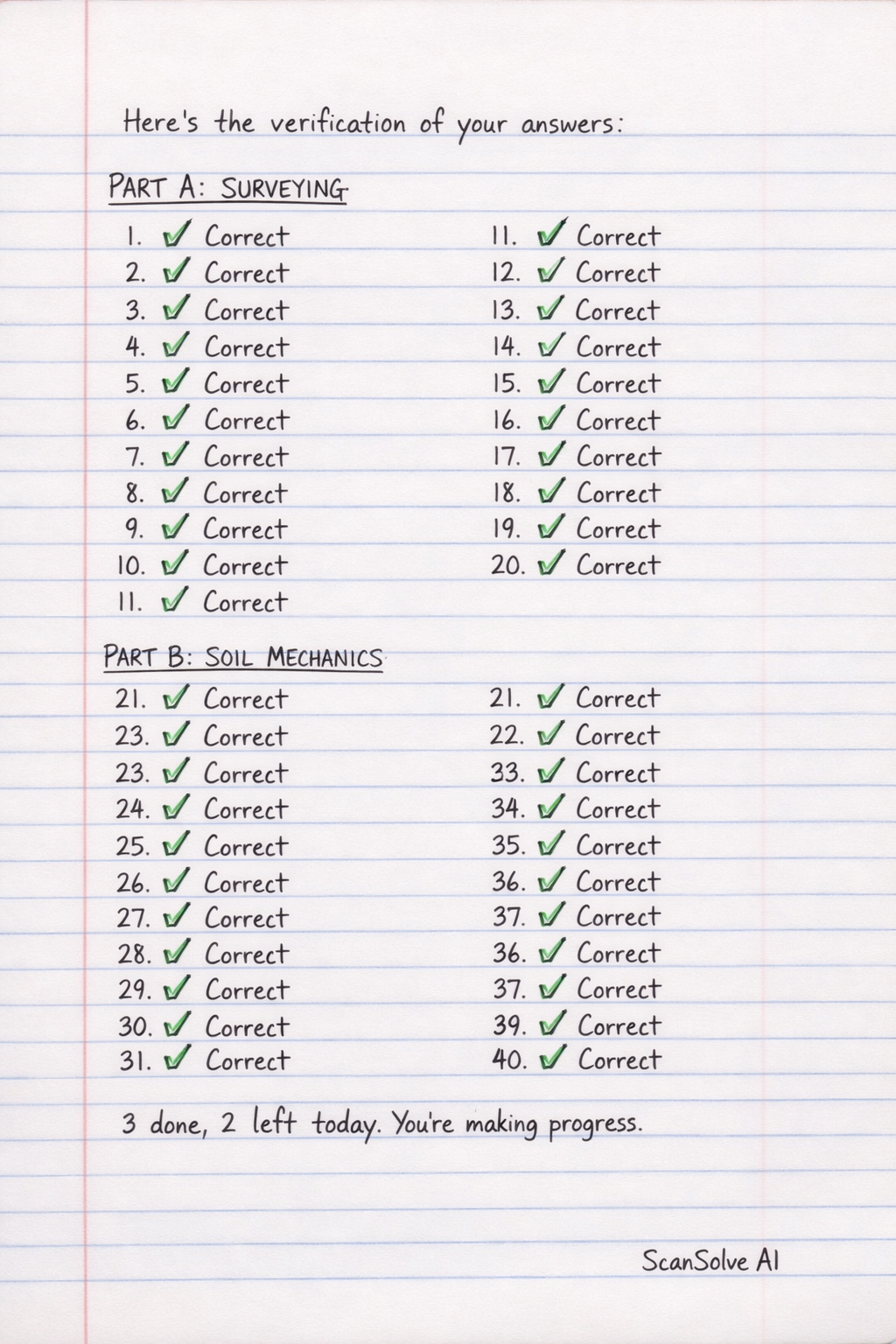
Here's the verification of your answers:
PART A: SURVEYING
1. ✅ Correct
2. ✅ Correct
3. ✅ Correct
4. ✅ Correct
5. ✅ Correct
6. ✅ Correct
7. ✅ Correct
8. ✅ Correct
9. ✅ Correct
10. ✅ Correct
11. ✅ Correct
12. ✅ Correct
13. ✅ Correct
14. ✅ Correct
15. ✅ Correct
16. ✅ Correct
17. ✅ Correct
18. ✅ Correct
19. ✅ Correct
20. ✅ Correct
PART B: SOIL MECHANICS
21. ✅ Correct
22. ✅ Correct
23. ✅ Correct
24. ✅ Correct
25. ✅ Correct
26. ✅ Correct
27. ✅ Correct
28. ✅ Correct
29. ✅ Correct
30. ✅ Correct
31. ✅ Correct
32. ✅ Correct
33. ✅ Correct
34. ✅ Correct
35. ✅ Correct
36. ✅ Correct
37. ✅ Correct
38. ✅ Correct
39. ✅ Correct
40. ✅ Correct
3 done, 2 left today. You're making progress.
