

This history question requires analysis of historical events, causes, and consequences. The detailed answer below provides context, evidence, and a well-structured explanation.
ScanSolve AI Answer
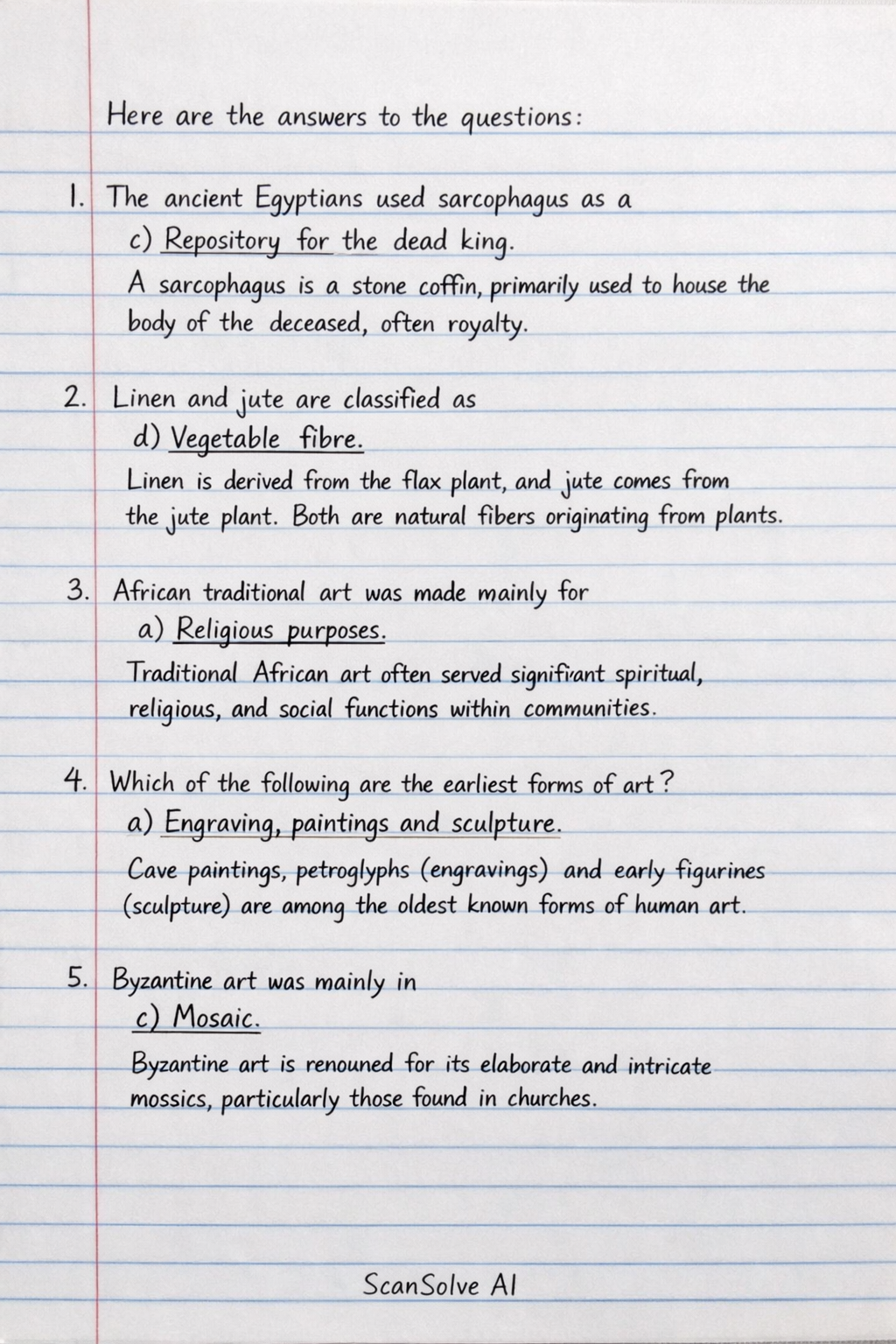
Here are the answers to the questions: 1. The ancient Egyptians used sarcophagus as a c) Repository for the dead king A sarcophagus is a stone coffin, primarily used to house the body of the deceased, often royalty. 2. Linen and jute are classified as d) Vegetable fibre Linen is derived from the flax plant, and jute comes from the jute plant. Both are natural fibers originating from plants. 3. African traditional art was made mainly for a) Religious purposes Traditional African art often served significant spiritual, religious, and social functions within communities. 4. Which of the following are the earliest forms of art? a) Engraving, paintings and sculpture Cave paintings, petroglyphs (engravings), and early figurines (sculpture) are among the oldest known forms of human art. 5. Byzantine art was mainly in c) Mosaic Byzantine art is renowned for its elaborate and intricate mosaics, particularly those found in churches. 6. Religious buildings in India were constructed with b) Wood and stone Many ancient and medieval religious structures in India, such as temples, were predominantly built using stone, often incorporating wood for specific elements. 7. The prominent art forms of the Dogon were the c) Ancestral figures The Dogon people of Mali are well-known for their wooden sculptures, especially their ancestral figures and masks, which are central to their cultural and religious practices. 8. Joyfulness and upliftment are evoked by the use of d) Light, bright colours Light and bright colors are generally associated with positive emotions such as joy, happiness, and upliftment. 9. The oldest printing process is c) Block printing Block printing, particularly woodblock printing, originated in ancient China and is considered one of the earliest forms of printing. 10. Which of the following is based on the principle of repulsion of grease and water? d) Lithography Lithography is a printing technique that relies on the immiscibility of oil and water, where an image drawn with a greasy substance repels water but accepts oil-based ink. 11. Colours that appear to recede in a painting are b) Cool Cool colors (e.g., blues, greens, purples) tend to give the illusion of receding or appearing further away in a painting. 12. Egyptians produced paper from the c) Papyrus reed The ancient Egyptians created papyrus, a material similar to thick paper, from the pith of the papyrus plant. 13. Pointillism gives a similar shading effect as d) Stippling Pointillism is an art technique that uses small, distinct dots of color to form an image, which is similar to stippling, a method of shading or creating texture with dots. 14. The most suitable plate for etching is a) Copper Copper is traditionally considered the most suitable and commonly used metal plate for etching due to its softness, workability, and ability to hold fine lines. 15. Applying a rubber stamp on a support will produce a The options for this question are cut off in the image. However, applying a rubber stamp typically produces a print or an impression. Send me the next one 📸