
The word, ‘Psychology’ is derived from two words, ‘Psyche’ and ‘Logos’. (A) Engish (B) Greek(C) Latin (D) Spanish 2. In the_, psychology was understood as the ‘Science of Mind’. (A) 17th century (B) 18th century(C) 19th century (D) 20th century 3. refers to our awareness about various stimuli which we encounter in different modalities such as vision, hearing, touch and taste. (A) Attention (B) Perception (C) Memory (D) Sensation 4. Educational Psychology is the study of how people. (A) study (B) acquire(C) pick up (D) learn 5. ___ aims at understanding, predicting and controlling human behavior.(A) Educational Psychology is a science (B) Educational Psychology is a natural science (C) Educational psychology is a social science (D) Educational psychology is a positive science 6. In ,W.A. Kelly listed the nature of Educational Psychology. (A) 1941 (B) 1942 (C) 1943 (D) 1944 7. ____ is the oldest method of educational psychology. (A) Experimental Method (B) Case study method (C) Introspection method (D) Observation method 8. is one of the most important and objective methods of psychology, as it is very scientific.(A) Experimental method (B) Case study method(C) Introspection method (D) Observation method 9. Piaget focused mainly on _. (A) moral thinking (B) cognitive changes (C) motivation (D) rational changes 10. was faced with the growing number of problems related to children that accompanied increased urbanization and expansion of public education. (A) Culture (B) Humanity(C) Civilization (D) Society 11. Research during the first two decades of the ____ was aimed at providing a clearer delineation and categorization of children’s behavior. (A) 1600s (B) 1700s (C) 1800s (D) 1900s 12. The remarkable rate of growth in developmental psychology was seriously curtailed at the end of the. (A) 1920s (B) 1930s (C) 1940s (D) 1950s 13. are purely descriptive and include naturalistic observation, contrived observation, participant observation, and archival analysis. (A) Observational methods (B) Experimental Method (C) Introspection method (D) Case study method 14. _is defined as the sum total of beliefs, behaviors, attitudes and values that distinguishes an individual. (A) Character (B) Nature(C) Personality (D) Temperament 15. In 2001, Myers wrote that heredity contributes intelligence within a group of people. (A) 40 to 60 per cent (B) 50 to 70 per cent (C) 60 to 80 per cent (D) 70 to 90 per cent 16. In ,Ngaroga wrote that inadequate nutrition to mothers and children. (A) 2001 (B) 2002(C) 2003 (D) 2004 17. gives the following general suggestions in provision of strategic, rich and stimulating learning environment. (A) Ngaroga (B) Ormorod(C) Piaget (D) Kelly 18. An should plan lessons and learning activities. (A) real teacher (B) current teacher (C) actual teacher (D) effective teacher 19. means the ordinary development of growth and aging. (A) Maturation (B) Development(C) Evolution (D) Regression 20. In, our physical abilities are at their peak, including muscle strength, reaction time, sensory abilities, and cardiac functioning. (A) early childhood (B) early adulthood (C) later adulthood (D) later adulthood 21. The first UNDP Human Development Report published in. (A) 1690 (B) 1790 (C) 1890 (D) 1990 22. Achieving a healthy level of helps children stay motivated to achieve. (A) self-confidence (B) self-care(C) self-health (D) self-development 23. _brings on even more new challenges and major decisions about school, career, and home life. (A) Childhood (B) Adulthood (C) Babyhood (D) Parenthood 24. _early capacities are dependent on catalysts and mediation. (A) Youngsters’ (B) Kids’(C) Children’s (D) Adolescents 25. There are ways that technology can be used to help meet the challenges of establishing effective learning environments. (A) two (B) three(C) four (D) five
History
ScanSolve AI Answer
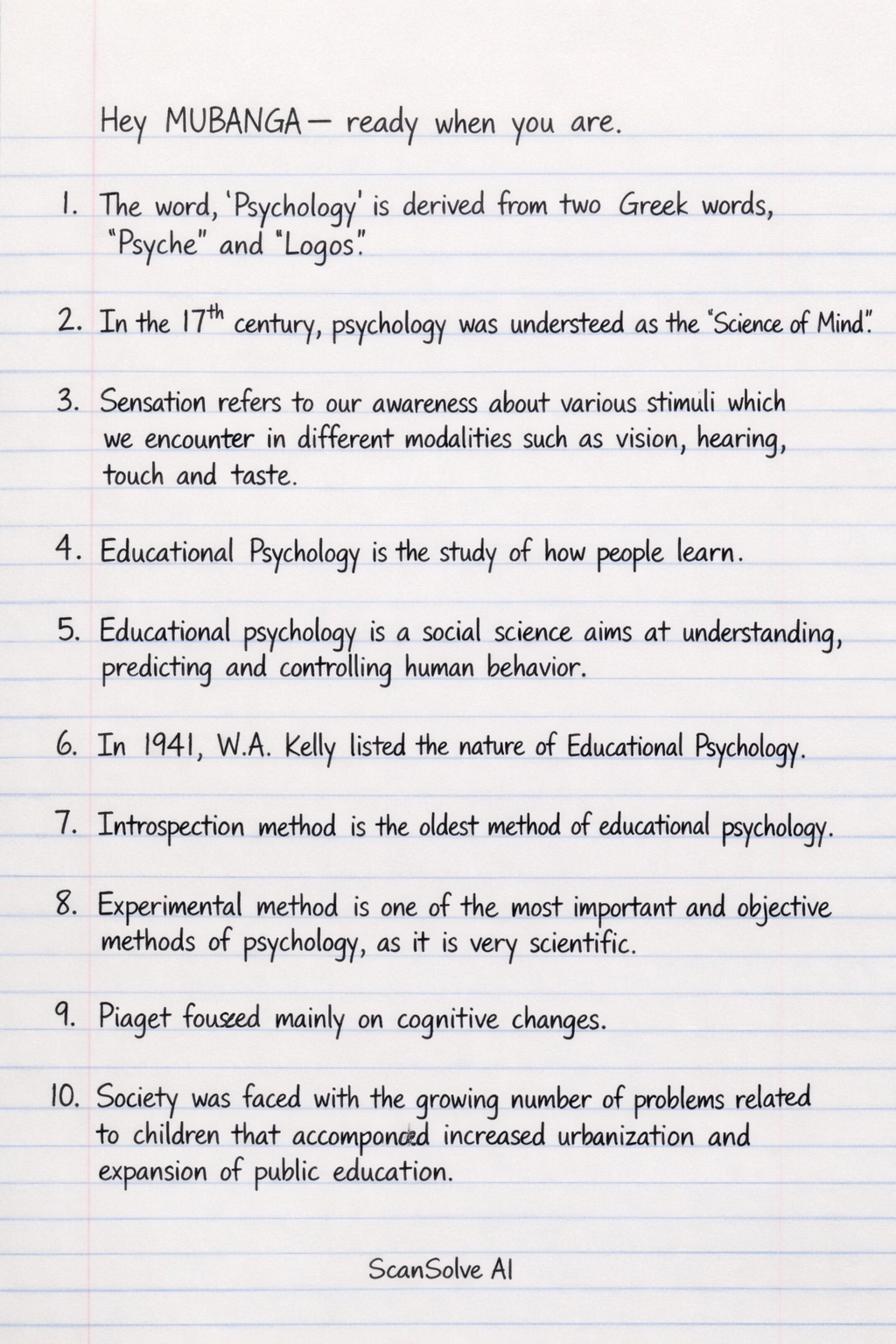
- The word, ‘Psychology’ is derived from two (B) Greek words, ‘Psyche’ and ‘Logos’.
- In the (A) 17th century, psychology was understood as the ‘Science of Mind’.
- (D) Sensation refers to our awareness about various stimuli which we encounter in different modalities such as vision, hearing, touch and taste.
- Educational Psychology is the study of how people (D) learn.
- (C) Educational psychology is a social science aims at understanding, predicting and controlling human behavior.
- In (A) 1941, W.A. Kelly listed the nature of Educational Psychology.
- (C) Introspection method is the oldest method of educational psychology.
- (A) Experimental method is one of the most important and objective methods of psychology, as it is very scientific.
- Piaget focused mainly on (B) cognitive changes.
- (D) Society was faced with the growing number of problems related to children that accompanied increased urbanization and expansion of public education.
- Research during the first two decades of the (D) 1900s was aimed at providing a clearer delineation and categorization of children’s behavior.
- The remarkable rate of growth in developmental psychology was seriously curtailed at the end of the (B) 1930s.
- (A) Observational methods are purely descriptive and include naturalistic observation, contrived observation, participant observation, and archival analysis.
- (C) Personality is defined as the sum total of beliefs, behaviors, attitudes and values that distinguishes an individual.
- In 2001, Myers wrote that heredity contributes (B) 50 to 70 per cent intelligence within a group of people.
- In (D) 2004, Ngaroga wrote that inadequate nutrition to mothers and children.
- (B) Ormorod gives the following general suggestions in provision of strategic, rich and stimulating learning environment.
- An (D) effective teacher should plan lessons and learning activities.
- (A) Maturation means the ordinary development of growth and aging.
- In (B) early adulthood, our physical abilities are at their peak, including muscle strength, reaction time, sensory abilities, and cardiac functioning.
- The first UNDP Human Development Report published in (D) 1990.
- Achieving a healthy level of (A) self-confidence helps children stay motivated to achieve.
- (B) Adulthood brings on even more new challenges and major decisions about school, career, and home life.
- (C) Children’s early capacities are dependent on catalysts and mediation.
- There are (C) four ways that technology can be used to help meet the challenges of establishing effective learning environments.
Was this helpful?
Still stuck on this one?
Ask a follow-up, and the answer starts from this question.
Got a different question?Ask your own question
More History Questions
QWhat are the answers to these multiple choice questions about psychology and human development?QWrite this summarize for me don't remove anything or add anything RESEARCH METHODS FOR MPhil…QWhat are the answers and explanations for questions 15-18 regarding psychological and educational…QGot you 👌 Here’s your full TAM2601 Assessment 2 / 2026 in a clean, ready-to-submit format. Just…QQUESTION ONE 23 Before answering Questions 1.1–1.2, study Unit 2, Section 1 (pp. 53–61) of your…
Browse by topic:World History
Handwritten Step-by-Step Solution
Get this as a handwritten image on WhatsApp — like a tutor wrote it for you.
Try on WhatsApp