
Which of the following is an economic activity? A. Attending a town’s meeting B. A visits to the stadium C. Payment of school fees D. Arresting a petty thief 2. The reward for land as a factor of production is A. Interest B. Rent C. Wages D. Dividend 3. The three broad categories of production are A. Direct, secondary and extrusive B. primary, tertiary, direct C. primary, secondary and tertiary D. secondary, primary and indirect 4. A carpenter’s consumer goods include I. a kilogram of rice II. 3 pairs of shoes III. 4 pairs of sacks IV. 3 screw – drivers A. I and IV only B. I, II, III and IV C. I, II and IV only D. I, II and III only 5. In a capitalist system, the means of production are owned and controlled by A. the government B. politician C. private individuals D. the workers 6. Mixed economy refers to a system in which the means of production are controlled by A. private enterprise and the governments B. private individual C. The governments only D. the workers and business man 7. An economic good is described as a good which A. yield utility and commands a price B. is useful and occupies a space C. is in high demand and transferable D. has unlimited supply 8. The concept of opportunity cost is important to the firm because it A. determines the prices of the firm’s product B. increases the level of output of the firm C. lead to maximum satisfaction of the consumers D. guides firms in allocating resources 9. As a firms expands, it enjoys some advantages called A. variable proportions B. diminishing marginal returns C. internal economies of scale D. decreasing of reforms to scale 10. Division of labour is limited by A. the size of the market B. the productivity of capital C. cost of production D. the factors of production 11. An entrepreneur is likely to make more profits when A. expenditure is more than revenue B. competition charge lower prices C. cost per unit output falls D. quality of output reduces 12. Natural growth rate is A. birth rate less death rate B. death rate less migration C. death rate plus birth rate D. birth rate plus migration 13. A major effect of ageing population is A. reduced labour force B. rise in prices of commodities C. reduced infrastructure D. neglect of agriculture 14. One of the problems associated with the middle man in the distribution of goods is that he A. buys in large quantities B. hoards good C. grants credit to the retailer D. sells variation of goods 15. The distribution of goods is said to be completed when it reaches the A. whole sellers B. consumer C. retailer D. manufacturer 16. The gap between demand and supply curves below the equilibrium price indicates A. excess demand B. excess supply C. equilibrium quantity D. equilibrium price 17. Demand for inferior goods is an example of A. expansion of demand B. contraction of demand C. individual demand D. abnormal demand 18. When a change in price does not affect the quantity demanded of a commodity, the price elasticity of demand is A. fairly in-elastic B. infinitely inelastic C. perfectly inelastic D. unitary elastic 19. The percentage change in supply is A. 20 B. 30 C. 40 D. 50 20. The percentage change in price is in A. 10 B. 20 C. 30 D. 40 21. The elasticity of supply is A. infinite B. equal to me C. less than one D. equal to zero 22. Which of the following cost curve is not u-shaped? A. marginal cost curve B. average fixed cost curve C. average total cost curve D. average variable cost curve 23. For both the monopolist and the perfectly competitive firm, profit maximizing output occurs as the point where the A. marginal cost curve cuts the marginal revenue from below B. marginal revenue curve cuts the marginal output from above C. marginal cost curve intersects the X – axis D. marginal revenue curve intersects the Y-axis 24. The market structure in which the operators are many and none of them can influence the price is A. imperfect market B. perfect market C. oligopolistic market D. stock market 25. One main benefit of partnership is A. the possibility of raising funds on the stock exchange B. the possibility of attracting twenty or more members C. that members can specializes in various functions D. that it enjoys its own separate legal entity 26. Joint ventures are partnerships involving A. the poor and the rich B. employers and workers C. government an private investors D. multinationals and individuals 27. The value of money is best determined by A. input-output ratio B. the purchasing power C. the importance people attach to it D. economies of scale 28. Which of the following will be an effect of inflation? A. wage earners will gain B. borrowing of money will be restricted C. money lenders will gain D. borrowers of money will gain 29. Government can control inflation by A. printing of more money B. reducing the rate of taxes C. reducing the level of expenditure D. establishing more banks 30. The market consist of a network of dealers where currencies can be bought and sold is known as A. capital market B. foreign exchange market C. commodity market D. the stock market 31. Open market operation (OMO) means the A. provision of credit facilities by commercial banks B. provision of credit facilities by the mortgage banks C. buying and selling of government securities by the central bank D. procedure for the establishment of commercial bank 32. Which of the following is an advantage of localization of industry? A. Development of subsidiary firm B. creation of parallel markets C. development of slums D. attraction of foreign capital 33. Which of the following will ensure efficiency in the industrial sector of your country? A. Indigenization B. Privatization C. Nationalization D. Liquidation 34. The number of people who are qualified to work and who offer themselves for employment are called A. Migrant labour B. Working population C. Labour turnover D. Mobility labour 35. Given the formula for the national income multiplier as k = 1/1-MPC MPC = 0.75, and an increase in government expenditure from N 20 billion to N 35 billion. Calculate the charge in the level of national income A. N140 billion B. N 80 billion C. N 75 billion D. N 60 billion 36. The formula for calculating price index is A. Current price x 100 / Base year B. Base year price x 100 / Current price C. current price x base year price / 100 D. current price x 100 / Weighed price 37. When the general price level persistently falls, the rate of unemployment A. rises B. stagnates C. rapidly reduces D. equals natural growth rate 38. Taxes levied on commodities are A. direct taxes B. indirect taxes C. poll taxes D. investment taxes 39. The act of selling goods in foreign markets of prices below those charged at home market is called A. exchange B. dumping C. specialization D. exporting 40. One disadvantage of direct taxes is that A. governments revenue is reduced B. price of essential commodities fall C. people are discouraged from additional work D. Firms make more profits 41. International trade is an application of the principle of A. industrial production B. Mass production C. regional production D. Comparative cost advantage 42. Trade among West Africa countries is poor because the A. countries are self sufficient B. communication links are weak C. number of banks is insufficient D. people are not enterprising 43. A policy by which government restrict the amount of foreign currencies bought and sold is known as A. devaluation B. credit control C. exchange control D. export promotion 44. Which of the following items is under the capital account of a balance of payments? A. Repayment of foreign loans B. Visible imports C. Invisible exports D. Cocoa exports 45. Development planning which takes an overall view of the economy is describes as A. Aggregate economic planning B. Disaggregate economic planning C. sectorial economic planning D. system economic planning 46. The national income of a country can be estimated by the A. cost-benefit method B. distribution method C. expenditure method D. consumption method 47. The difference between Gross Domestic Product (GDP) and Gross National Product (GNP) is A. depreciation B. Domestic investment abroad C. Foreign investment at home D. Net income from abroad 48. Which of the following is excluded when estimating national income? A. dividends B. wages and salaries C. transfer payments D. Profits 49. The Economic community of West African states (ECOWAS) has been slow in achieving its objectives because of A. political instability in member state B. the activities of multinationals C. inadequately personnel at the secretariat D. inadequately international support 50. A major achievement of the Organization of Petroleum Exporting countries (OPEC) is that A. crude oil price has increased tremendously B. petroleum products prices have remained low THEORY INSTRUCTION: Answer SEVEN questions in all, THREE question from section A and any FOUR questions from section B. SECTION A 1. The output and cost of production of rice (in bags) are presented in the table below. Use the information in the table to answer the questions that follow. Output of rice (in bags) 1 2 3 4 5 Total variable cost (TVC) 0 5 7 10 20 Total cost (TC) 7 12 14 17 27 Calculate the • Average fixed cost (AFC) at the output levels 0,2 and 4 • Marginal cost (MC) at all levels of output • If the price of a bag of rice were 10 • Calculate the profit/loss at all levels of output • At what output level(s) is the maximum profit made ? • Draw the marginal cost curve (the use of graph sheet is essential) The table below shows the scale of preference of a student – Mr. Smith whose disposable income is 7.00. use the information in the table to answer the questions that f
History
ScanSolve AI Answer
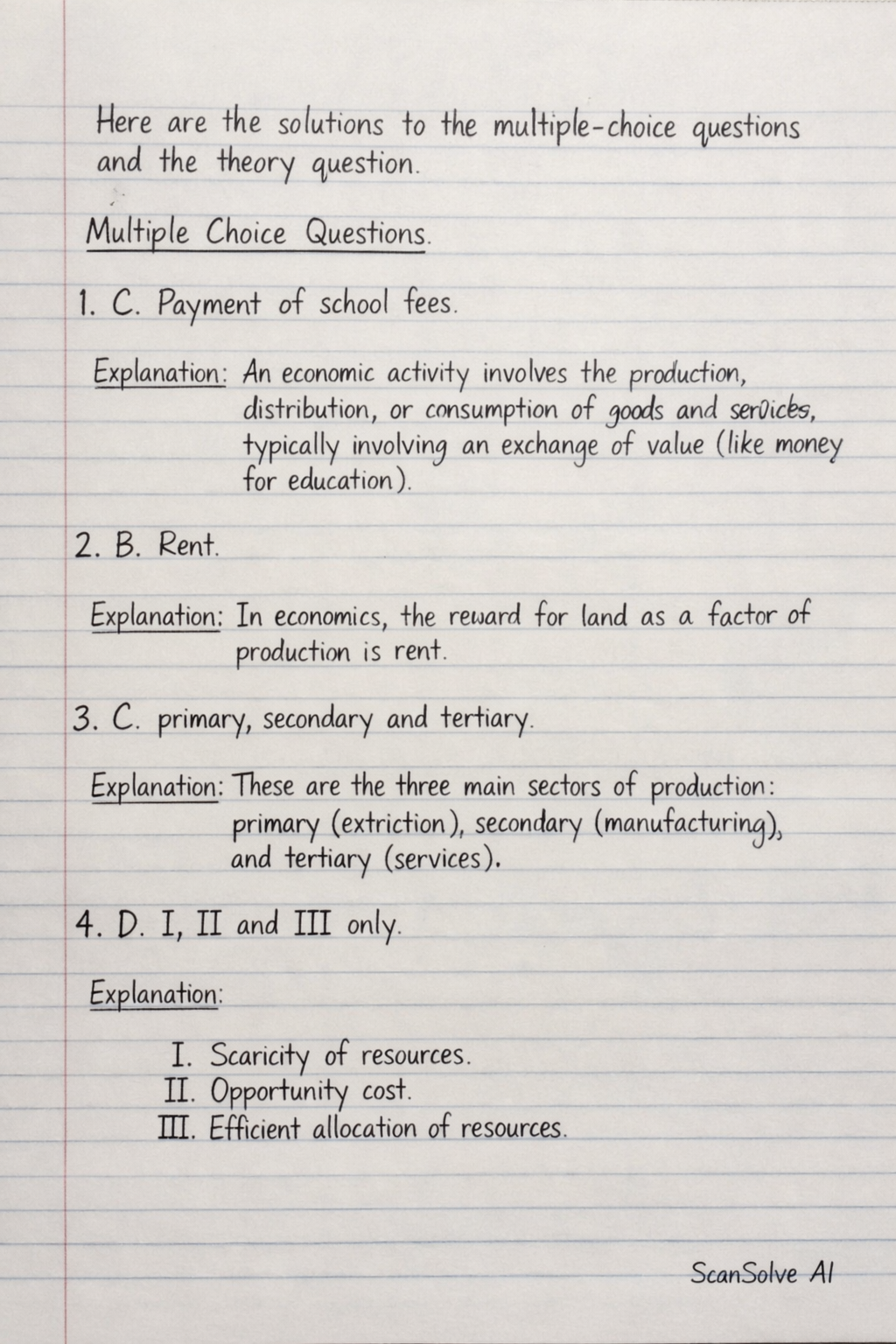
Here are the solutions to the multiple-choice questions and the theory question.
Multiple Choice Questions
-
C. Payment of school fees
- Explanation: An economic activity involves the production, distribution, or consumption of goods and services, typically involving an exchange of value (like money for education).
-
B. Rent
- Explanation: In economics, the reward for land as a factor of production is rent.
-
C. primary, secondary and tertiary
- Explanation: These are the three main sectors of production: primary (extraction), secondary (manufacturing), and tertiary (services).
-
D. I, II and III only
- Explanation:
Was this helpful?
Still stuck on this one?
Ask a follow-up, and the answer starts from this question.
Got a different question?Ask your own question
More History Questions
QNd, Supply and Elasticity If the price elasticity of demand for a commodity is unity, a fall in…QWAEC 2026 Economics Likely Questions Share this to 5 groups and 10 classmates so we can post more…QEconomics – Advanced Level Paper 1 50 Multiple Choice Questions Paper 1 is multiple choice. 1 mark…QSe the correct answer from A–D. Commerce can best be defined as: A. Buying and selling only B…Q(Ordinary Level Economics) Define the following terms in economics Inflation (ii) Demand pull…
Handwritten Step-by-Step Solution
Get this as a handwritten image on WhatsApp — like a tutor wrote it for you.
Try on WhatsApp