

This history question requires analysis of historical events, causes, and consequences. The detailed answer below provides context, evidence, and a well-structured explanation.
ScanSolve AI Answer
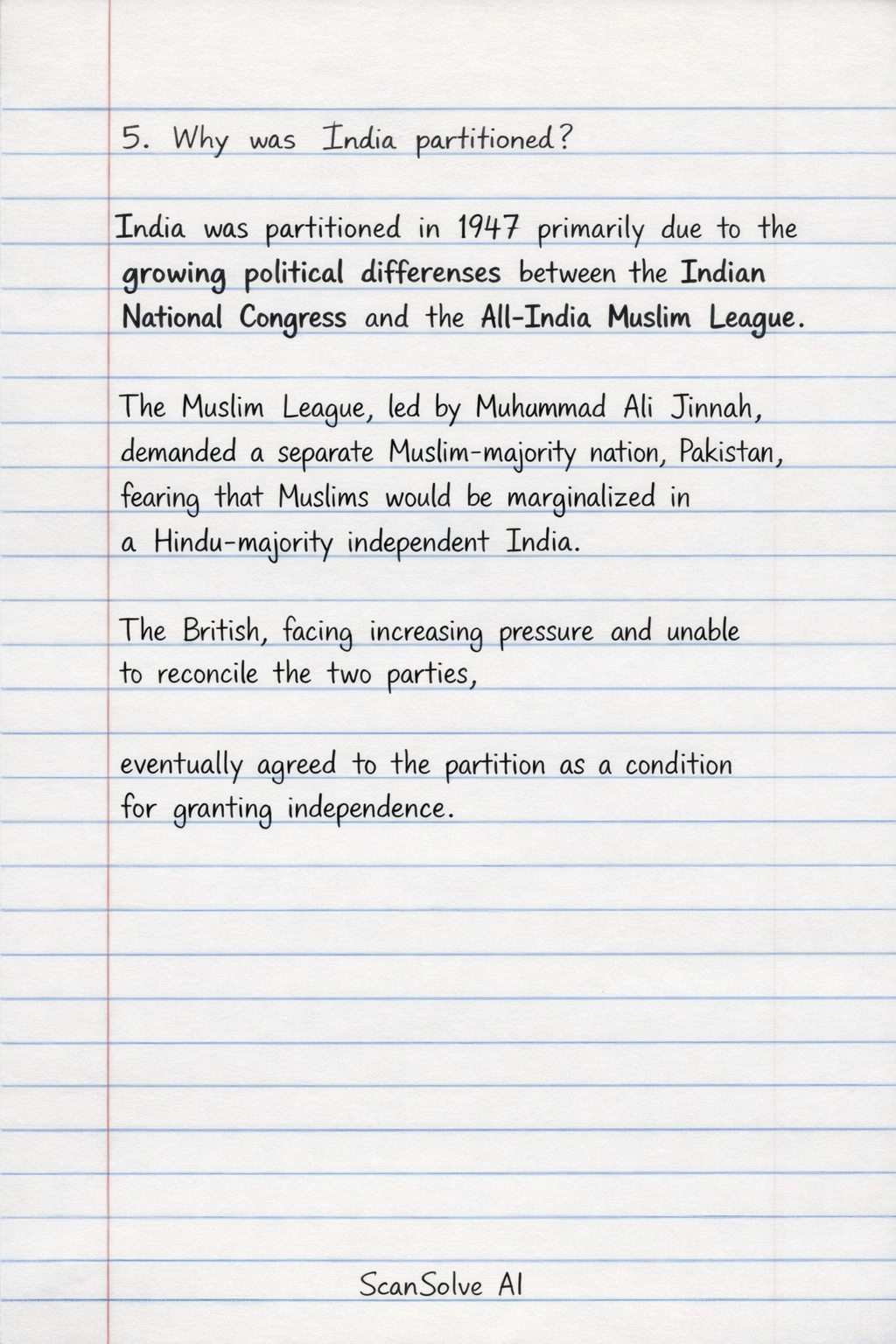
Here are the answers to the questions: 1. Why did Gandhiji go on the country tour after coming back from South Africa? After returning from South Africa in 1915, Mahatma Gandhi undertook an extensive country tour across India to understand the conditions of the common people, the political situation, and to build a connection with the masses before launching any major political movements. This tour was advised by his political guru, Gopal Krishna Gokhale. 2. How did Subhash Chandra Bose work to make India free? Subhash Chandra Bose worked to make India free by advocating for armed struggle against the British. He formed the Forward Bloc within the Congress and later, during World War II, he escaped India and organized the Indian National Army (INA), also known as Azad Hind Fauj, with the support of Japan and Germany, to fight against the British. 3. Write a short note on Dandi March. The Dandi March, also known as the Salt Satyagraha, was a non-violent civil disobedience movement led by Mahatma Gandhi in 1930. It was a protest against the British salt tax, which prohibited Indians from collecting or selling salt. Gandhi and his followers marched over 240 miles from Sabarmati Ashram to Dandi, where they illegally produced salt from seawater, inspiring widespread civil disobedience across India. 4. What was the result of the Jallianwala Bagh episode? The Jallianwala Bagh massacre on April 13, 1919, resulted in the death of hundreds of unarmed Indian civilians who were peacefully protesting. This brutal act by British troops, led by General Dyer, intensified nationalist sentiment across India, leading to widespread outrage and strengthening the demand for complete independence. It also led to Gandhi launching the Non-Cooperation Movement. 5. Why was India partitioned? India was partitioned in 1947 primarily due to the growing political differences between the Indian National Congress and the All-India Muslim League. The Muslim League, led by Muhammad Ali Jinnah, demanded a separate Muslim-majority nation, Pakistan, fearing that Muslims would be marginalized in a Hindu-majority independent India. The British, facing increasing pressure and unable to reconcile the two parties, eventually agreed to the partition as a condition for granting independence.