
We read your photo as:
Why is it important to study history?
ScanSolve AI Answer
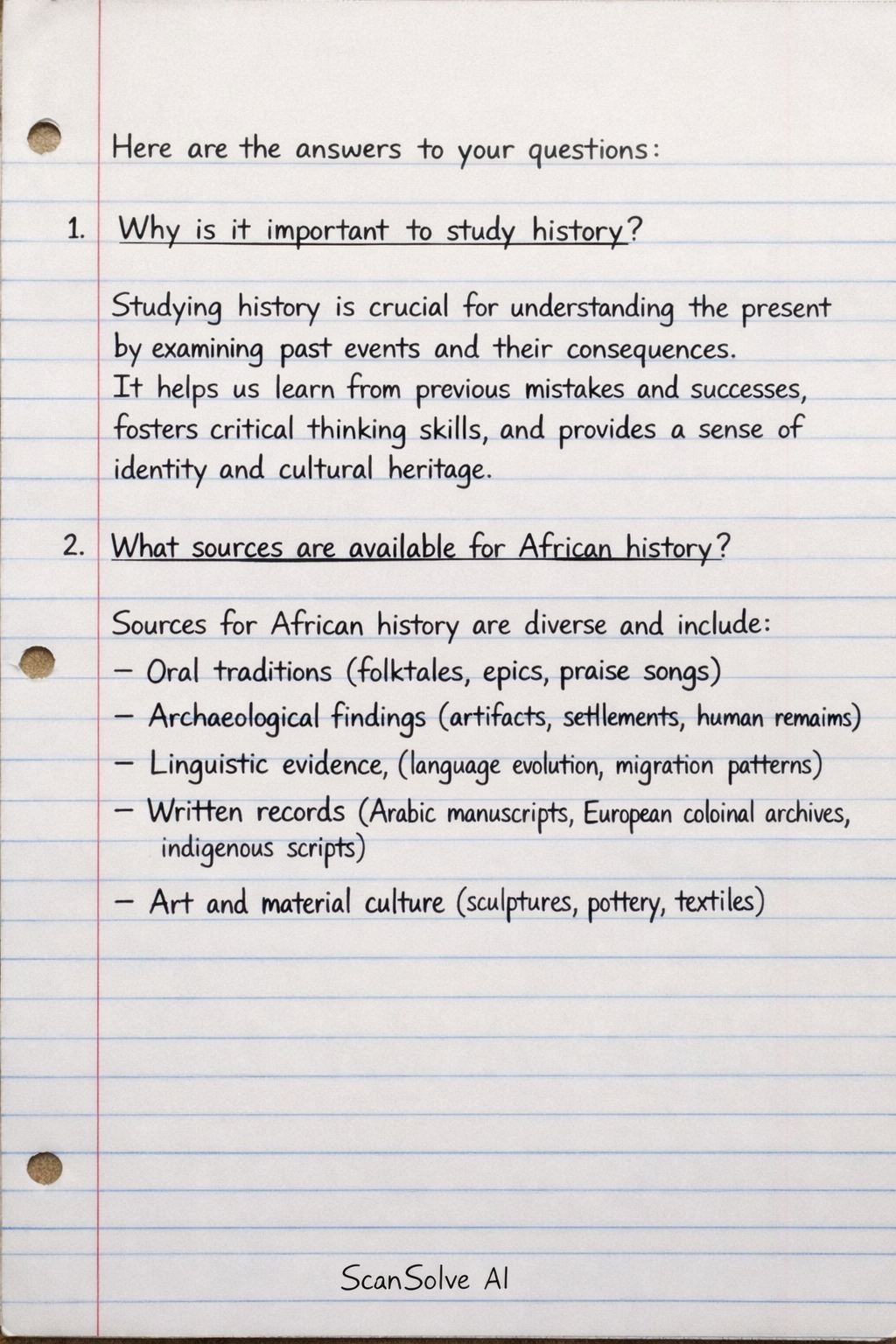
Here are the answers to your questions:
-
Why is it important to study history? Studying history is crucial for understanding the present by examining past events and their consequences. It helps us learn from previous mistakes and successes, fosters critical thinking skills, and provides a sense of identity and cultural heritage.
-
What sources are available for African history? Sources for African history are diverse and include oral traditions (folktales, epics, praise songs), archaeological findings (artifacts, settlements, human remains), linguistic evidence (language evolution, migration patterns), written records (Arabic manuscripts, European colonial archives, indigenous scripts), and art and material culture (sculptures, pottery, textiles).
-
State the merits and demerits of any four non-documentary sources of African history.
- Oral Traditions
- Merit: Provides direct accounts of past events, cultural values, and social structures, often covering periods before written records.
- Demerit: Can be subject to distortion, memory loss, or bias over time, and often lacks precise chronology.
- Archaeology
- Merit: Offers tangible, physical evidence of past human activities, independent of human memory or bias, and can cover very deep historical periods.
- Demerit: Interpretation can be challenging and subjective, limited to material culture, and sites can be destroyed or difficult to access.
- Linguistics
- Merit: Helps trace population movements, cultural contacts, and the historical relationships between different ethnic groups and their languages.
- Demerit: Cannot provide specific dates or detailed narratives of events, and interpretations can be complex and require specialized knowledge.
- Art and Material Culture
- Merit: Reflects the beliefs, social organization, technological advancements, and aesthetic values of past societies.
- Demerit: Interpretation can be highly subjective, the original context is often lost, and accurate dating can be difficult without corroborating evidence.
- Oral Traditions
-
Discuss how writing of African history. The writing of African history is a complex and interdisciplinary endeavor, largely due to the historical scarcity of indigenous written records in many regions. Historians rely heavily on a combination of oral traditions, archaeological excavations, linguistic analysis, and ethnobotany to reconstruct the past. They also critically analyze external written accounts (e.g., Arab chronicles, European colonial records) while being mindful of inherent biases. The process involves cross-referencing these diverse sources to build a comprehensive and nuanced understanding of African societies, cultures, and political developments over millennia.
-
Outline five importance of I.C.T in historical studies.
- Enhanced Access to Sources: ICT facilitates access to digitized archives, historical documents, and databases from around the world, making research more efficient.
- Improved Research and Analysis: Digital tools allow for complex data processing, statistical analysis of historical data, and Geographic Information Systems (GIS) for mapping historical changes.
- Preservation of Heritage: Digitalization helps preserve fragile historical documents, photographs, and audio-visual materials, ensuring their longevity and accessibility.
- Dissemination and Education: ICT enables the creation of online exhibitions, virtual museums, educational platforms, and digital publications, making history more accessible to a wider audience.
- Global Collaboration: Historians can easily collaborate with colleagues internationally, share research, and participate in joint projects through online communication tools and platforms.
Still stuck on this one?
Ask a follow-up, and the answer starts from this question.
More History Questions
Handwritten Step-by-Step Solution
Get this as a handwritten image on WhatsApp — like a tutor wrote it for you.
Try on WhatsApp