
We read your photo as:
State 3 reasons why Adolf Hitler of Germany was interested in Russia at the beginning of 2nd World War and explain the social effects of the Second World War 1939-1945.
ScanSolve AI Answer
here are the answers to your questions:
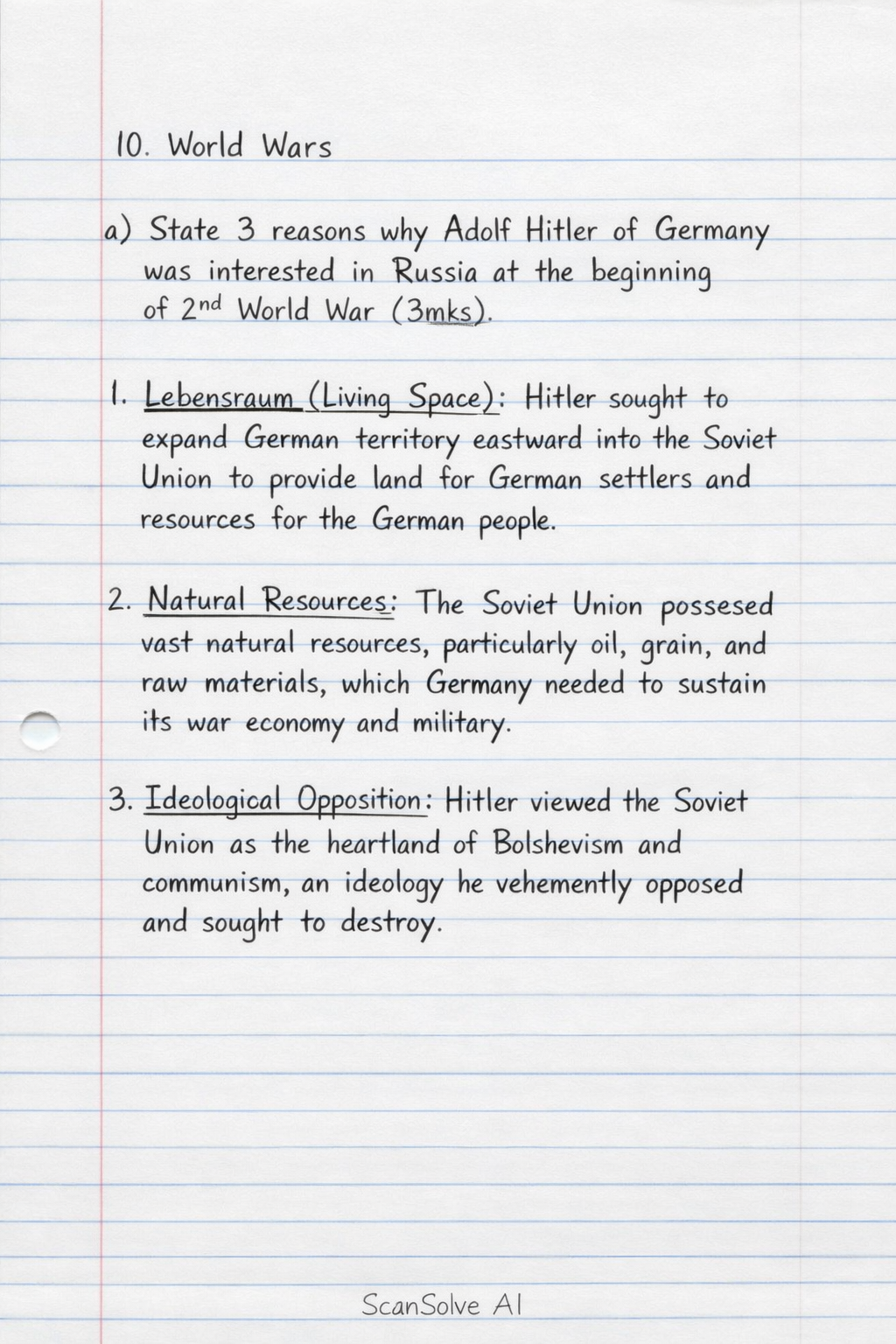
10. World Wars
a) State 3 reasons why Adolf Hitler of Germany was interested in Russia at the beginning of 2nd World War (3mks)
- Lebensraum (Living Space): Hitler sought to expand German territory eastward into the Soviet Union to provide land for German settlers and resources for the German people.
- Natural Resources: The Soviet Union possessed vast natural resources, particularly oil, grain, and raw materials, which Germany needed to sustain its war economy and military.
- Ideological Opposition: Hitler viewed the Soviet Union as the heartland of Bolshevism and communism, an ideology he vehemently opposed and sought to destroy.
b) Explain the social effects of the Second World War 1939-1945 (12mks)
The Second World War had profound social effects globally:
- Mass Casualties and Displacement: The war resulted in an unprecedented number of deaths, both military and civilian, leading to widespread grief and trauma. Millions were displaced from their homes, becoming refugees across Europe and Asia.
- Changes in Gender Roles: Women took on vital roles in factories, agriculture, and other industries to support the war effort, challenging traditional gender norms and contributing to future movements for women's rights.
- Psychological Trauma: Many veterans and civilians suffered from severe psychological trauma, including PTSD, due to the horrors of combat, bombing raids, and concentration camps, leading to long-term mental health challenges.
- Urban Destruction and Reconstruction: Extensive bombing campaigns devastated cities, leading to massive destruction of infrastructure and housing. This necessitated large-scale reconstruction efforts in the post-war period, reshaping urban landscapes.
- Demographic Shifts: The war led to significant demographic changes, including altered birth rates, increased mortality, and large-scale migrations, which reshaped populations and ethnic compositions in many regions.
- Rise of Welfare States: In many countries, the war prompted governments to expand social welfare programs to support veterans, war widows, and the general population, contributing to the development of modern welfare states and social security systems.
11. World War I
What event prompted the United States of America to join the First World War in 1917 (1mk)
The event that prompted the United States to join the First World War in 1917 was Germany's resumption of unrestricted submarine warfare and the revelation of the Zimmermann Telegram.
12. World War I & II
a) Give three reasons why the United States of America (USA) did not join the First World War until 1917 (3mks)
- Isolationism: The U.S. had a long-standing policy of avoiding entanglement in European political and military conflicts.
- Economic Interests: The U.S. was profiting from trade with both Allied and Central Powers, and joining the war would disrupt these lucrative economic ties.
- Public Opinion: There was significant public sentiment against joining the war, partly due to a diverse immigrant population with ties to various warring nations, and a general desire to remain neutral.
b) Explain 6 factors that enabled the Allied Powers to win the Second World War (12mks)
- Superior Industrial Capacity: The combined industrial output of the Allied Powers, particularly the United States, far surpassed that of the Axis, allowing for overwhelming production of weapons, vehicles, and supplies.
- Strategic Cooperation: Despite ideological differences, the major Allied powers (USA, UK, USSR) maintained a more effective strategic coordination and unified command structure compared to the Axis.
- Soviet Resistance on the Eastern Front: The immense scale of fighting on the Eastern Front tied up and decimated the majority of the German army, preventing them from concentrating forces against the Western Allies.
- Allied Control of the Seas and Air Superiority: Allied naval dominance ensured secure supply lines and enabled amphibious invasions, while growing air superiority crippled Axis logistics, industry, and air defenses.
- Effective Leadership and Morale: Strong leadership from figures like Winston Churchill, Franklin D. Roosevelt, and Joseph Stalin, combined with the morale of fighting against fascism, sustained the Allied war effort.
- Axis Strategic Blunders: Critical mistakes by the Axis, such as Hitler's invasion of the Soviet Union, Japan's attack on Pearl Harbor, and their failure to effectively coordinate global strategies, ultimately overstretched their resources and capabilities.
Still stuck on this one?
Ask a follow-up, and the answer starts from this question.
More History Questions
Handwritten Step-by-Step Solution
Get this as a handwritten image on WhatsApp — like a tutor wrote it for you.
Try on WhatsApp