
We read your photo as:
State 5 examples of Print Media and explain how they can be used in teaching and learning of one of your teaching subjects.
ScanSolve AI Answer
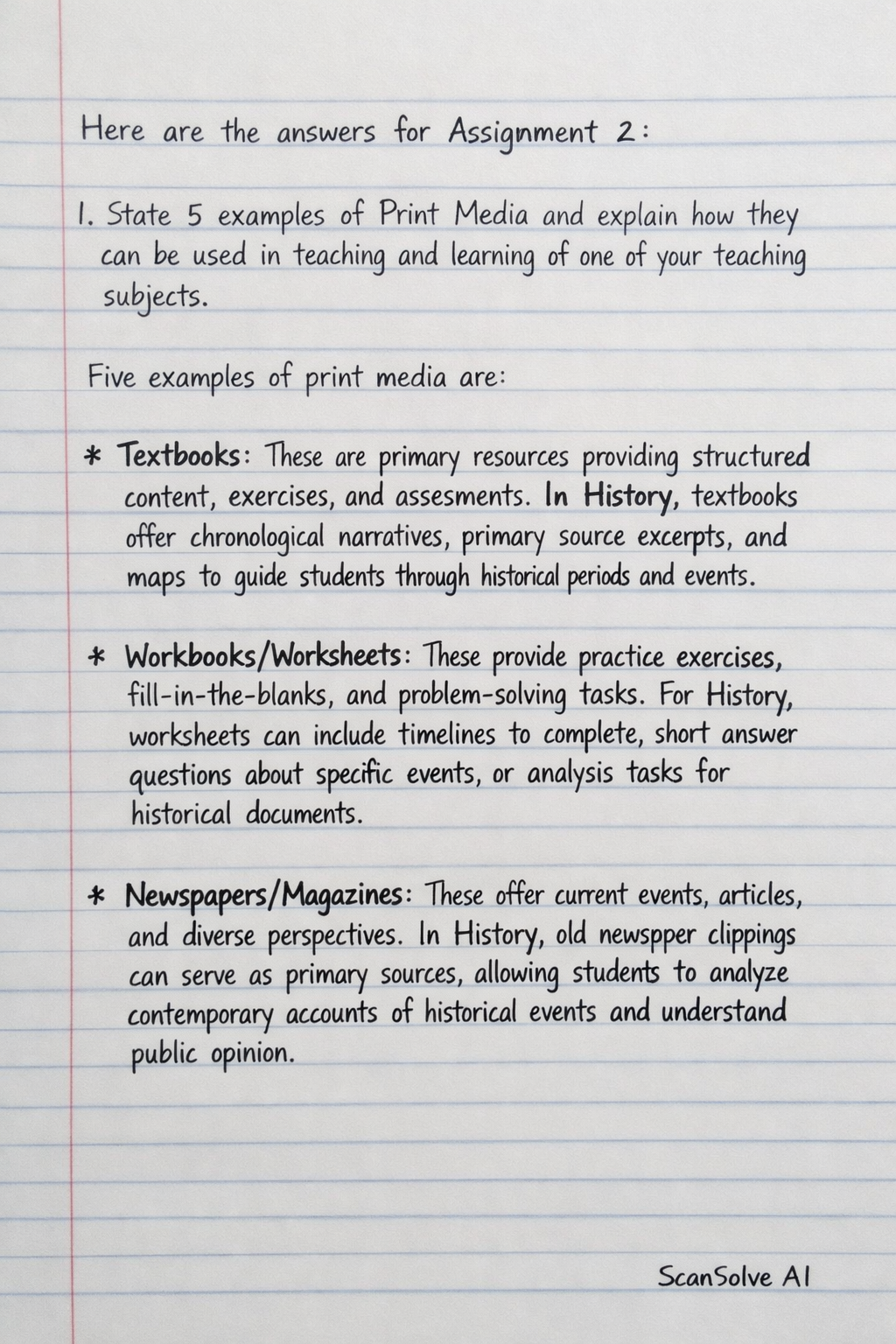
Here are the answers for Assignment 2:
1. State 5 examples of Print Media and explain how they can be used in teaching and learning of one of your teaching subjects.
Five examples of print media are:
- Textbooks: These are primary resources providing structured content, exercises, and assessments. In History, textbooks offer chronological narratives, primary source excerpts, and maps to guide students through historical periods and events.
- Workbooks/Worksheets: These provide practice exercises, fill-in-the-blanks, and problem-solving tasks. For History, worksheets can include timelines to complete, short answer questions about specific events, or analysis tasks for historical documents.
- Newspapers/Magazines: These offer current events, articles, and diverse perspectives. In History, old newspaper clippings can serve as primary sources, allowing students to analyze contemporary accounts of historical events and understand public opinion.
- Reference Books (e.g., Encyclopedias, Atlases): These provide detailed information, definitions, and geographical context. For History, an atlas helps students locate historical sites and understand geographical influences on events, while encyclopedias offer background on figures and concepts.
- Posters/Charts: These are visual aids displaying key information, diagrams, or illustrations. In History, a poster might display a timeline of a specific era, a family tree of a dynasty, or a map illustrating a major battle, aiding visual learners in grasping complex information.
2. Name any 3 factors that may influence the degree to which a recipient understands the message in communication.
Three factors that may influence the degree to which a recipient understands a message are:
- Prior Knowledge/Experience: A recipient's existing understanding of a topic or their past experiences can significantly affect how they interpret new information. If the message aligns with or builds upon what they already know, comprehension is enhanced.
- Language and Vocabulary: The clarity, complexity, and familiarity of the language used in the message directly impact understanding. Jargon, ambiguous phrasing, or unfamiliar vocabulary can create barriers to comprehension.
- Context and Environment: The setting and surrounding circumstances in which the message is received play a crucial role. Distractions, noise, cultural differences, or the emotional atmosphere can all influence how well a recipient processes and understands the message.
3. Name and explain emerging learning technologies and illustrate their applications in A.B.C.
Emerging learning technologies are innovative tools and platforms that are transforming educational practices.
- Virtual Reality (VR) and Augmented Reality (AR): VR immerses users in simulated environments, while AR overlays digital information onto the real world. In education, VR can transport students to historical sites or inside the human body for immersive learning experiences. AR apps can allow students to interact with 3D models of objects in their classroom, enhancing visualization and engagement.
- Artificial Intelligence (AI) and Machine Learning (ML): AI systems can analyze student performance, provide personalized feedback, and adapt learning paths. ML algorithms power intelligent tutoring systems that identify individual learning gaps and recommend tailored resources, making learning more efficient and effective for each student.
- Gamification: This involves applying game-design elements and game principles in non-game contexts, like education. Gamified learning platforms use points, badges, leaderboards, and challenges to motivate students, increase participation, and make learning more enjoyable and competitive.
4. Explain why most Kenyan Secondary Schools teachers fail to integrate ICT (Information & Communication Technology) in their classroom practice despite documented benefits.
Most Kenyan Secondary School teachers face several challenges in integrating ICT into their classroom practice:
- Lack of Adequate Infrastructure: Many schools lack reliable internet connectivity, sufficient computers, projectors, or other necessary ICT equipment, making integration difficult or impossible.
- Insufficient Training and Skills: Teachers often receive limited or no professional development on how to effectively use ICT tools for teaching and learning, leading to a lack of confidence and competence.
- Curriculum and Assessment Constraints: The existing curriculum and examination-oriented assessment methods may not explicitly encourage or reward ICT integration, leading teachers to prioritize traditional methods.
- Time Constraints and Workload: Teachers often have heavy workloads and limited time for lesson preparation, making it challenging to learn new technologies and design ICT-integrated lessons.
- Maintenance and Technical Support Issues: Even when ICT resources are available, schools often lack dedicated technical support staff to maintain equipment or troubleshoot problems, leading to disuse of available technology.
Still stuck on this one?
Ask a follow-up, and the answer starts from this question.
More History Questions
Handwritten Step-by-Step Solution
Get this as a handwritten image on WhatsApp — like a tutor wrote it for you.
Try on WhatsApp