
We read your photo as:
How far did the Greek War of Independence contribute to the demise of the Concert of Europe in the 1820's?
ScanSolve AI Answer
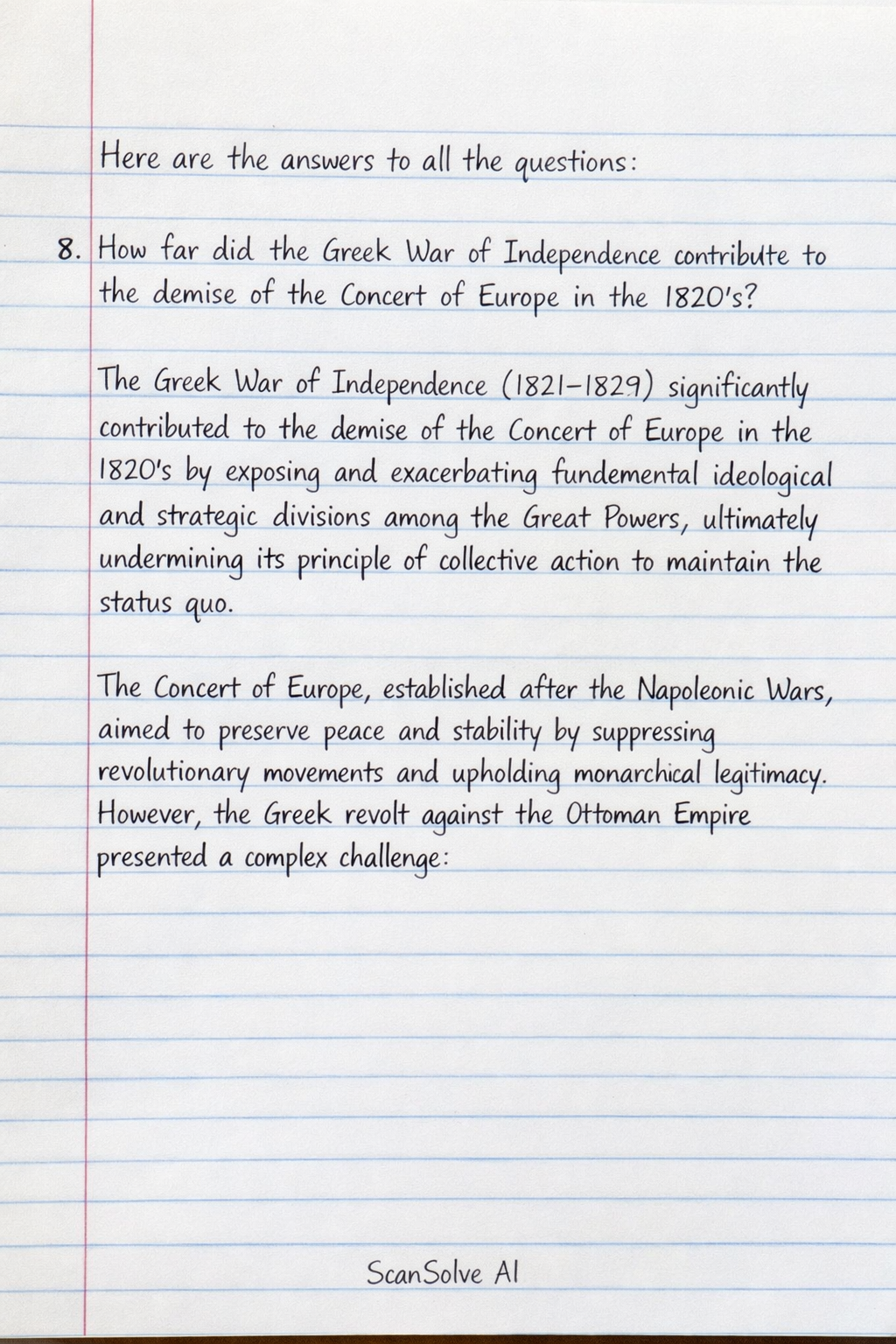
Here are the answers to all the questions:
8. How far did the Greek War of Independence contribute to the demise of the Concert of Europe in the 1820's?
The Greek War of Independence (1821-1829) significantly contributed to the demise of the Concert of Europe in the 1820s by exposing and exacerbating fundamental ideological and strategic divisions among the Great Powers, ultimately undermining its principle of collective action to maintain the status quo.
The Concert of Europe, established after the Napoleonic Wars, aimed to preserve peace and stability by suppressing revolutionary movements and upholding monarchical legitimacy. However, the Greek revolt against the Ottoman Empire presented a complex challenge:
-
Ideological Split:
- Conservative Powers (Austria, Prussia): Initially, these powers, particularly Metternich's Austria, viewed the Greek uprising as another dangerous liberal-nationalist revolution that threatened the existing order and the integrity of the Ottoman Empire (the "sick man of Europe"). They advocated for non-intervention and suppression of the revolt, aligning with the Concert's anti-revolutionary principles.
- Liberal/Philhellenic Powers (Britain, France, Russia): Public opinion in Britain and France, fueled by Philhellenism (love of Greek culture) and religious sympathy for Orthodox Christians, pressured their governments to support the Greeks. Russia, as a fellow Orthodox Christian power and with strategic interests in the Balkans and access to the Mediterranean, also increasingly sided with the Greeks.
-
Undermining Collective Action: This ideological divergence prevented a unified Concert response. Instead of collectively suppressing the revolt, Britain, France, and Russia eventually intervened on behalf of the Greeks, culminating in the Battle of Navarino (1827), where their combined fleets destroyed the Ottoman-Egyptian fleet. This direct military intervention by some Great Powers against another sovereign state (the Ottoman Empire) without the full consensus of the Concert was a clear violation of its principles of non-intervention and collective security.
-
Strategic Rivalries: The Greek crisis also highlighted and intensified existing strategic rivalries, particularly between Russia and Austria over influence in the Balkans, and between Britain and Russia over control of the Eastern Mediterranean. Each power pursued its own national interests, rather than a unified Concert approach.
The Greek War of Independence thus demonstrated that the Great Powers were unwilling to consistently uphold the Concert's principles when their national interests, ideological sympathies, or strategic ambitions diverged. This fractured unity and led to independent actions, marking a significant step towards the breakdown of the Concert system as an effective mechanism for collective security and the maintenance of the European status quo.
The final answer is
9. "Even though it hardened the minds of the Germans against peace, it was nevertheless a good peace treaty". Is this a fair assessment of the treaty of Versailles of 1919?
This assessment of the Treaty of Versailles is not entirely fair, as it oversimplifies a complex historical event and overlooks the treaty's significant flaws that contributed to future instability. While it aimed for peace and had some justifiable elements, its punitive nature ultimately undermined its "goodness."
Arguments for "hardening the minds of the Germans against peace":
- "Diktat" and War Guilt: Germans viewed the treaty as a Diktat (dictated peace) imposed without negotiation. Article 231, the "War Guilt Clause," forced Germany to accept sole responsibility for starting the war, which deeply offended national pride and was seen as a humiliation.
- Reparations: The enormous reparations demanded (initially set at 132 billion gold marks) were perceived as economically crippling and unjust, leading to hyperinflation and economic hardship in the Weimar Republic.
- Territorial Losses: Germany lost significant territory (e.g., Alsace-Lorraine, parts of Prussia to Poland, all overseas colonies), which fueled irredentist sentiments and a desire for revision.
- Military Restrictions: Severe limitations on the German army and navy, and the demilitarization of the Rhineland, were seen as an infringement on sovereignty and left Germany feeling vulnerable.
- Exclusion from League of Nations: Germany was initially excluded from the League of Nations, further isolating it and reinforcing the perception of unfair treatment.
Arguments for it being "nevertheless a good peace treaty" (or justifiable):
- Desire for Lasting Peace: The Allied powers genuinely sought to prevent future German aggression and establish a lasting peace after the devastation of WWI.
- Punishment for Aggression: Many believed Germany deserved punishment for its role in the war, particularly given its harsh treatment of Russia in the Treaty of Brest-Litovsk.
- Self-Determination: The treaty promoted the principle of self-determination by creating new states (e.g., Poland, Czechoslovakia) from former empires, though this was inconsistently applied.
- Creation of the League of Nations: The treaty established the League of Nations, an ambitious attempt at collective security and international cooperation, which was a forward-looking aspect.
- French Security Concerns: France, having suffered two German invasions in 50 years, had legitimate security concerns that the treaty attempted to address.
Conclusion on Fairness:
The assessment is not fair because while the treaty contained elements aimed at peace and justice, its punitive aspects were so severe and perceived as unjust by Germans that they created deep resentment and a strong desire for revision. This resentment was skillfully exploited by extremist groups, most notably the Nazis, who promised to overturn the treaty, directly contributing to the rise of Hitler and the outbreak of World War II. A "good" peace treaty should ideally foster reconciliation and stability, but Versailles, by hardening German minds, ultimately failed in this crucial aspect, making it a flawed rather than a "good" peace.
The final answer is
10. Evaluate the efforts made within the League of Nations towards Collective Security in the 1920's.
The League of Nations, established after World War I, aimed to prevent future conflicts through collective security. This principle meant that an attack on one member state would be considered an attack on all, obligating members to act together to deter aggression.
The League's efforts towards collective security in the 1920s included:
- Covenant Articles: Article 10 committed members to respect and preserve the territorial integrity and political independence of all members. Article 11 declared any war or threat of war a matter of concern to the whole League. Article 16 outlined sanctions (economic and military) against aggressor states.
- Dispute Resolution: The League successfully resolved several minor disputes in the 1920s, demonstrating its potential for collective action. Examples include:
- Aaland Islands (1921): The League successfully mediated a dispute between Sweden and Finland over the Aaland Islands, awarding them to Finland but with guarantees for Swedish culture.
- Upper Silesia (1921): The League divided the industrial region of Upper Silesia between Germany and Poland after a plebiscite, preventing conflict.
- Mosul (1924): The League settled a border dispute between Turkey and Iraq (a British mandate), awarding Mosul to Iraq.
- Greco-Bulgarian Incident (1925): The League intervened swiftly to stop a border conflict, ordering Greece to withdraw and pay reparations to Bulgaria.
However, the League's efforts were significantly hampered by several factors:
- Lack of Universal Membership: Key powers like the United States never joined, and Germany and the Soviet Union were initially excluded, weakening its global authority and enforcement capabilities.
- Absence of Enforcement Power: The League lacked its own army and relied on member states to provide troops for military sanctions, which they were often reluctant to do.
- Great Power Self-Interest: Major powers often prioritized their national interests over collective security.
- Corfu Incident (1923): When Italy invaded Corfu after the murder of an Italian general, the League condemned Italy, but Italy used its influence to pressure Greece directly, undermining the League's authority.
- Vilna (1920): Poland seized Vilna from Lithuania, and the League failed to enforce its decision for Polish withdrawal.
- Unanimity Rule: Decisions in the Council required unanimous consent, making decisive action difficult, especially when powerful nations were involved.
In conclusion, while the League of Nations achieved some successes in resolving smaller disputes in the 1920s, its efforts towards collective security were largely undermined by the absence of major powers, the lack of an independent enforcement mechanism, and the prioritization of national interests by its most influential members. This limited its ability to deter or punish aggression effectively against determined states.
The final answer is
11. "Mutual suspicion and Distrust for Russia by the Western powers was largely responsible for the outbreak of the Second World War". Do you agree?
While mutual suspicion and distrust between Western powers and the Soviet Union (Russia) certainly played a role in the lead-up to World War II, it is not accurate to say it was largely responsible for its outbreak. The primary responsibility lies with the aggressive expansionist policies of Nazi Germany and Imperial Japan, coupled with the failures of collective security and appeasement by Western democracies.
Arguments for the role of suspicion and distrust:
- Western Appeasement of Hitler: Western powers (Britain and France) were often more concerned with the threat of Soviet Communism than with Nazi Germany in the early 1930s. This fear contributed to their policy of appeasement towards Hitler, hoping he would act as a bulwark against the USSR. They tolerated German rearmament and territorial expansion (e.g., Rhineland, Austria, Sudetenland) partly out of a desire to strengthen Germany against the East.
- Exclusion of USSR from Western Alliances: The Soviet Union felt isolated and excluded from Western efforts to contain Germany. Its proposals for collective security pacts were often met with skepticism, notably its exclusion from the Munich Agreement (1938), which decided the fate of Czechoslovakia without Soviet input.
- Molotov-Ribbentrop Pact (1939): The culmination of this distrust was the Nazi-Soviet Non-Aggression Pact. Feeling abandoned by the West and fearing a two-front war, Stalin signed this pact with Hitler, which included secret protocols to divide Eastern Europe. This pact removed the threat of Soviet intervention, giving Hitler the green light to invade Poland, directly triggering WWII.
Arguments against it being largely responsible (other primary factors):
- German Aggression and Expansionism: The fundamental cause of WWII was Hitler's ideology of Lebensraum (living space) and his aggressive foreign policy aimed at conquering Eastern Europe and establishing German hegemony. This was evident in his rearmament, withdrawal from the League of Nations, annexation of Austria, and invasion of Czechoslovakia and Poland.
- Failure of the Treaty of Versailles: The punitive nature of the Treaty of Versailles created deep resentment in Germany, which Hitler exploited to gain power and justify his revisionist policies.
- Failure of Collective Security: The League of Nations proved ineffective in deterring aggression by Japan (Manchuria), Italy (Abyssinia), and Germany, demonstrating that international institutions could not enforce peace without the commitment of major powers.
- Appeasement Policy: The policy of appeasement, driven by a desire to avoid another major war and a misjudgment of Hitler's intentions, emboldened Germany and allowed it to grow stronger without significant resistance.
Conclusion:
While mutual suspicion and distrust between the Soviet Union and Western powers were significant factors that shaped diplomatic alignments and contributed to the circumstances leading to the war (e.g., the Molotov-Ribbentrop Pact), they were not largely responsible for the outbreak. The primary impetus for the war came from Nazi Germany's expansionist ambitions and its direct acts of aggression. The distrust merely influenced the strategic choices made by various powers, which, in turn, facilitated Germany's ability to launch its war.
The final answer is
12. How beneficial is the Commonwealth of Nations to member countries of the Developing World.
The Commonwealth of Nations offers several significant benefits to its member countries in the Developing World, acting as a unique platform for cooperation, advocacy, and shared values,
Still stuck on this one?
Ask a follow-up, and the answer starts from this question.
More History Questions
Handwritten Step-by-Step Solution
Get this as a handwritten image on WhatsApp — like a tutor wrote it for you.
Try on WhatsApp