
We read your photo as:
A) What were the political reasons for the European scramble for African territories in the late 19th century?
ScanSolve AI Answer
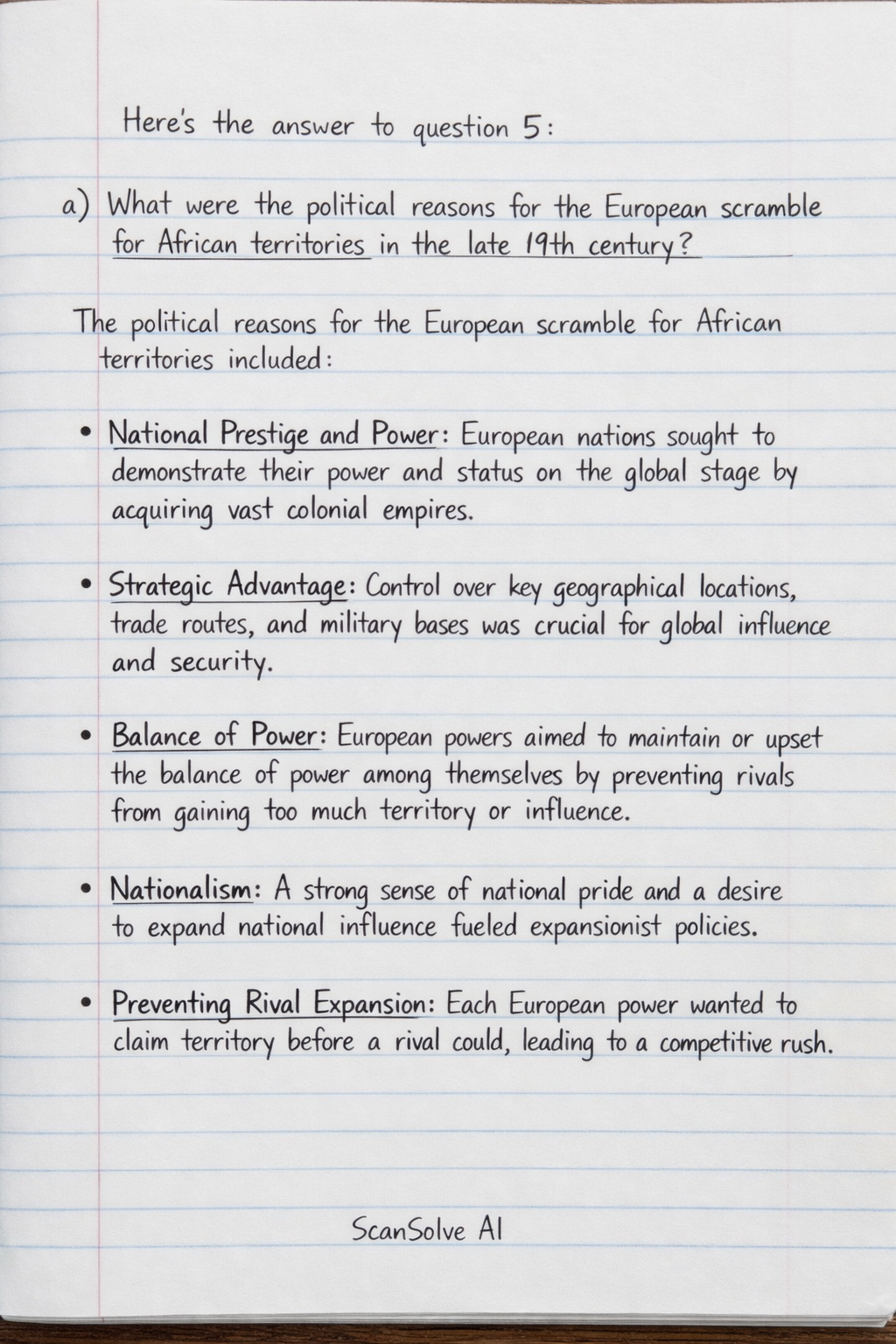
Here's the answer to question 5:
a) What were the political reasons for the European scramble for African territories in the late 19th century?
The political reasons for the European scramble for African territories included:
- National Prestige and Power: European nations sought to demonstrate their power and status on the global stage by acquiring vast colonial empires.
- Strategic Advantage: Control over key geographical locations, trade routes, and military bases was crucial for global influence and security.
- Balance of Power: European powers aimed to maintain or upset the balance of power among themselves by preventing rivals from gaining too much territory or influence.
- Nationalism: A strong sense of national pride and a desire to expand national influence fueled expansionist policies.
- Preventing Rival Expansion: Each European power wanted to claim territory before a rival could, leading to a competitive rush.
b) What efforts were made at the Berlin West Africa Conference of 1884-1885 to guarantee a peaceful partition of the continent?
At the Berlin West Africa Conference, efforts to ensure a peaceful partition included:
- Principle of Notification: Any power claiming new territory on the African coast had to notify other signatory powers to allow them to make counter-claims.
- Principle of Effective Occupation: Claims to territory had to be backed by actual administration, such as establishing a presence, signing treaties with local rulers, and maintaining law and order, rather than just "paper claims."
- Freedom of Navigation: The conference guaranteed free navigation for all nations on the Congo and Niger Rivers, which were vital for trade and access to the interior.
- Defining Spheres of Influence: European powers formally recognized each other's claims and drew boundaries to avoid direct military conflict over African territories.
- Commitment to Suppress Slavery: Signatories agreed to work towards suppressing the slave trade.
c) What were the effects of this partition on the African people?
The effects of the partition on the African people were profound and largely negative:
- Arbitrary Borders: New colonial borders ignored existing ethnic, linguistic, and cultural divisions, splitting communities and forcing disparate groups together, which led to future conflicts.
- Loss of Sovereignty: African kingdoms, states, and communities lost their independence and self-governance, becoming subjects of European colonial powers.
- Economic Exploitation: African resources (minerals, agricultural products) were systematically exploited for the benefit of European industries, with little to no benefit for the African people.
- Imposition of Foreign Systems: European administrative, legal, and educational systems were imposed, often undermining traditional African structures and cultures.
- Forced Labor and Taxation: Africans were often subjected to forced labor, heavy taxation, and conscription into colonial armies.
- Cultural Disruption: Traditional African cultures, religions, and social structures were often suppressed or undermined by colonial policies and missionary activities.
- Underdevelopment: The focus on resource extraction and lack of investment in local industries hindered genuine economic development for Africans.
- Rise of Nationalism: The shared experience of colonial oppression eventually fostered a sense of African nationalism, leading to movements for independence in the 20th century.
Still stuck on this one?
Ask a follow-up, and the answer starts from this question.
More History Questions
Handwritten Step-by-Step Solution
Get this as a handwritten image on WhatsApp — like a tutor wrote it for you.
Try on WhatsApp