
We read your photo as:
Analyze British racial policies and legislation concerning Aboriginal populations, covering background, colonization, and the concept of 'racial suicide'.
ScanSolve AI Answer
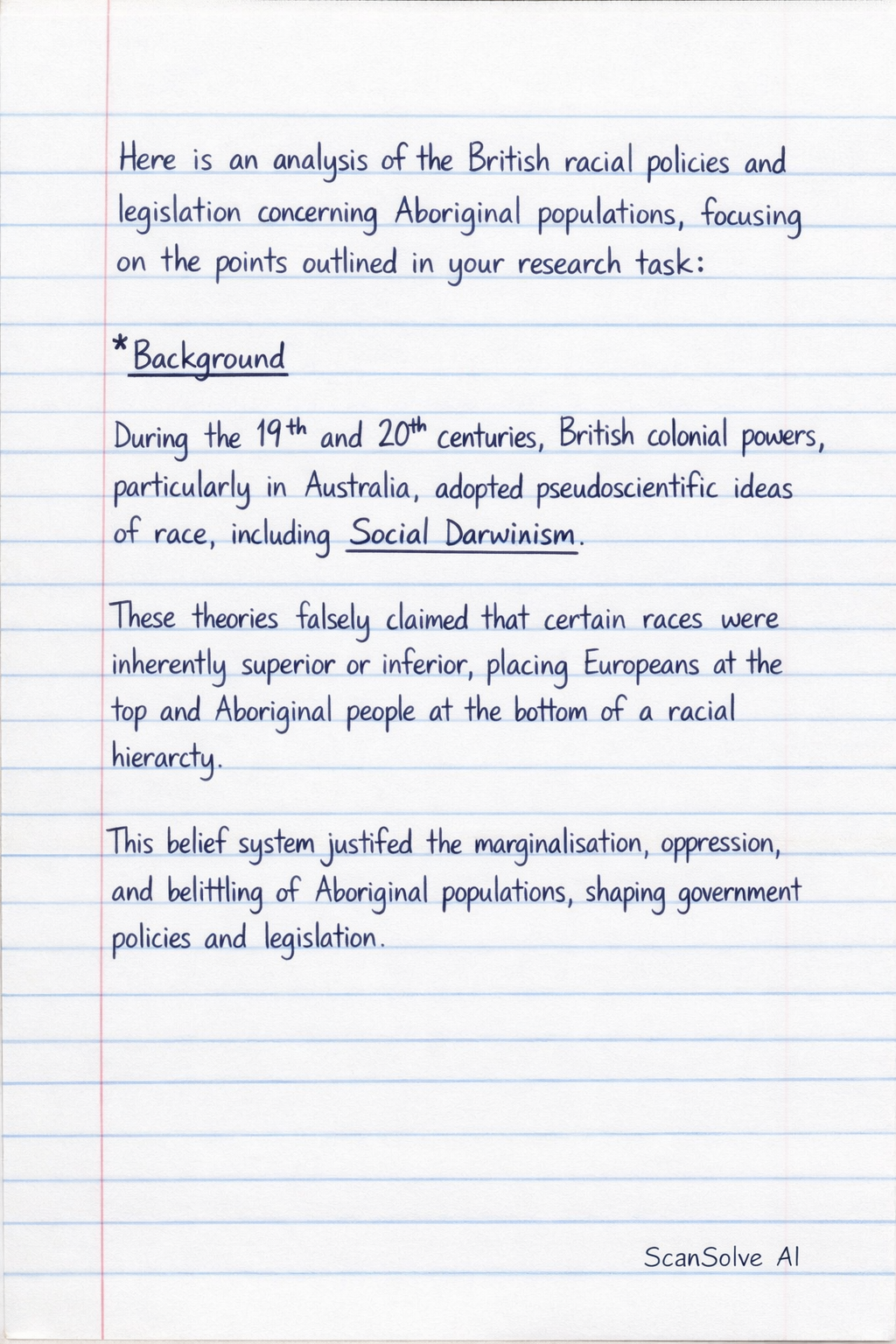
Here is an analysis of the British racial policies and legislation concerning Aboriginal populations, focusing on the points outlined in your research task:
Background
During the 19th and 20th centuries, British colonial powers, particularly in Australia, adopted pseudoscientific ideas of race, including Social Darwinism. These theories falsely claimed that certain races were inherently superior or inferior, placing Europeans at the top and Aboriginal people at the bottom of a racial hierarchy. This belief system justified the marginalisation, oppression, and belittling of Aboriginal populations, shaping government policies and legislation.
Colonisation or Penal Colony
Australia was initially established by the British as a penal colony in 1788. This colonisation was based on the legal fiction of terra nullius ("land belonging to no one"), which ignored the long-standing presence and sovereignty of Aboriginal peoples. The arrival of British settlers led to violent conflicts, dispossession of land, and the introduction of diseases, severely impacting Aboriginal communities and their traditional way of life. The primary goal was to establish a new British society, with little regard for the existing Indigenous inhabitants.
Racial Suicide
This concept, as discussed previously, refers to the belief that Aboriginal populations were destined to die out or be absorbed into the white population. Policies were designed not for direct extermination but to dismantle Aboriginal culture and identity, making it impossible for them to continue as a distinct people. This was often framed as a "natural" process or a benevolent act of "civilising" them.
Racial Decay
Closely linked to racial suicide, racial decay was the idea that Aboriginal people were a "dying race" due to their perceived inability to adapt to European civilisation. This belief was used to justify policies that offered minimal support or protection, as it was thought their decline was inevitable. It also contributed to the idea that "full-blood" Aboriginal people would eventually disappear, leaving only "mixed-race" individuals who could then be assimilated.
White Immigration Policy
The White Australia Policy, implemented from the late 19th century and formally dismantled in the 1970s, was a series of laws designed to restrict non-European immigration to Australia. While primarily aimed at preventing Asian immigration, it reinforced the racial hierarchy and the idea of Australia as a "white" nation. This policy indirectly impacted Aboriginal people by solidifying the dominance of European culture and further marginalising Indigenous populations within their own land, denying them equal status and rights.
Stolen Generation
The Stolen Generations refers to the period, primarily from the early 1900s to the 1970s, when Aboriginal and Torres Strait Islander children were forcibly removed from their families by government agencies and church missions. These removals were justified by assimilation policies, which aimed to "protect" children by integrating them into white society and "breeding out" their Aboriginality. Children were often placed in institutions or with white foster families, forbidden from speaking their language or practicing their culture.
Legacy of Stolen Generation
The legacy of the Stolen Generations is profound and continues to affect Aboriginal communities today.
- Intergenerational Trauma: The forced removals caused deep psychological trauma, grief, and loss that has been passed down through generations, contributing to mental health issues, substance abuse, and family breakdown.
- Loss of Culture and Language: Many individuals lost their connection to their heritage, language, and traditional knowledge, leading to a significant cultural void.
- Mistrust of Institutions: The experience fostered a deep mistrust of government, police, and welfare agencies, impacting engagement with essential services.
- Social Disadvantage: The Stolen Generations contributed to ongoing disparities in health, education, and economic opportunities for Aboriginal people, perpetuating cycles of disadvantage.
Reference: These policies and their impacts are extensively documented in historical accounts, government reports such as Australia's Bringing Them Home report (1997), and academic studies on Australian colonial history and Indigenous affairs.
Still stuck on this one?
Ask a follow-up, and the answer starts from this question.
More History Questions
Handwritten Step-by-Step Solution
Get this as a handwritten image on WhatsApp — like a tutor wrote it for you.
Try on WhatsApp