
We read your photo as:
Analyze the impact of scientific racism and eugenics on Australian assimilation policies and Aboriginal people.
ScanSolve AI Answer
Here are the answers to the questions:
-
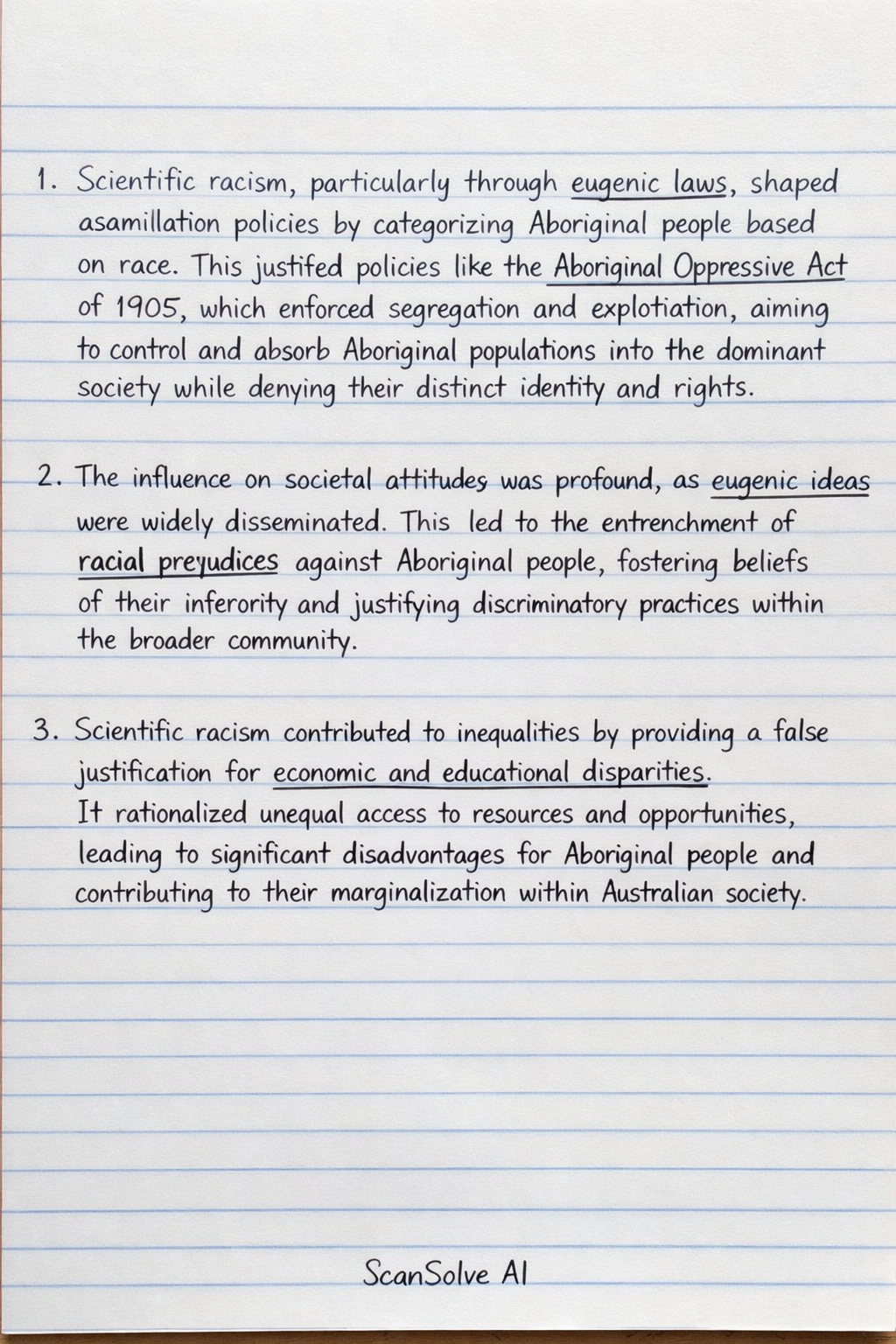
Scientific racism, particularly through eugenic laws, shaped assimilation policies by categorizing Aboriginal people based on race. This justified policies like the Aboriginal Oppressive Act of 1905, which enforced segregation and exploitation, aiming to control and absorb Aboriginal populations into the dominant society while denying their distinct identity and rights.
-
The influence on societal attitudes was profound, as eugenic ideas were widely disseminated. This led to the entrenchment of racial prejudices against Aboriginal people, fostering beliefs of their inferiority and justifying discriminatory practices within the broader community.
-
Scientific racism contributed to inequalities by providing a false justification for economic and educational disparities. It rationalized unequal access to resources and opportunities, leading to significant disadvantages for Aboriginal people and contributing to their marginalization within Australian society.
-
The lasting impact today includes systemic racism, which continues to affect Aboriginal people in various institutions. It also manifests as persistent health inequities and the perpetuation of ongoing stereotypes, which contribute to social and economic disadvantages.
Still stuck on this one?
Ask a follow-up, and the answer starts from this question.
More History Questions
Handwritten Step-by-Step Solution
Get this as a handwritten image on WhatsApp — like a tutor wrote it for you.
Try on WhatsApp