
We read your photo as:
Answer all this questions in History
ScanSolve AI Answer
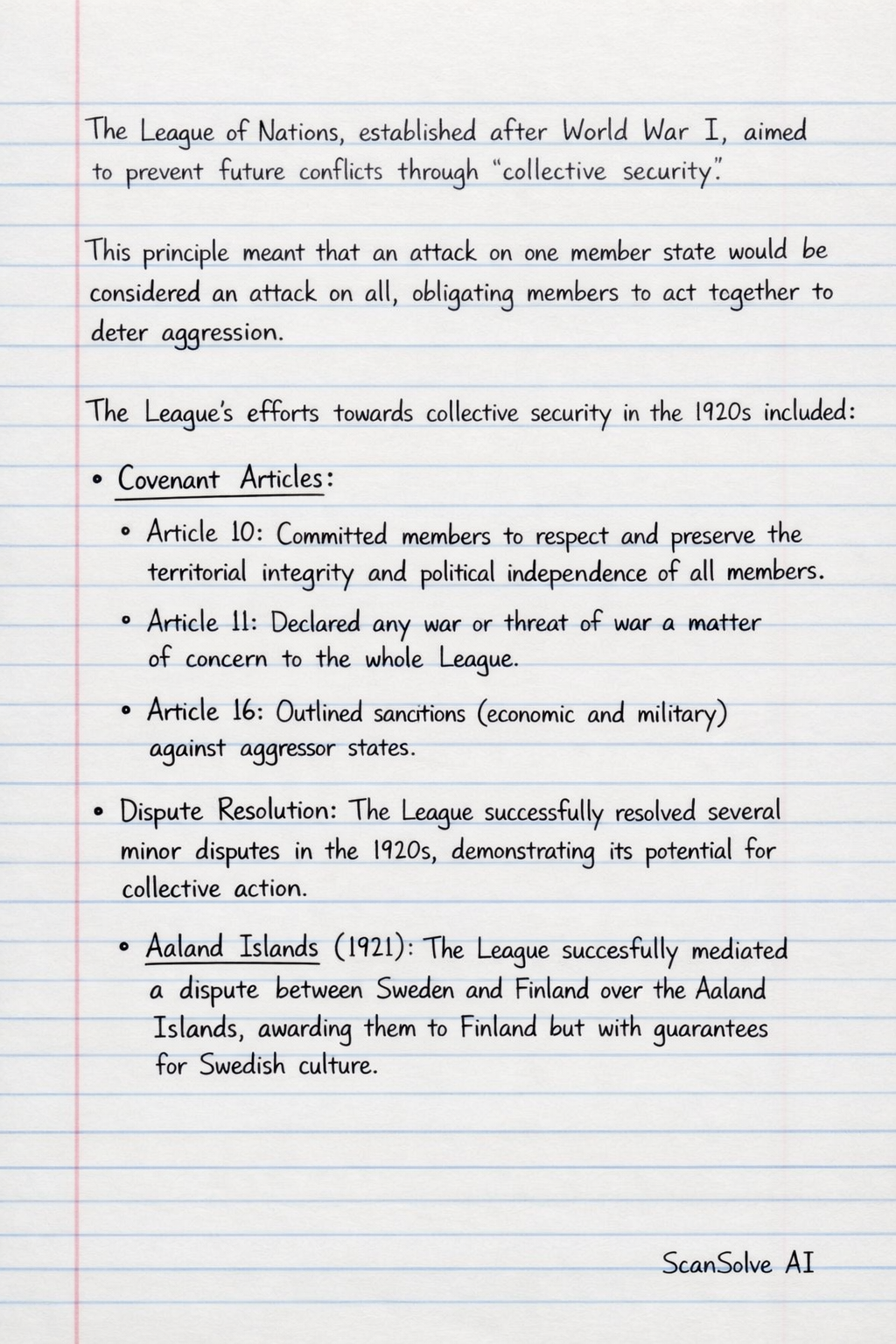
The League of Nations, established after World War I, aimed to prevent future conflicts through collective security. This principle meant that an attack on one member state would be considered an attack on all, obligating members to act together to deter aggression.
The League's efforts towards collective security in the 1920s included:
- Covenant Articles: Article 10 committed members to respect and preserve the territorial integrity and political independence of all members. Article 11 declared any war or threat of war a matter of concern to the whole League. Article 16 outlined sanctions (economic and military) against aggressor states.
- Dispute Resolution: The League successfully resolved several minor disputes in the 1920s, demonstrating its potential for collective action. Examples include:
- Aaland Islands (1921): The League successfully mediated a dispute between Sweden and Finland over the Aaland Islands, awarding them to Finland but with guarantees for Swedish culture.
- Upper Silesia (1921): The League divided the industrial region of Upper Silesia between Germany and Poland after a plebiscite, preventing conflict.
- Mosul (1924): The League settled a border dispute between Turkey and Iraq (a British mandate), awarding Mosul to Iraq.
- Greco-Bulgarian Incident (1925): The League intervened swiftly to stop a border conflict, ordering Greece to withdraw and pay reparations to Bulgaria.
However, the League's efforts were significantly hampered by several factors:
- Lack of Universal Membership: Key powers like the United States never joined, and Germany and the Soviet Union were initially excluded, weakening its global authority and enforcement capabilities.
- Absence of Enforcement Power: The League lacked its own army and relied on member states to provide troops for military sanctions, which they were often reluctant to do.
- Great Power Self-Interest: Major powers often prioritized their national interests over collective security.
- Corfu Incident (1923): When Italy invaded Corfu after the murder of an Italian general, the League condemned Italy, but Italy used its influence to pressure Greece directly, undermining the League's authority.
- Vilna (1920): Poland seized Vilna from Lithuania, and the League failed to enforce its decision for Polish withdrawal.
- Unanimity Rule: Decisions in the Council required unanimous consent, making decisive action difficult, especially when powerful nations were involved.
In conclusion, while the League of Nations achieved some successes in resolving smaller disputes in the 1920s, its efforts towards collective security were largely undermined by the absence of major powers, the lack of an independent enforcement mechanism, and the prioritization of national interests by its most influential members. This limited its ability to deter or punish aggression effectively against determined states.
The final answer is
Still stuck on this one?
Ask a follow-up, and the answer starts from this question.
More History Questions
Handwritten Step-by-Step Solution
Get this as a handwritten image on WhatsApp — like a tutor wrote it for you.
Try on WhatsApp