
We read your photo as:
Answer question 10 in Cameroon history
ScanSolve AI Answer
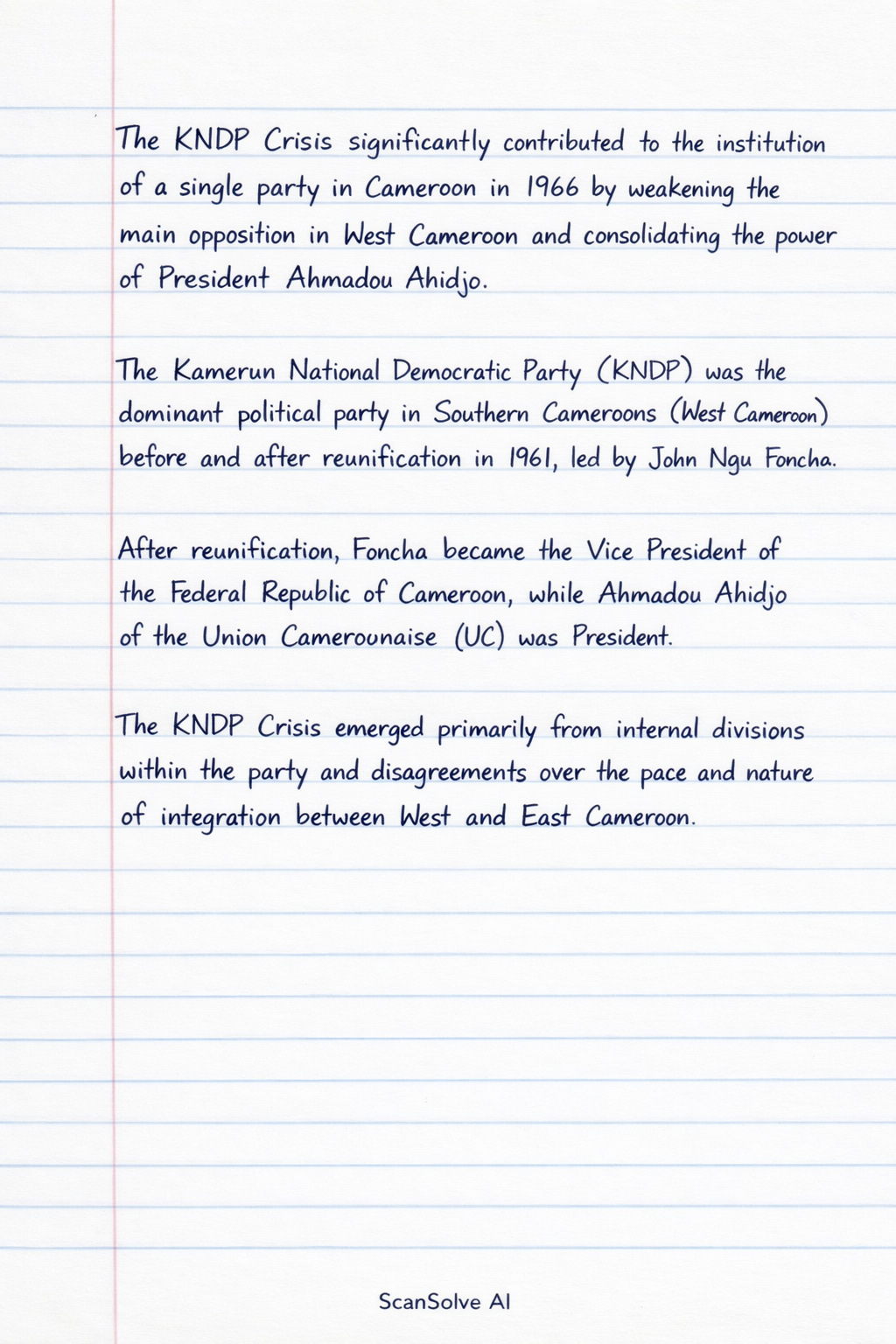
The KNDP Crisis significantly contributed to the institution of a single party in Cameroon in 1966 by weakening the main opposition in West Cameroon and consolidating the power of President Ahmadou Ahidjo.
The Kamerun National Democratic Party (KNDP) was the dominant political party in Southern Cameroons (West Cameroon) before and after reunification in 1961, led by John Ngu Foncha. After reunification, Foncha became the Vice President of the Federal Republic of Cameroon, while Ahmadou Ahidjo of the Union Camerounaise (UC) was President.
The KNDP Crisis emerged primarily from internal divisions within the party and disagreements over the pace and nature of integration between West and East Cameroon.
- Internal Divisions: By 1965, the KNDP was plagued by factionalism. A significant split occurred when some prominent KNDP members, notably Solomon Tandeng Muna, disagreed with Foncha's leadership and his approach to federalism. They felt Foncha was too slow in integrating West Cameroon with East Cameroon and that the KNDP was losing its influence.
- Defections and Weakening: This internal strife led to a major defection of KNDP members, including Muna, to Ahidjo's UC party or to form new parties that were more aligned with Ahidjo's vision of a strong central government. These defections severely weakened the KNDP's numerical strength and political cohesion in the West Cameroon House of Assembly.
- Ahidjo's Consolidation of Power: President Ahidjo skillfully exploited these divisions. He advocated for national unity and a stronger central government, which resonated with those KNDP members disillusioned with their party's internal conflicts and perceived lack of progress. By welcoming defectors into the UC, Ahidjo effectively absorbed the opposition and expanded his party's reach into West Cameroon.
- Paving the Way for a Single Party: The KNDP's fragmentation and loss of influence meant that there was no longer a strong, unified opposition capable of challenging Ahidjo's agenda. This political vacuum, coupled with Ahidjo's consistent push for national unity and a more centralized system, created the ideal conditions for the establishment of a single-party state. In 1966, the major political parties, including the remnants of the KNDP and the UC, merged to form the Cameroon National Union (CNU), effectively ending multi-party politics and instituting a single-party system under Ahidjo's leadership.
The KNDP Crisis, therefore, directly contributed to the institution of a single party by dismantling the most significant regional opposition, thereby removing a major obstacle to Ahidjo's vision of a unified, one-party state.
The final answer is
Still stuck on this one?
Ask a follow-up, and the answer starts from this question.
More History Questions
Handwritten Step-by-Step Solution
Get this as a handwritten image on WhatsApp — like a tutor wrote it for you.
Try on WhatsApp