
We read your photo as:
Answer the questions below using the provided sources. a) Identify the destinations of slaves from Source E and Source D. b) What was the total number of slaves shipped across the Atlantic? c) Evaluat
ScanSolve AI Answer
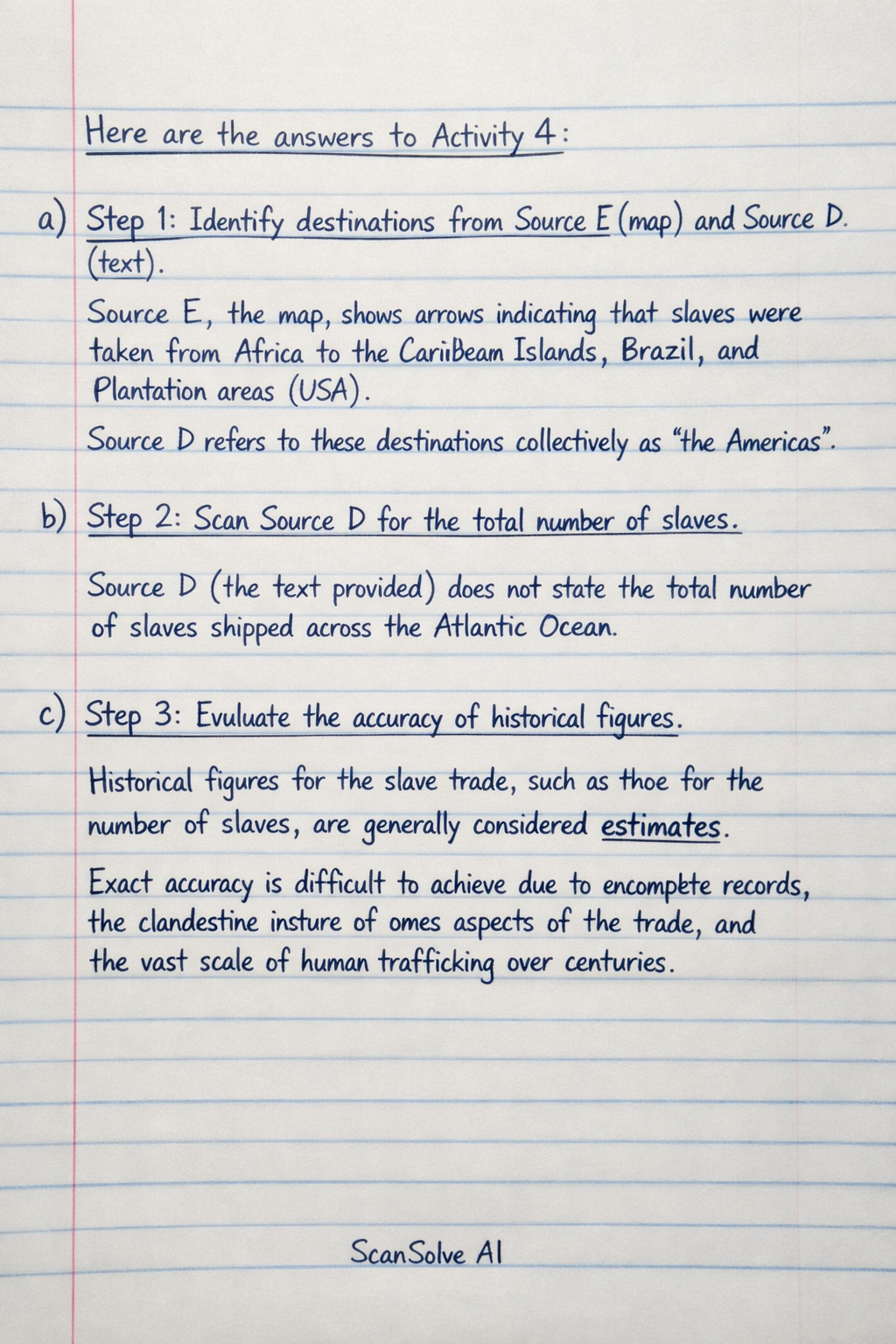
Here are the answers to Activity 4:
a) Step 1: Identify destinations from Source E (map) and Source D (text).
Source E, the map, shows arrows indicating that slaves were taken from Africa to the Caribbean Islands, Brazil, and Plantation areas (USA). Source D refers to these destinations collectively as "the Americas".
b) Step 2: Scan Source D for the total number of slaves.
Source D (the text provided) does not state the total number of slaves shipped across the Atlantic Ocean.
c) Step 3: Evaluate the accuracy of historical figures.
Historical figures for the slave trade, such as those for the number of slaves, are generally considered estimates. Exact accuracy is difficult to achieve due to incomplete records, the clandestine nature of some aspects of the trade, and the vast scale of human trafficking over centuries.
d) Step 4: Account for the difference in slave population figures.
If 4 million slaves were in North America by the 1860s and 339,000 were shipped from Africa, the vast majority of the remaining slave population came from natural increase, meaning they were born into slavery within North America.
e) Step 5: Explain the link between areas and European names.
The areas mentioned, such as Brazil (Portuguese Brazil), the Caribbean Islands, and the USA (originally British colonies), were colonies of European powers. They were named after or linked to their European colonizers who established control over these territories and exploited their resources and labor.
f) Step 6: Describe the triangular trade using Source E.
Source E, the map, illustrates the triangular trade as a three-sided route across the Atlantic Ocean:
- The first leg involved ships carrying manufactured goods (like cloth, guns, and iron) from Europe to Africa.
- The second leg, known as the Middle Passage, involved transporting enslaved people from Africa to the Americas.
- The third leg involved ships carrying plantation crops (such as sugar, tobacco, and cotton) from the Americas back to Europe. This trade is called "triangular" because the routes connecting Europe, Africa, and the Americas formed a distinct triangle on the map.
Still stuck on this one?
Ask a follow-up, and the answer starts from this question.
More History Questions
Handwritten Step-by-Step Solution
Get this as a handwritten image on WhatsApp — like a tutor wrote it for you.
Try on WhatsApp