
We read your photo as:
b) Enumerate the sources of study for Jainism and Buddhism. b) Write about flood its effects and the mitigation.
ScanSolve AI Answer
Here are the answers to the remaining questions from your social studies exam:
VI. Answer the following in detail:
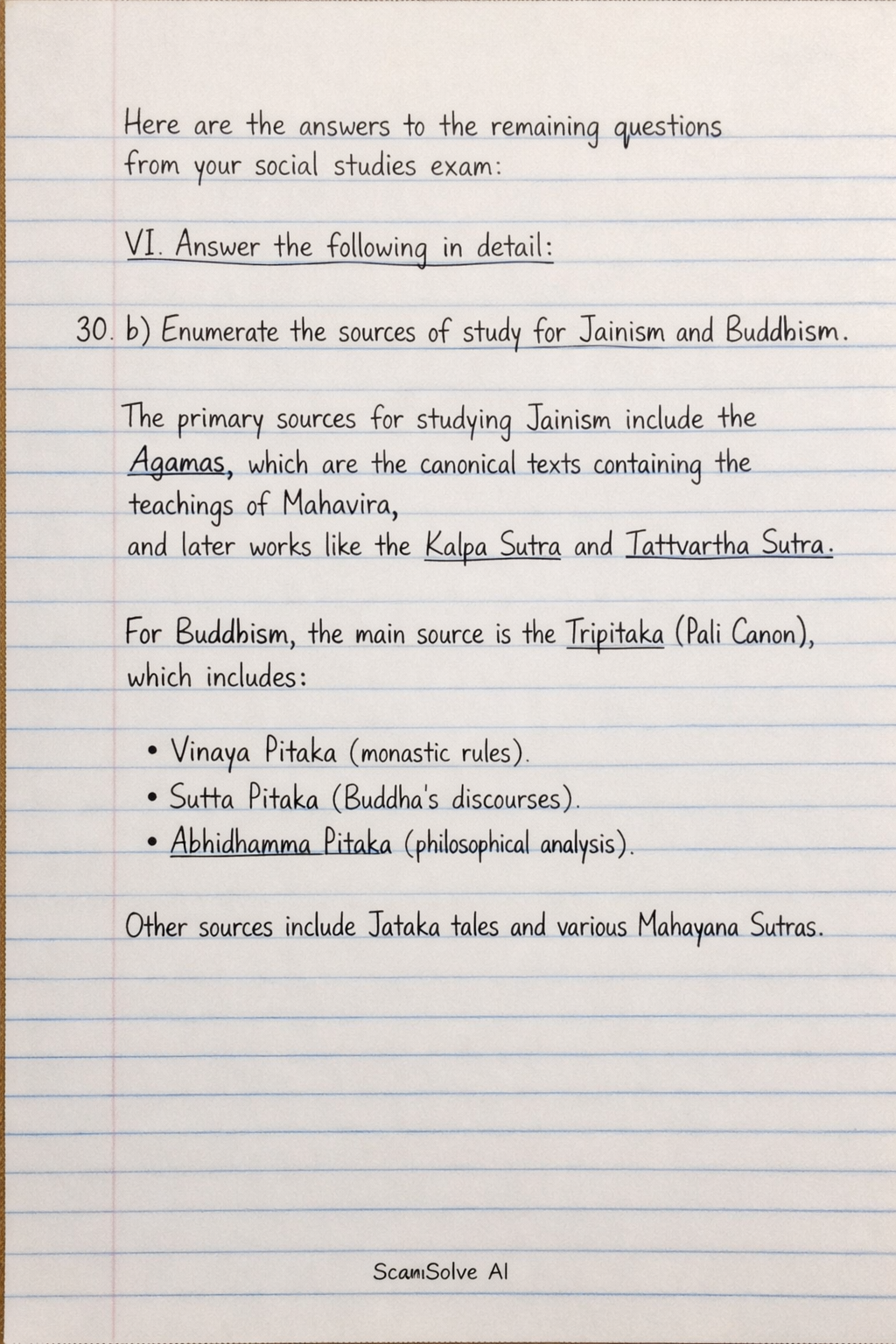
30. b) Enumerate the sources of study for Jainism and Buddhism.
The primary sources for studying Jainism include the Agamas, which are the canonical texts containing the teachings of Mahavira, and later works like the Kalpa Sutra and Tattvartha Sutra. For Buddhism, the main source is the Tripitaka (Pali Canon), comprising the Vinaya Pitaka (monastic rules), Sutta Pitaka (Buddha's discourses), and Abhidhamma Pitaka (philosophical analysis). Other sources include Jataka tales and various Mahayana Sutras.
31. b) Write about flood its effects and the mitigation.
A flood occurs when water overflows from rivers, lakes, or oceans, or accumulates from heavy rainfall, submerging land that is usually dry.
- Effects: Floods cause significant damage, including loss of human lives and livestock, destruction of homes and infrastructure, crop damage leading to food shortages, and the spread of waterborne diseases. They also disrupt economic activities and displace communities.
- Mitigation: Mitigation strategies include building dams, levees, and embankments to control water flow, implementing early warning systems, promoting afforestation to increase soil absorption, improving drainage systems, and enforcing land-use zoning to prevent construction in flood-prone areas.
32. b) Explain the direct and indirect tax with examples.
- Direct Tax: A direct tax is levied directly on an individual or organization, and the burden of the tax cannot be shifted to another person. The person who pays the tax is the one on whom it is imposed.
- Examples: Income tax, wealth tax, corporate tax.
- Indirect Tax: An indirect tax is levied on goods and services, and its burden can be shifted from the person who initially pays it to the final consumer. The tax is collected by an intermediary (like a retailer) and then paid to the government.
- Examples: Goods and Services Tax (GST), sales tax, customs duty.
Still stuck on this one?
Ask a follow-up, and the answer starts from this question.
More History Questions
Handwritten Step-by-Step Solution
Get this as a handwritten image on WhatsApp — like a tutor wrote it for you.
Try on WhatsApp