
Cameroon History The earliest known inhabitants of Cameroon were the: A. Fulani B. Baka (Pygmies) C. Bamileke D. Tikar The Portuguese explorer who reached the Cameroon coast in 1472 was: A. Vasco da Gama B. Ferdinand Magellan C. Fernão do Pó D. Bartholomew Diaz The name "Rio dos Camarões" was given because of: A. Palm oil trade B. Gold deposits C. Large quantities of prawns D. Slave markets The German annexation treaty with Douala chiefs was signed in: A. 1883 B. 1884 C. 1885 D. 1886 Which chief was not among the signatories of the 1884 treaty? A. King Bell B. King Akwa C. Chief Manga Williams D. King Njoya The first German Governor of Kamerun was: A. Jesko von Puttkamer B. Julius von Soden C. Gustav Nachtigal D. Theodor Seitz The major aim of the German policy of direct rule was to: A. Promote democracy B. Rule through traditional authorities only C. Exercise direct control over colonies D. Prepare colonies for independence The capital of German Kamerun was first located at: A. Yaounde B. Buea C. Douala D. Garoua The execution of Rudolf Duala Manga Bell took place in: A. 1905 B. 1910 C. 1914 D. 1916 During World War I, German Kamerun fell to: A. Britain alone B. France alone C. Britain and France D. Belgium The League of Nations Mandate system was established in: A. 1914 B. 1918 C. 1919 D. 1923 British Cameroons was administered as part of: A. Nigeria B. Ghana C. Sierra Leone D. Gambia The United Nations Trusteeship system replaced the Mandate system in: A. 1945 B. 1946 C. 1948 D. 1950 The UPC was founded in: A. 1945 B. 1948 C. 1952 D. 1955 The principal founder of the UPC was: A. Ahmadou Ahidjo B. Charles Assalé C. Ruben Um Nyobè D. John Ngu Foncha Ruben Um Nyobè was assassinated in: A. 1956 B. 1957 C. 1958 D. 1960 French Cameroon gained independence on: A. 1 January 1960 B. 11 February 1961 C. 1 October 1961 D. 20 May 1972 Southern Cameroons joined the Republic of Cameroon after the plebiscite of: A. 1959 B. 1960 C. 1961 D. 1962 The Federal Republic of Cameroon was established in: A. 1960 B. 1961 C. 1972 D. 1984 The unitary state was introduced following the: A. Foumban Conference B. Plebiscite C. Referendum of 1972 D. Tripartite Conference African History The ancient kingdom famous for gold and salt trade was: A. Mali B. Ghana C. Songhai D. Kanem-Bornu The capital of the Ghana Empire was: A. Timbuktu B. Gao C. Kumbi Saleh D. Jenne Mansa Musa became famous mainly because of: A. Military conquest B. Pilgrimage to Mecca C. Defeating Morocco D. Establishing Islam in Egypt The founder of the Songhai Empire was: A. Sunni Ali B. Askia Mohammed C. Sonni Baru D. Mansa Musa Which African kingdom was centered around Lake Chad? A. Benin B. Oyo C. Kanem-Bornu D. Mali The Mfecane in Southern Africa was associated with: A. Shaka Zulu B. Moshoeshoe C. Lobengula D. Cetshwayo The main purpose of the Berlin Conference was to: A. End slavery B. Divide Africa among European powers C. Promote Christianity D. Establish African unity The Berlin Conference took place between: A. 1870–1871 B. 1884–1885 C. 1890–1891 D. 1900–1901 The conference was convened by: A. Napoleon III B. Otto von Bismarck C. Kaiser Wilhelm II D. Cecil Rhodes Which principle was adopted at the Berlin Conference? A. Self-determination B. Effective occupation C. Pan-Africanism D. Non-alignment Samori Touré resisted French expansion in: A. Senegal B. Guinea region C. Algeria D. Egypt Menelik II is remembered for: A. Defeating Britain at Khartoum B. Defeating Italy at Adowa C. Conquering Egypt D. Defeating Germany in Tanganyika The Battle of Adowa occurred in: A. 1885 B. 1890 C. 1896 D. 1902 The Maji-Maji uprising occurred in: A. German East Africa B. British East Africa C. Belgian Congo D. French Equatorial Africa The main cause of the Maji-Maji revolt was: A. Forced cotton cultivation B. Taxation only C. Religious persecution D. Gold mining The first President of independent Ghana was: A. J.B. Danquah B. Kwame Nkrumah C. Nnamdi Azikiwe D. Julius Nyerere Ghana became independent in: A. 1956 B. 1957 C. 1960 D. 1961 The Mau Mau rebellion occurred in: A. Uganda B. Kenya C. Tanzania D. Zambia Apartheid was officially introduced in: A. South Africa B. Namibia C. Zimbabwe D. Botswana Nelson Mandela became President of South Africa in: A. 1990 B. 1992 C. 1994 D. 1996 Mixed Difficult Questions The Foumban Constitutional Conference was held in: A. 1959 B. 1960 C. 1961 D. 1962 Which territory voted to join Nigeria in the 1961 plebiscite? A. Southern Cameroons B. French Cameroon C. Northern Cameroons D. Adamawa The United Nations supervised the plebiscite because Cameroon was: A. A protectorate B. A colony C. A trust territory D. An independent state The Bamum kingdom reached its greatest development under: A. Sultan Ibrahim Njoya B. King Bell C. Fon Galega D. Chief Akwa Njoya is credited with inventing: A. Arabic writing B. Bamum script C. Swahili alphabet D. Fulani script Pan-Africanism primarily aimed at: A. European integration B. African unity and liberation C. Religious reform D. Military alliances The Organization of African Unity (OAU) was founded in: A. 1960 B. 1961 C. 1963 D. 1965 The OAU was transformed into the African Union in: A. 1999 B. 2000 C. 2001 D. 2002 Which African country was never formally colonized? A. Ethiopia B. Kenya C. Ghana D. Nigeria The most important long-term consequence of the Berlin Conference was: A. Spread of Islam B. Growth of local industries C. Partition and colonization of Africa D. End of nationalism
ScanSolve AI Answer
Answer
Baka (Pygmies)
Step-by-step solution
50 stepsCameroon History
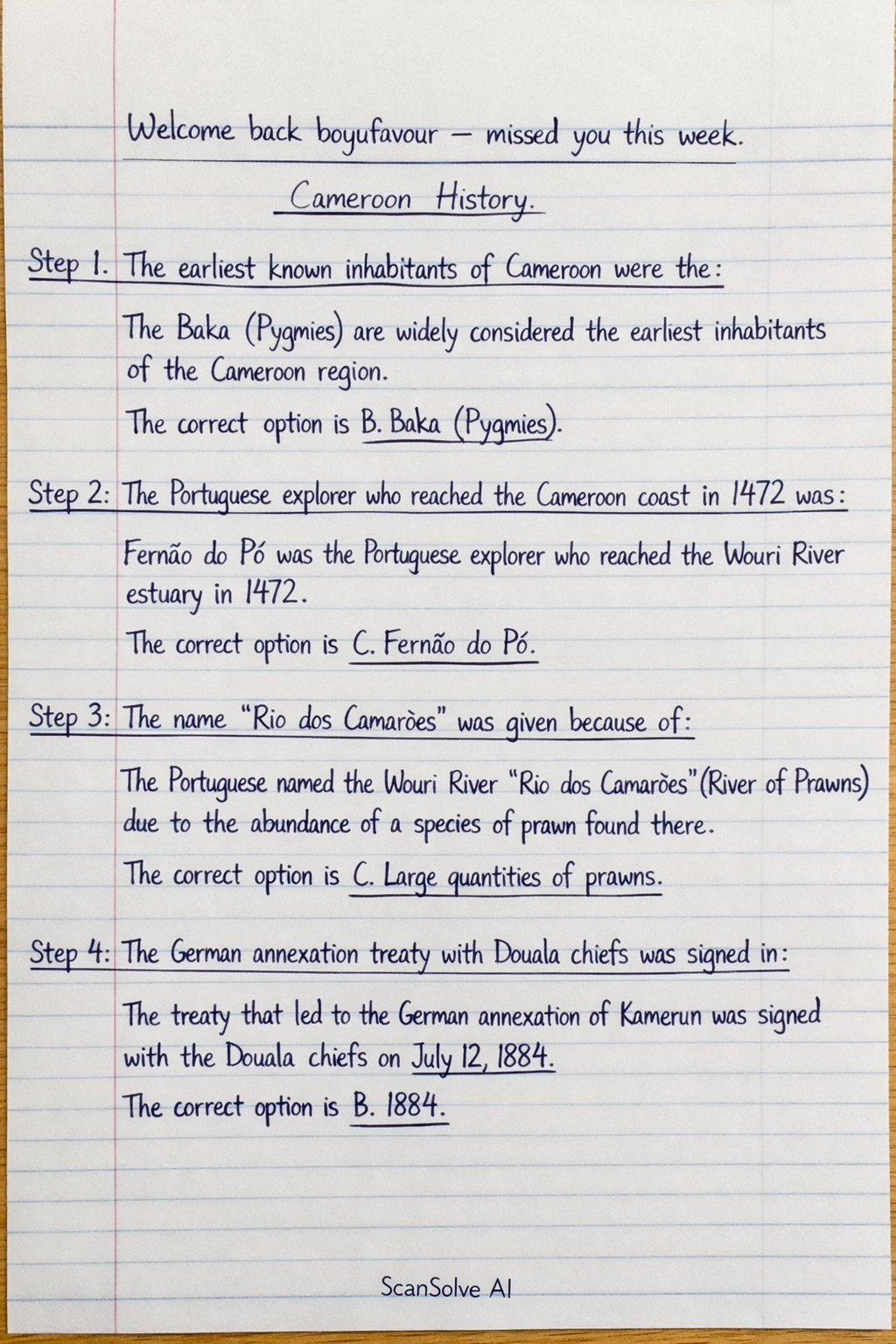
The earliest known inhabitants of Cameroon were the
The Baka (Pygmies) are widely considered the earliest inhabitants of the Cameroon region.
The correct option is B. Baka (Pygmies).The Portuguese explorer who reached the Cameroon coast in 1472 was
Fernão do Pó was the Portuguese explorer who reached the Wouri River estuary in 1472.
The correct option is C. Fernão do Pó.The name "Rio dos Camarões" was given because of
The Portuguese named the Wouri River "Rio dos Camarões" (River of Prawns) due to the abundance of a species of prawn found there.
The correct option is C. Large quantities of prawns.The German annexation treaty with Douala chiefs was signed in
The treaty that led to the German annexation of Kamerun was signed with the Douala chiefs on July 12, 1884.
The correct option is B. 1884.Which chief was not among the signatories of the 1884 treaty?
King Njoya was the Sultan of the Bamum Kingdom, located inland, and was not a signatory to the 1884 treaty with the coastal Douala chiefs. King Bell and King Akwa were prominent Douala chiefs who signed.
The correct option is D. King Njoya.The first German Governor of Kamerun was
Julius von Soden was appointed as the first Imperial Governor of Kamerun in 1885. Gustav Nachtigal was the Imperial Commissioner who signed the treaty.
The correct option is B. Julius von Soden.The major aim of the German policy of direct rule was to
Direct rule was a colonial administrative system where the colonial power directly controlled the administration of the colony, often by replacing traditional authorities or integrating them into the colonial structure, to exercise full control.
The correct option is C. Exercise direct control over colonies.The capital of German Kamerun was first located at
Douala (then known as Kamerunstadt) was the initial capital of German Kamerun before it was moved to Buea.
The correct option is C. Douala.The execution of Rudolf Duala Manga Bell took place in
Rudolf Duala Manga Bell, a Douala chief who resisted German land policies, was executed by the Germans in August 1914.
The correct option is C. 1914.During World War I, German Kamerun fell to
During World War I, German Kamerun was invaded and eventually conquered by Allied forces, primarily from Britain and France.
The correct option is C. Britain and France.The League of Nations Mandate system was established in
The League of Nations Mandate system was established after World War I, in 1919, to administer former German and Ottoman territories.
The correct option is C. 1919.British Cameroons was administered as part of
Following the partition of Kamerun, British Cameroons was administered as two separate parts (Northern and Southern Cameroons) as part of the British colony of Nigeria.
The correct option is A. Nigeria.The United Nations Trusteeship system replaced the Mandate system in
The United Nations Trusteeship system replaced the League of Nations Mandate system after World War II, in 1946.
The correct option is B. 1946.The UPC was founded in
The Union des Populations du Cameroun (UPC) was founded on April 10, 1948.
The correct option is B. 1948.The principal founder of the UPC was
Ruben Um Nyobè was the principal founder and leader of the Union des Populations du Cameroun (UPC).
The correct option is C. Ruben Um Nyobè.Ruben Um Nyobè was assassinated in
Ruben Um Nyobè was killed by French forces in the Sanaga-Maritime region on September 13, 1958.
The correct option is C. 1958.French Cameroon gained independence on
French Cameroon gained independence on January 1, 1960.
The correct option is A. 1 January 1960.Southern Cameroons joined the Republic of Cameroon after the plebiscite of
Southern Cameroons voted in a plebiscite to join the Republic of Cameroon in February 1961, with the unification taking effect on October 1, 1961.
The correct option is C. 1961.The Federal Republic of Cameroon was established in
The Federal Republic of Cameroon was established on October 1, 1961, following the unification of French Cameroon and Southern Cameroons.
The correct option is B. 1961.The unitary state was introduced following the
The Federal Republic of Cameroon was dissolved and replaced by a unitary state, the United Republic of Cameroon, after a referendum in 1972.
The correct option is C. Referendum of 1972.African History
The ancient kingdom famous for gold and salt trade was
The Ghana Empire, located in West Africa, was renowned for its control over the trans-Saharan gold and salt trade routes.
The correct option is B. Ghana.The capital of the Ghana Empire was
Kumbi Saleh was the capital city of the ancient Ghana Empire.
The correct option is C. Kumbi Saleh.Mansa Musa became famous mainly because of
Mansa Musa, the emperor of the Mali Empire, became widely known for his lavish pilgrimage to Mecca in 1324-1325, which showcased the immense wealth of his empire.
The correct option is B. Pilgrimage to Mecca.The founder of the Songhai Empire was
Sunni Ali is credited with founding the Songhai Empire in the 15th century.
The correct option is A. Sunni Ali.Which African kingdom was centered around Lake Chad?
The Kanem-Bornu Empire was a powerful kingdom located in the region around Lake Chad in Central Africa.
The correct option is C. Kanem-Bornu.The Mfecane in Southern Africa was associated with
The Mfecane (or Difaqane) was a period of widespread chaos and warfare among indigenous ethnic communities in Southern Africa during the early 19th century, largely associated with the rise of the Zulu kingdom under Shaka Zulu.
The correct option is A. Shaka Zulu.The main purpose of the Berlin Conference was to
The Berlin Conference (1884-1885) was convened by European powers to regulate European colonization and trade in Africa and to formally divide the continent among themselves.
The correct option is B. Divide Africa among European powers.The Berlin Conference took place between
The Berlin Conference was held from November 15, 1884, to February 26, 1885.
The correct option is B. 1884–1885.The conference was convened by
The Berlin Conference was convened by Otto von Bismarck, the first Chancellor of Germany.
The correct option is B. Otto von Bismarck.Which principle was adopted at the Berlin Conference?
The principle of "effective occupation" was adopted at the Berlin Conference, meaning that European powers had to demonstrate actual control over a territory to claim it, rather than just asserting a claim.
The correct option is B. Effective occupation.Samori Touré resisted French expansion in
Samori Touré was a West African Muslim cleric and military leader who established the Wassoulou Empire and fiercely resisted French colonial expansion in the Guinea region (present-day Guinea, Mali, Côte d'Ivoire).
The correct option is B. Guinea region.Menelik II is remembered for
Emperor Menelik II of Ethiopia is famously remembered for leading the Ethiopian forces to a decisive victory over the invading Italian army at the Battle of Adowa.
The correct option is B. Defeating Italy at Adowa.The Battle of Adowa occurred in
The Battle of Adowa took place on March 1, 1896.
The correct option is C. 1896.The Maji-Maji uprising occurred in
The Maji-Maji Rebellion was an armed uprising against German colonial rule in German East Africa (present-day Tanzania).
The correct option is A. German East Africa.The main cause of the Maji-Maji revolt was
The primary cause of the Maji-Maji revolt was the German colonial policy of forced cotton cultivation, which disrupted traditional farming practices and imposed heavy labor demands, alongside other grievances like taxation.
The correct option is A. Forced cotton cultivation.The first President of independent Ghana was
Kwame Nkrumah led Ghana to independence and became its first President.
The correct option is B. Kwame Nkrumah.Ghana became independent in
Ghana gained independence from British rule on March 6, 1957.
The correct option is B. 1957.The Mau Mau rebellion occurred in
The Mau Mau Uprising was a Kikuyu-led insurgency against British colonial rule in Kenya during the 1950s.
The correct option is B. Kenya.Apartheid was officially introduced in
Apartheid, a system of institutionalized racial segregation and discrimination, was officially introduced in South Africa in 1948.
The correct option is A. South Africa.Nelson Mandela became President of South Africa in
Nelson Mandela became the first democratically elected President of South Africa on May 10, 1994, after the end of apartheid.
The correct option is C. 1994.Mixed Difficult Questions
The Foumban Constitutional Conference was held in
The Foumban Constitutional Conference, which discussed the terms of the federation between French Cameroon and Southern Cameroons, was held in July 1961.
The correct option is C. 1961.Which territory voted to join Nigeria in the 1961 plebiscite?
In the 1961 plebiscite, Northern Cameroons voted to join Nigeria, while Southern Cameroons voted to join the Republic of Cameroon.
The correct option is C. Northern Cameroons.The United Nations supervised the plebiscite because Cameroon was
The United Nations supervised the plebiscite in British Cameroons because it was a UN Trust Territory, meaning it was administered by a colonial power under UN oversight with the goal of eventual self-determination.
The correct option is C. A trust territory.The Bamum kingdom reached its greatest development under
The Bamum kingdom reached its peak under the reign of Sultan Ibrahim Njoya, who was known for his administrative reforms, cultural innovations, and the invention of the Bamum script.
The correct option is A. Sultan Ibrahim Njoya.Njoya is credited with inventing
Sultan Ibrahim Njoya of the Bamum kingdom is famously credited with inventing the Bamum script (Shü-Mom) for writing the Bamum language.
The correct option is B. Bamum script.Pan-Africanism primarily aimed at
Pan-Africanism is an ideology and movement that encourages the solidarity of Africans worldwide, aiming for the political unification and liberation of Africa.
The correct option is B. African unity and liberation.The Organization of African Unity (OAU) was founded in
The Organization of African Unity (OAU) was founded on May 25, 1963, in Addis Ababa, Ethiopia.
The correct option is C. 1963.The OAU was transformed into the African Union in
The Organization of African Unity (OAU) was transformed into the African Union (AU) in 2002.
The correct option is D. 2002.Which African country was never formally colonized?
Ethiopia (Abyssinia) is unique among African nations for largely maintaining its independence throughout the Scramble for Africa, except for a brief Italian occupation during World War II.
The correct option is A. Ethiopia.The most important long-term consequence of the Berlin Conference was
The most significant long-term consequence of the Berlin Conference was the formal partition and subsequent colonization of almost the entire African continent by European powers, leading to artificial borders and lasting political and economic impacts.
The correct option is C. Partition and colonization of Africa.
Try one yourself
A new problem that tests the same skill.
Still stuck on this one?
Ask a follow-up, and the answer starts from this question.
More History Questions
Handwritten Step-by-Step Solution
Get this as a handwritten image on WhatsApp — like a tutor wrote it for you.
Try on WhatsApp