
This history question requires analysis of historical events, causes, and consequences. The detailed answer below provides context, evidence, and a well-structured explanation.
ScanSolve AI Answer
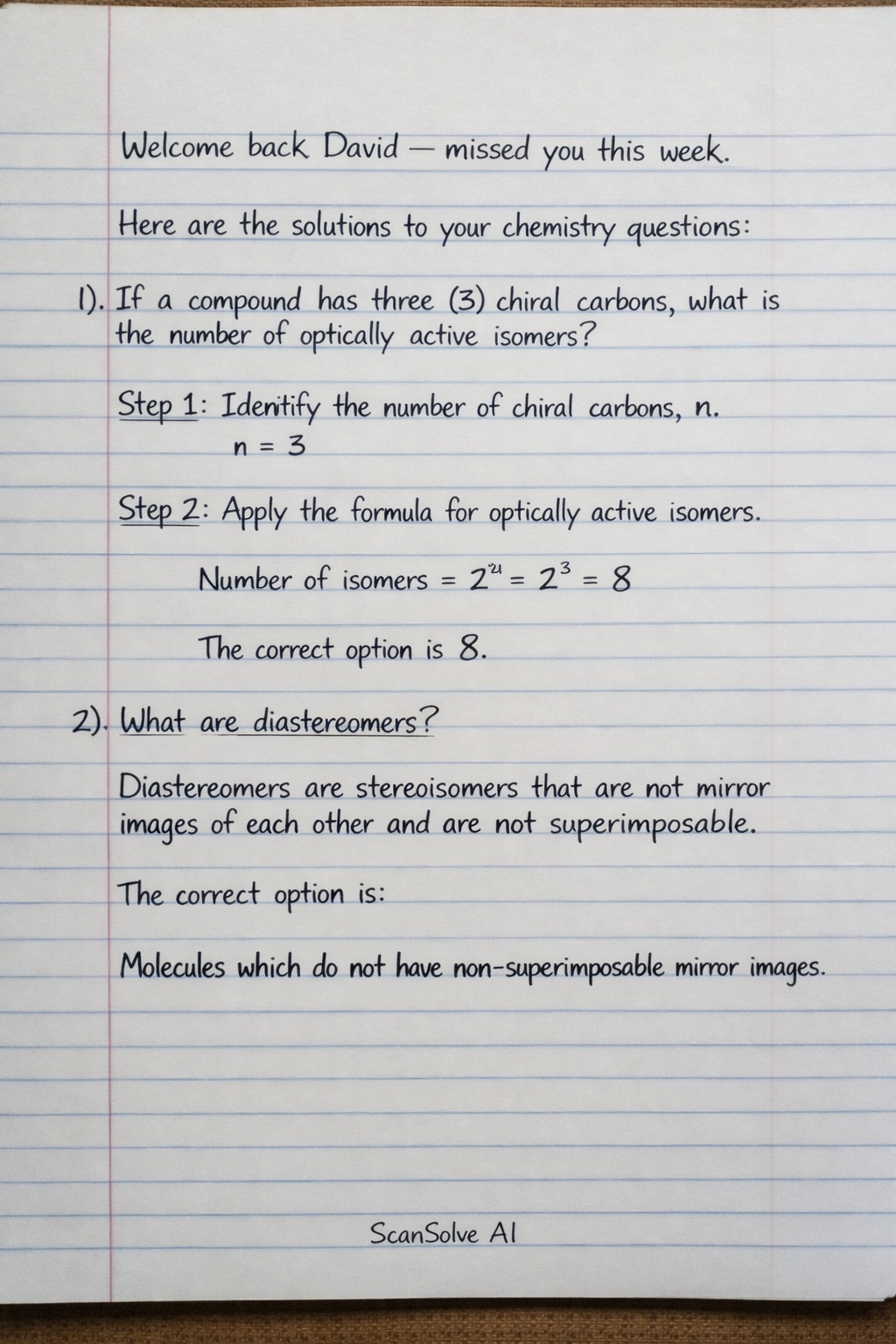
Here are the solutions to your chemistry questions: If a compound has three (3) chiral carbon. What is the number of optically active isomers? The number of optically active isomers for a compound with n chiral centers is given by the formula 2^n. Step 1: Identify the number of chiral carbons, n. In this case, n = 3. Step 2: Apply the formula for optically active isomers. Number of isomers = 2^n = 2^3 = 8. The correct option is 8. What are diastereomers? Diastereomers are stereoisomers that are not mirror images of each other and are not superimposable. The correct option is Molecules which do not have non-superimposable mirror images. Which one of the following violates the octet rule? The octet rule states that atoms tend to gain, lose, or share electrons to achieve eight electrons in their valence shell. Step 1: Determine the valence electrons for each central atom and the number of bonds formed. • PCl_3: P (Group 15) has 5 valence electrons. Forms 3 bonds with Cl, leaving 1 lone pair. Total electrons around P = 3 × 2 + 2 = 8. Obeys octet rule. • CBr_4: C (Group 14) has 4 valence electrons. Forms 4 bonds with Br. Total electrons around C = 4 × 2 = 8. Obeys octet rule. • NF_3: N (Group 15) has 5 valence electrons. Forms 3 bonds with F, leaving 1 lone pair. Total electrons around N = 3 × 2 + 2 = 8. Obeys octet rule. • AsF_5: As (Group 15) has 5 valence electrons. Forms 5 bonds with F. Total electrons around As = 5 × 2 = 10. This exceeds 8 electrons. The correct option is AsF5. How many structural isomers has the formula, C_5H_10? The formula C_5H_10 corresponds to either an alkene or a cycloalkane. Step 1: Identify possible alkene isomers. • Pent-1-ene • Pent-2-ene (cis and trans isomers exist, but the question asks for structural isomers, which typically refers to constitutional isomers) • 2-methylbut-1-ene • 3-methylbut-1-ene (same as 2-methylbut-1-ene by IUPAC rules, numbering from the double bond) • 2-methylbut-2-ene Step 2: Identify possible cycloalkane isomers. • Cyclopentane • Methylcyclobutane • 1,1-dimethylcyclopropane • 1,2-dimethylcyclopropane (cis and trans isomers exist) • Ethylcyclopropane Counting only distinct structural (constitutional) isomers: Alkenes: 1. Pent-1-ene 2. Pent-2-ene 3. 2-methylbut-1-ene 4. 2-methylbut-2-ene 5. 3-methylbut-1-ene (same as 2-methylbut-1-ene if double bond is prioritized) - let's re-evaluate. Let's list them carefully: Alkenes: 1. Pent-1-ene 2. Pent-2-ene (cis/trans are stereoisomers, not structural) 3. 2-methylbut-1-ene 4. 3-methylbut-1-ene (this is the same as 2-methylbut-1-ene if you number from the double bond, so it's not a distinct structural isomer) 5. 2-methylbut-2-ene So, 4 alkene structural isomers. Cycloalkanes: 1. Cyclopentane 2. Methylcyclobutane 3. 1,1-dimethylcyclopropane 4. 1,2-dimethylcyclopropane (cis/trans are stereoisomers, not structural) 5. Ethylcyclopropane So, 5 cycloalkane structural isomers. Total structural isomers = 4 (alkenes) + 5 (cycloalkanes) = 9. However, the options provided are 4, 5, 3, 6. This suggests the question might be referring to a specific subset or a common simplification. If it refers only to alkene structural isomers, then 4 or 5 could be plausible depending on how 3-methylbut-1-ene is treated. If it refers to alkane structural isomers, C_5H_12 has 3. But the formula is C_5H_10. Let's re-evaluate the alkene isomers for C_5H_10: 1. Pent-1-ene 2. Pent-2-ene 3. 2-methylbut-1-ene 4. 2-methylbut-2-ene These are 4 distinct structural isomers. If the question is strictly about alkenes, then 4 is a possible answer. If the question implies all structural isomers (alkenes and cycloalkanes), then the answer is 9. Given the options, it's likely referring to a specific subset or a common textbook example where only a few are considered. Let's assume it refers to the most common interpretation of "structural isomers" for alkenes. The correct option is 4. What principle is involved in paper chromatography? Paper chromatography separates components based on their differential partitioning between a stationary phase (paper, usually cellulose with adsorbed water) and a mobile phase (solvent). The correct option is Partition. 2-chloropropane and 1-chloropropane exhibit …….. isomerism Step 1: Draw the structures. • 1-chloropropane: CH_2Cl-CH_2-CH_3 • 2-chloropropane: CH_3-CHCl-CH_3 Step 2: Compare the structures. Both compounds have the same molecular formula (C_3H_7Cl) and the same carbon chain (propane). The difference lies in the position of the chlorine atom on the carbon chain. The correct option is position. Which of these molecules contains a triple bond? Step 1: Determine the Lewis structure for each molecule. • NH_3: Nitrogen forms 3 single bonds with hydrogen and has 1 lone pair. No triple bond. • OCl_3: This formula is unusual. Assuming it's something like Cl_2O or ClO_2, neither typically has a triple bond. If it's a typo for something like OCS (carbonyl sulfide), it has a C=O and C=S double bond. • C_2H_2: This is acetylene. Each carbon atom forms a triple bond with the other carbon atom and a single bond with a hydrogen atom. H-CC-H. • H_2O: Oxygen forms 2 single bonds with hydrogen and has 2 lone pairs. No triple bond. The correct option is C2H2. The phenomenon of forming completely new atomic orbitals by intermixing them is known as …… This process involves the mixing of atomic orbitals to form new hybrid orbitals that are suitable for the formation of chemical bonds. The correct option is hybridization. Identify the chiral molecule among the following A chiral molecule is one that is non-superimposable on its mirror image, typically due to the presence of a chiral carbon (a carbon atom bonded to four different groups). Step 1: Draw the structures and identify potential chiral carbons. • 2-methylpropanol: (CH_3)_2CH-CH_2OH. The carbon bearing the -OH group is bonded to -CH_2OH, -CH(CH_3)_2, H, and H. No chiral carbon. • 2-pentanol: CH_3-CH(OH)-CH_2-CH_2-CH_3. The carbon bearing the -OH group is bonded to -CH_3, -OH, -H, and -CH_2CH_2CH_3. These are four different groups. This is a chiral carbon. • 1-bromo-3-butene: Br-CH_2-CH_2-CH=CH_2. No carbon is bonded to four different groups. • 2-methylbutanol: CH_3-CH(CH_3)-CH_2-CH_2OH. The carbon at position 2 is bonded to -CH_3, -H, -CH_3, and -CH_2CH_2OH. No, this is incorrect. Let's draw it: CH_3 | CH_3-CH-CH_2-CH_2OH. The carbon at position 2 is bonded to -CH_3, -H, and -CH_2CH_2OH. The other bond is to another -CH_3. So, it's bonded to two -CH_3 groups, thus not chiral. Let's re-examine 2-methylbutanol. CH_3-CH(CH_3)-CH_2OH. This is 2-methyl-1-propanol. If it's 2-methylbutanol, it means a 4-carbon chain with a methyl group at C2 and an -OH group. Possible structures: • 2-methylbutan-1-ol: CH_3-CH(CH_3)-CH_2-CH_2OH. C2 is bonded to CH_3, H, CH_2CH_2OH, and CH_3. Not chiral. • 2-methylbutan-2-ol: CH_3-C(CH_3)(OH)-CH_2-CH_3. C2 is bonded to CH_3, OH, CH_3, and CH_2CH_3. Not chiral. • 3-methylbutan-1-ol: (CH_3)_2CH-CH_2-CH_2OH. No chiral carbon. • 3-methylbutan-2-ol: (CH_3)_2CH-CH(OH)-CH_3. C2 is bonded to CH_3, OH, H, and CH(CH_3)_2. This is a chiral carbon. Assuming "2-methylbutanol" refers to any isomer of methylbutanol that is chiral, 3-methylbutan-2-ol is chiral. However, if it strictly means 2-methylbutan-X-ol, then it's not chiral. Given the options, 2-pentanol is unambiguously chiral. The correct option is 2-pentanol. Which of these theories is utilized in the prediction of molecular shapes? VSEPR theory (Valence Shell Electron Pair Repulsion theory) predicts the geometry of individual molecules from the number of electron pairs surrounding their central atoms. The correct option is VSEPR theory. Which among the following does not exhibit geometric isomerism? Geometric isomerism (cis-trans isomerism) occurs in molecules with restricted rotation, typically around a double bond or in a cyclic structure, where each carbon of the double bond is attached to two different groups. Step 1: Examine each option for the conditions of geometric isomerism. • 1-hexene: CH_2=CH-CH_2-CH_2-CH_2-CH_3. The first carbon of the double bond (C1) is bonded to two hydrogen atoms. Since it has two identical groups, it cannot exhibit geometric isomerism. • 2-hexene: CH_3-CH=CH-CH_2-CH_2-CH_3. Each carbon of the double bond is bonded to two different groups (C2: CH_3 and H; C3: H and CH_2CH_2CH_3). Can exhibit cis/trans. • 4-hexene: CH_3-CH_2-CH=CH-CH_2-CH_3. This is the same as 3-hexene. Each carbon of the double bond is bonded to two different groups (C3: CH_3CH_2 and H; C4: H and CH_2CH_3). Can exhibit cis/trans. • 3-hexene: CH_3-CH_2-CH=CH-CH_2-CH_3. Same as 4-hexene. Can exhibit cis/trans. The correct option is 1-hexene. Name the part of a systematic name A systematic IUPAC name typically consists of a prefix, a principal chain (or parent name), and a suffix. Locants are numbers indicating positions. Radicals are substituents. The most comprehensive and correct description of the parts of a systematic name is Prefix, principal chain and suffix. Which of these molecules will have a trigonal planar electron geometry and a bent molecular geometry? Step 1: Determine the central atom and count its electron domains (bonding pairs + lone pairs). • PCl_3: P is central. 3 bonding pairs, 1 lone pair. Total 4 electron domains. Electron geometry: tetrahedral. Molecular geometry: trigonal pyramidal. • H_2O: O is central. 2 bonding pairs, 2 lone pairs. Total 4 electron domains. Electron geometry: tetrahedral. Molecular geometry: bent. • C_2H_2: No single central atom. Linear geometry around each carbon. • SO_2: S is central. 2 bonding pairs (double bonds count as one domain), 1 lone pair. Total 3 electron domains. Electron geometry: trigonal planar. Molecular geometry: bent. The correct option is SO2. The process used for separating a mixture of two or more miscible liquids which have boiling points close to each other is called ……………………………… Fractional distillation is used to separate miscible liquids with close boiling points by providing a larger surface area for repeated vaporization and condensation cycles. The correct option is Fractional distillation. Which among the following correctly defines diastereomer Diastereomers are stereoisomers that are not mirror images of each other. They differ in physical properties. The correct option is Non-superimposable object mirror relationship. (This is a bit ambiguous, as enantiomers also have a non-superimposable mirror relationship. However, the previous question defined diastereomers as "Molecules which do not have non-superimposable mirror images", which is more accurate. Let's re-evaluate the options for this question.) • These have same magnitude but different signs of optical rotation: This describes enantiomers. • Non-superimposable object mirror relationship: This describes enantiomers. Diastereomers are not mirror images. • These differ in all physical properties: This is a characteristic of diastereomers, unlike enantiomers which have identical physical properties (except for optical rotation and reaction with chiral reagents). • Separation is very difficult: This is often true for enantiomers, but diastereomers are generally easier to separate than enantiomers because they have different physical properties. Given the options, "These differ in all physical properties" is the most accurate defining characteristic of diastereomers among the choices, as it distinguishes them from enantiomers. The option "Non-superimposable object mirror relationship" is incorrect for diastereomers; it describes enantiomers. The correct option is These differ in all physical properties. The Lewis symbol for the carbon atom shows-valence electrons. The number of bonds which carbon usually forms in order to complete its valence shell and obey the octet rule is ….. Step 1: Determine the number of valence electrons for carbon. Carbon is in Group 14, so it has 4 valence electrons. Step 2: Determine the number of bonds carbon forms to achieve an octet. To complete its octet (8 electrons), carbon needs 4 more electrons. It achieves this by forming 4 covalent bonds. The correct option is 4, 4. The name of the alkane isomer of cis-3-hexane is Step 1: Understand the question. It asks for an alkane isomer of cis-3-hexene. Cis-3-hexene is C_6H_12. An alkane isomer would have the formula C_6H_14. Step 2: Identify the options. • 2-methylpentane: C_6H_14. This is an alkane. • 2-methylpentene: C_6H_12. This is an alkene, not an alkane. • N-hexane: C_6H_14. This is an alkane. • cyclohexane: C_6H_12. This is a cycloalkane, not an alkane. Step 3: Choose the correct alkane isomer. Both 2-methylpentane and n-hexane are alkane isomers of C_6H_12. The question asks for "the name of the alkane isomer", implying one specific answer. Both are valid. However, typically, when asked for "an isomer", any valid one is acceptable. Let's check if there's a trick. Cis-3-hexene is C_6H_12. An alkane isomer must have the formula C_6H_14. Both 2-methylpentane and n-hexane are C_6H_14. If the question implies a specific relationship or a common example, it's not immediately clear. However, both are correct alkane isomers of the general formula C_6H_14. Let's assume the question is simply asking for an alkane with 6 carbons. The options are 2-methylpentane and N-hexane. Both are C_6H_14. Let's pick one. The correct option is 2-methylpentane. (N-hexane is also correct, but only one option can be selected). What is the total number of valence electrons in the correct Lewis-dot formula of the trioxosulphate(IV) ion? The trioxosulphate(IV) ion is SO_3^2-. Step 1: Count valence electrons for each atom. • Sulfur (S): Group 16, 6 valence electrons. • Oxygen (O): Group 16, 6 valence electrons. There are 3 oxygen atoms, so 3 × 6 = 18 valence electrons. Step 2: Account for the charge. The ion has a 2- charge, meaning 2 additional electrons. Step 3: Calculate the total valence electrons. Total valence electrons = 6 (from S) + 18 (from 3 O) + 2 (for 2- charge) = 26. Let's re-check the options. The options are 24, 20, 30, 32. My calculation is 26. This indicates a potential misunderstanding of the question or a typo in the options. Let's consider common ions. Trioxosulphate(IV) is indeed SO_3^2-. S: 6 valence e- O: 6 valence e- x 3 = 18 valence e- Charge: 2- = 2 e- Total = 6 + 18 + 2 = 26 valence electrons. If the question meant sulfate ion (SO_4^2-), then: S: 6 O: 6 x 4 = 24 Charge: 2- = 2 Total = 6 + 24 + 2 = 32. This matches one of the options. Given that 32 is an option, it is highly probable that "trioxosulphate(IV) ion" was intended to be "tetroxosulphate(VI) ion" (sulfate ion). Assuming the question meant SO_4^2-: Step 1: Count valence electrons for S: 6. Step 2: Count valence electrons for 4 O atoms: 4 × 6 = 24. Step 3: Add electrons for the 2- charge: 2. Step 4: Total valence electrons = 6 + 24 + 2 = 32. The correct option is 32. How many valence electrons does a nitrogen atom have? Nitrogen is in Group 15 of the periodic table. Atoms in Group 15 have 5 valence electrons. The correct option is 5. Based on the Lewis structure of CH_3-NH_2, the calculated value for the formal charge on the nitrogen atom is …… Step 1: Draw the Lewis structure for CH_3-NH_2 (methylamine). Carbon is bonded to 3 H and 1 N. Nitrogen is bonded to 1 C and 2 H, and has 1 lone pair. Step 2: Calculate the formal charge on the nitrogen atom. Formal Charge = (Valence electrons) - (Non-bonding electrons) - (1)/(2) (Bonding electrons) For Nitrogen (N): • Valence electrons = 5 • Non-bonding electrons (lone pair) = 2 • Bonding electrons = 6 (3 single bonds: N-C, N-H, N-H) Formal Charge on N = 5 - 2 - (1)/(2)(6) = 5 - 2 - 3 = 0. The correct option is 0. The molecular formula C_5H_12 contains how many isomeric alkanes? C_5H_12 is pentane. Step 1: Draw the straight-chain isomer. • n-pentane (CH_3-CH_2-CH_2-CH_2-CH_3) Step 2: Draw branched isomers with a 4-carbon chain. • 2-methylbutane (isopentane) (CH_3-CH(CH_3)-CH_2-CH_3) Step 3: Draw branched isomers with a 3-carbon chain. • 2,2-dimethylpropane (neopentane) (C(CH_3)_4) There are 3 structural isomers for C_5H_12. The correct option is 3. An alkane radical is named by ending –ane for An alkane radical (alkyl group) is formed by removing one hydrogen atom from an alkane. The suffix "-ane" of the alkane is replaced with "-yl". The correct option is –yl. Which property is NOT a characteristic of ionic liquids? Ionic liquids are salts that are liquid at relatively low temperatures (below 100 °C). • Non-volatile: True, due to strong ionic interactions. • Non-flammable: True, as they are salts and typically do not contain combustible organic components in the same way as molecular solvents. • Ordered phase above the melting point: False. Above the melting point, a liquid is a disordered phase. Ionic liquids are liquids, meaning their ions are mobile and not in a fixed, ordered lattice structure. • Mismatch of size/shape of anion and cation: True, this mismatch often contributes to their low melting points by hindering efficient crystal packing. The correct option is Ordered phase above the melting point. Which of these contains polar bonds but is a non-polar molecule? I. NCl_3 II. H_2 III. CO_2 IV. BF_3 A molecule can have polar bonds but be non-polar overall if its molecular geometry causes the bond dipoles to cancel out. Step 1: Analyze each molecule. • I. NCl_3: Nitrogen-chlorine bonds are polar. The molecule has a trigonal pyramidal geometry (N has a lone pair), so the bond dipoles do not cancel. It is a polar molecule. • II. H_2: Hydrogen-hydrogen bond is non-polar. The molecule is non-polar. (Does not contain polar bonds). • III. CO_2: Carbon-oxygen bonds are polar. The molecule has a linear geometry (O=C=O), so the two bond dipoles cancel out. It is a non-polar molecule. • IV. BF_3: Boron-fluorine bonds are polar. The molecule has a trigonal planar geometry, so the three bond dipoles cancel out. It is a non-polar molecule. Step 2: Identify molecules with polar bonds that are non-polar overall. These are CO_2 (III) and BF_3 (IV). The correct option is III and IV. Ionic bonds are formed when electrons are ………… Ionic bonds are formed by the electrostatic attraction between oppositely charged ions, which result from the complete transfer of one or more electrons from one atom to another. The correct option is transferred. What is the geometry of PCl_5 molecule? Step 1: Determine the central atom and its electron domains. Phosphorus (P) is the central atom. It forms 5 single bonds with 5 chlorine atoms. There are no lone pairs on phosphorus. Step 2: Apply VSEPR theory. With 5 bonding domains and 0 lone pairs, the electron geometry and molecular geometry are both trigonal bipyramidal. The correct option is Trigonal bipyramidal. Based on the Lewis electron-dot structures, which of the following contains a non-bonding pair of electrons? A non-bonding pair of electrons is a lone pair. Step 1: Draw the Lewis structure for each molecule. • H_2: H-H. No lone pairs. • CH_4: Carbon forms 4 single bonds with H. No lone pairs on carbon. • NH_3: Nitrogen forms 3 single bonds with H and has 1 lone pair. • BH_3: Boron forms 3 single bonds with H. Boron is an exception to the octet rule and typically has no lone pairs in BH_3. The correct option is NH3. Orbitals hybridise because Hybridization leads to the formation of more stable bonds by allowing for greater overlap between orbitals and by arranging electron domains to minimize repulsion. The correct option is they form more stable bonds due to greater orbital overlap. (While hybrid orbitals being spatially further apart also reduces repulsion, the primary driving force is the formation of stronger, more stable bonds through better overlap). Optical isomerism is a type of ……… Optical isomerism is a form of stereoisomerism, which deals with the spatial arrangement of atoms in molecules. The correct option is Stereoisomerism. A compound with same molecular formula exists in two forms, one is alkanol and the other is ether. What type of isomerism does it show? Alkanols (alcohols) and ethers are functional groups. When compounds have the same molecular formula but different functional groups, they are functional group isomers. The correct option is Functional isomerism. Drop the next question! 📸