
We read your photo as:
Complete the following fill-in-the-blanks and true/false questions about ancient Indian history:
History
ScanSolve AI Answer
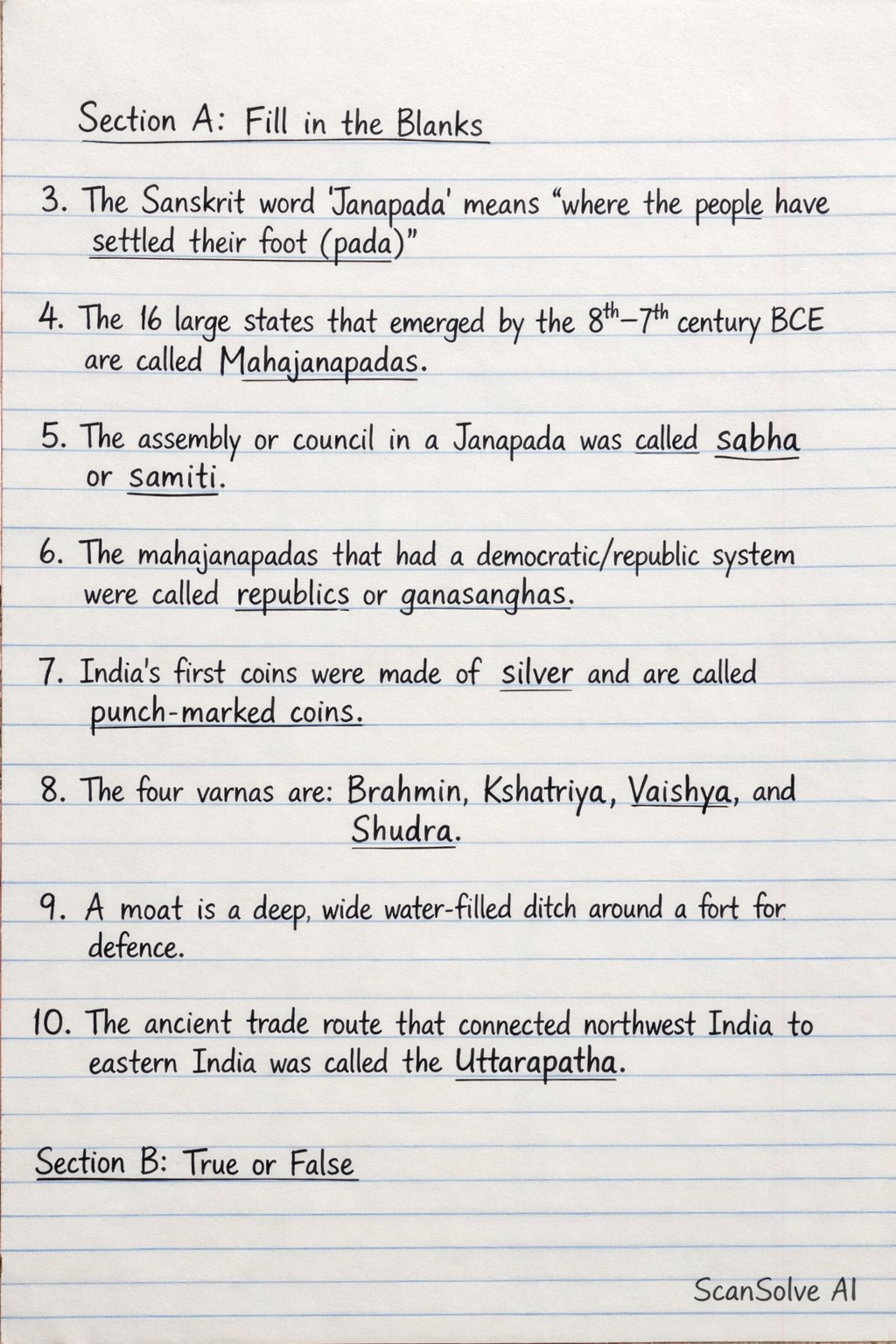
Section A: Fill in the Blanks
- The Sanskrit word 'Janapada' means 'where the people have settled their foot (pada)'.
- The 16 large states that emerged by the 8th–7th century BCE are called Mahajanapadas.
- The assembly or council in a Janapada was called sabha or samiti.
- The mahajanapadas that had a democratic/republic system were called republics or ganasanghas.
- India's first coins were made of silver and are called punch-marked coins.
- The four varnas are: Brahmin, Kshatriya, Vaishya, and Shudra.
- A moat is a deep, wide water-filled ditch around a fort for defence.
- The ancient trade route that connected northwest India to eastern India was called the Uttarapatha.
Section B: True or False
- The Harappan civilisation collapsed around the early 2nd millennium BCE. TRUE
- India had no urban life for about 500 years after the Harappan collapse. TRUE
- The Second Urbanisation began in the Deccan plateau region. FALSE
- Vajji and Malla were early republics where the assembly chose the ruler. TRUE
- The mahajanapada of Magadha was located in what is today Bihar. TRUE
- Iron tools and weapons were used during the Harappan civilisation. FALSE
- The first Indian coins were made of gold. FALSE
- The word 'caste' comes from the Portuguese word 'casta'. TRUE
- In early periods, the varna-jati system was more flexible than later. TRUE
- Most ancient mahajanapada capitals are no longer existing cities today. FALSE
Section C: Match the Columns
- Uttarapatha - d. Trade route: NW India to east India
- Brahmin - f. Varna that preserves knowledge
- Vajji - g. Early republic mahajanapada
- Punch-marked coins - c. Silver coins with punched symbols
- Dakshinapatha - h. Trade route from Kaushambi to south India
- Kshatriya - e. Varna that defends the society
- Moat - b. Water ditch around a fort
- Janapada - a. Territory settled by a clan
Section D: Short Answer Questions
- What is the difference between a Janapada and a Mahajanapada? A Janapada was an early territorial unit or clan settlement, often led by a Raja with an assembly. A Mahajanapada was a larger, more powerful state formed by the amalgamation of several smaller Janapadas, emerging around the 8th-7th century BCE.
Was this helpful?
Still stuck on this one?
Ask a follow-up, and the answer starts from this question.
Got a different question?Ask your own question
More History Questions
QFill in the blanks and write True/False based on the provided text about India's geography.QA student's homework assignment with fill-in-the-blanks, diagram completion, one-sentence answers…QAnswer the following questions in brief, fill in the blanks, and state whether the statements are…QAnswer the following True or False statements:QWhat are the answers to the following fill-in-the-blanks and multiple-choice questions about the…
Browse by topic:World History
Handwritten Step-by-Step Solution
Get this as a handwritten image on WhatsApp — like a tutor wrote it for you.
Try on WhatsApp