
We read your photo as:
Create a research project outline on the United Democratic Front (UDF) and its role in opposing apartheid in the 1980s.
ScanSolve AI Answer
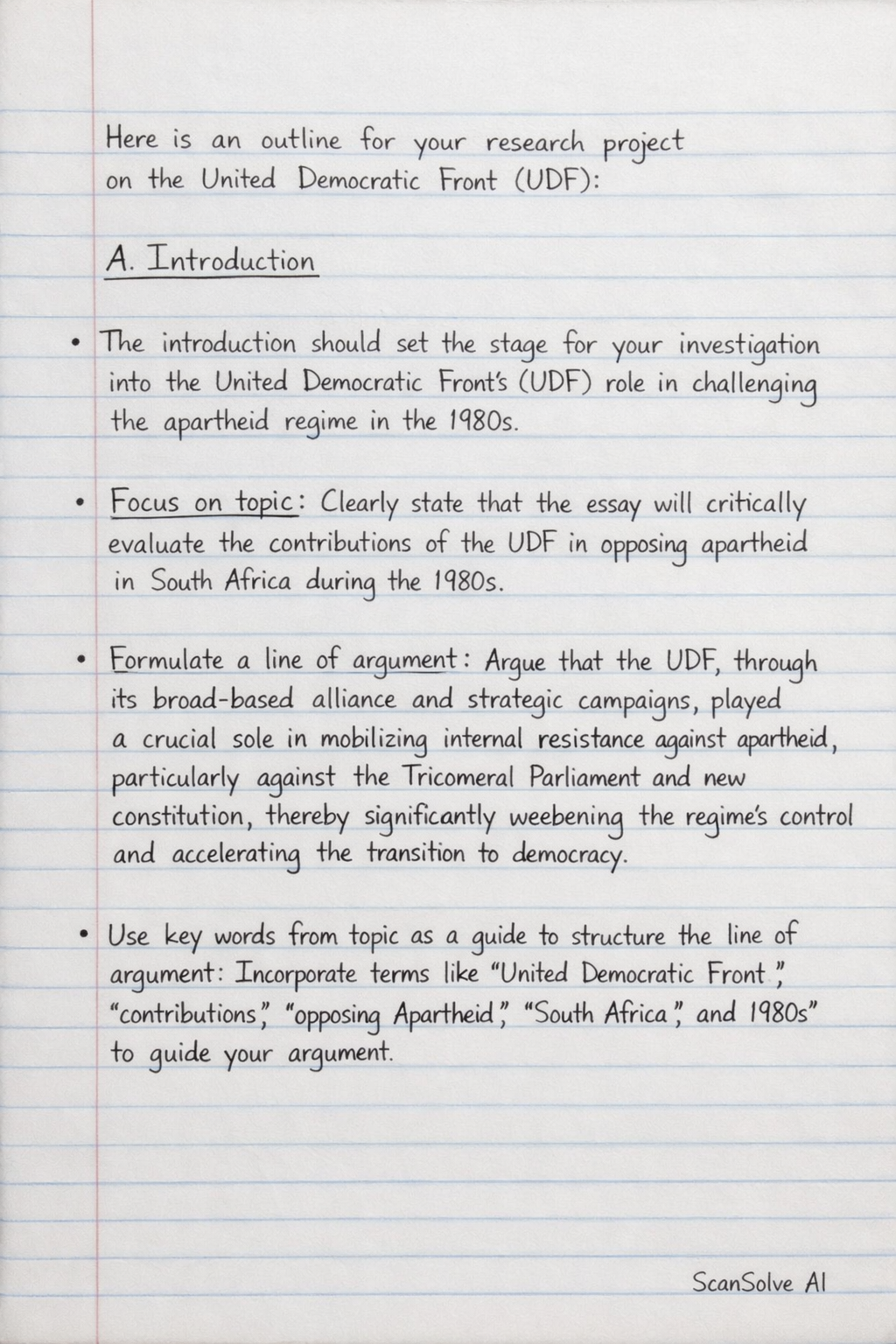
Here is an outline for your research project on the United Democratic Front (UDF):
A. Introduction
The introduction should set the stage for your investigation into the United Democratic Front's (UDF) role in challenging the apartheid regime in the 1980s.
- Focus on topic: Clearly state that the essay will critically evaluate the contributions of the UDF in opposing apartheid in South Africa during the 1980s.
- Formulate a line of argument: Argue that the UDF, through its broad-based alliance and strategic campaigns, played a crucial role in mobilizing internal resistance against apartheid, particularly against the Tricameral Parliament and new constitution, thereby significantly weakening the regime's control and accelerating the transition to democracy.
- Use key words from topic as a guide to structure the line of argument: Incorporate terms like "United Democratic Front," "contributions," "opposing Apartheid," "South Africa," and "1980s" to guide your argument.
B. Body
This section will delve into the specific aspects of the UDF's formation, actions, and impact.
- Formation of the UDF:
- Explain the context of its formation in August 1983 in response to the apartheid government's proposed Tricameral Parliament and new constitution, which excluded Black Africans.
- Mention Reverend Allan Boesak's influential "ALL, HERE and Now" speech at its launch in Cape Town, which articulated the movement's intentions to unite all anti-apartheid forces.
- Nature and Structure of the UDF:
- Describe the UDF as a loose alliance or "front" of over 700 diverse anti-apartheid organizations (civic associations, trade unions, student groups, religious bodies, women's organizations).
- Explain that its decentralized structure was a deliberate strategy to make it difficult for the government to suppress, unlike a centralized political party.
- Key Campaigns and Actions:
- Opposition to the Tricameral Parliament and New Constitution: Detail how the UDF successfully mobilized a boycott of the 1984 elections for the Tricameral Parliament, demonstrating widespread rejection of the reforms.
- Community-level Mobilization: Discuss the UDF's role in organizing and supporting various forms of resistance, including:
- Consumer boycotts against white-owned businesses.
- Rent boycotts in townships.
- School boycotts by students.
- Stayaways and strikes by workers.
- Support for Political Prisoners: Highlight the UDF's advocacy for the release of political prisoners, including Nelson Mandela.
- Making the Townships Ungovernable: Explain how the UDF's grassroots mobilization contributed to making many townships ungovernable, challenging the authority of the apartheid state.
- Relationship with other Anti-Apartheid Movements:
- Discuss the UDF's de facto role as an internal wing of the banned African National Congress (ANC), providing a legal platform for anti-apartheid activism within South Africa.
- Impact on the Apartheid Regime:
- Explain how the UDF's widespread internal resistance, combined with international pressure, intensified the crisis of apartheid.
- Its actions demonstrated the regime's inability to control the population and forced it to resort to increasingly repressive measures, such as the States of Emergency in the mid-1980s.
- Challenges and Repression:
- Discuss the severe repression faced by the UDF, including the detention of thousands of activists, bannings, treason trials (e.g., the Delmas Treason Trial), and violence from state security forces.
C. Conclusion
- How did the UDF contribute to opposing Apartheid in South Africa in the 1980s? The United Democratic Front made significant contributions to opposing apartheid by successfully mobilizing a broad-based internal resistance movement against the regime's reforms and policies. Its campaigns, particularly against the Tricameral Parliament, and its ability to unite diverse organizations, created widespread unrest and made the country increasingly ungovernable. This internal pressure, alongside international sanctions, played a crucial role in weakening the apartheid government and accelerating the process towards negotiations for a democratic South Africa.
D. Reflections
- What have you learnt whilst doing the research? Reflect on the power of civil society mobilization, the effectiveness of broad alliances in challenging oppressive regimes, and the resilience of people in the face of severe repression. You might also consider the strategic importance of non-violent resistance and the complex interplay between internal and external pressures in bringing about political change.
E. Bibliography/References
This section should list all the sources you used to gather information for your research. This includes books, academic journals, reputable websites, documentaries, and interviews. Ensure you use a consistent citation style (e.g., APA, MLA, Chicago) as required by your institution.
Still stuck on this one?
Ask a follow-up, and the answer starts from this question.
More History Questions
Handwritten Step-by-Step Solution
Get this as a handwritten image on WhatsApp — like a tutor wrote it for you.
Try on WhatsApp