
We read your photo as:
Create an outline for a heritage investigation report focusing on tangible and intangible heritage, including definitions, importance, and local examples.
History
ScanSolve AI Answer
Here is an outline for your heritage investigation report on Tangible and Intangible Heritage:
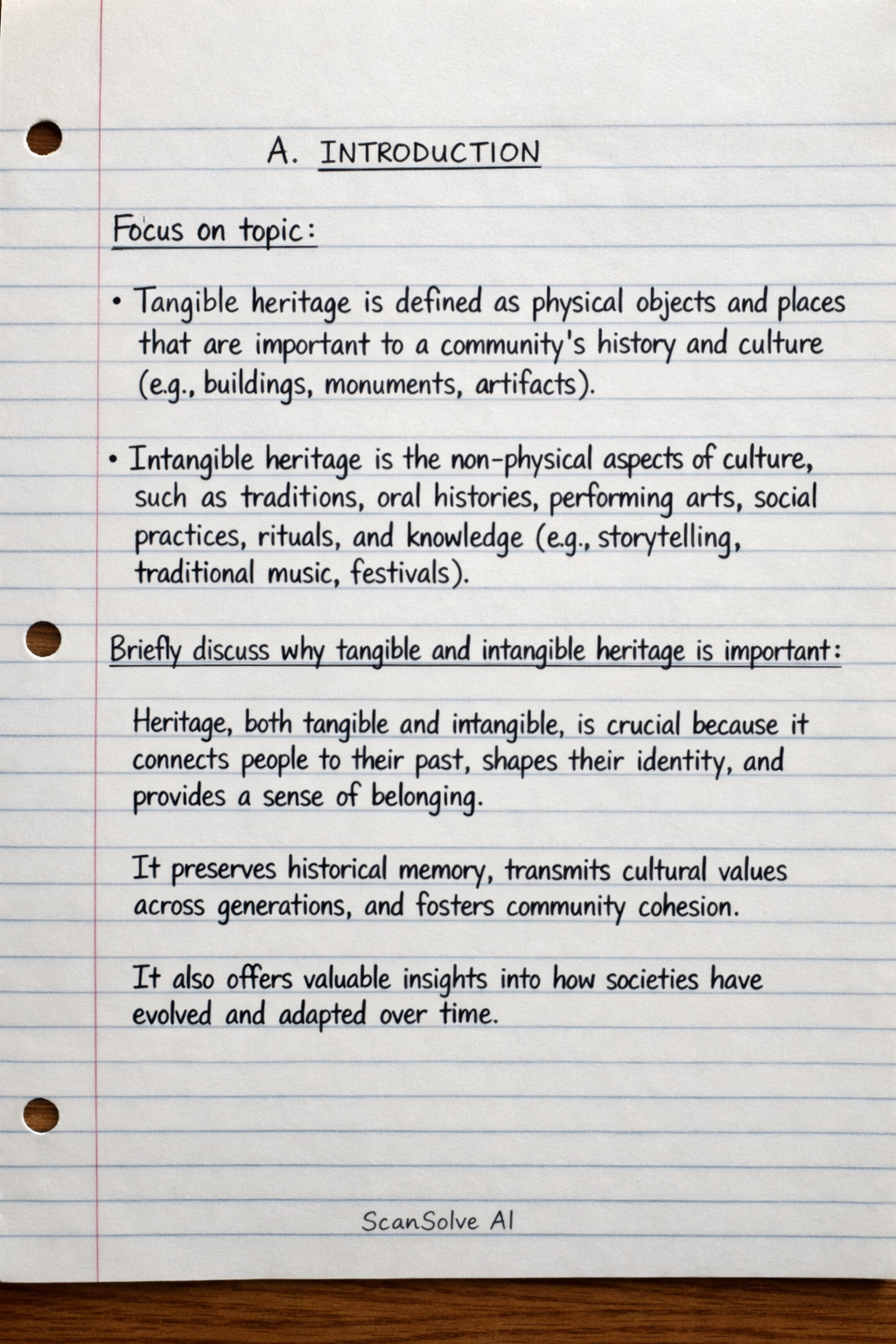
A INTRODUCTION
- Focus on topic: Begin by defining tangible heritage as physical objects and places that are important to a community's history and culture (e.g., buildings, monuments, artifacts). Define intangible heritage as the non-physical aspects of culture, such as traditions, oral histories, performing arts, social practices, rituals, and knowledge (e.g., storytelling, traditional music, festivals).
- Briefly discuss why tangible and intangible heritage is important: Heritage, both tangible and intangible, is crucial because it connects people to their past, shapes their identity, and provides a sense of belonging. It preserves historical memory, transmits cultural values across generations, and fosters community cohesion. It also offers valuable insights into how societies have evolved and adapted over time.
- Mention types of these heritage found in your local area: Briefly list examples relevant to your specific local area. For instance, "In [Your Local Area], tangible heritage includes historic buildings like [Name of Building] and archaeological sites, while intangible heritage encompasses traditional storytelling, local festivals, and specific culinary practices."
- Use key words from the topic as a guide to structure the line of argument: Your argument should focus on the profound and interconnected historical importance of both tangible and intangible heritage in shaping the identity and experiences of people in your local area. For example, "This report will investigate how the tangible structures and intangible traditions of [Your Local Area] collectively narrate its unique history, reflecting the resilience, creativity, and evolving identity of its people."
B BODY
- Tangible heritage in your local area and its historic importance:
- Identify specific examples of tangible heritage in your local area. These could be:
- Historic buildings: Old churches, schools, government buildings, homesteads, or commercial structures.
- Monuments or memorials: Statues, plaques, or sites commemorating significant events or people.
- Archaeological sites: Remains of ancient settlements, rock art, or historical battlefields.
- Artifacts: Objects found in local museums or private collections (e.g., tools, clothing, documents).
- For each example, describe its historical importance. Explain:
- What event or period it represents.
- Who built it or used it.
- What stories or memories are associated with it.
- How it reflects the social, economic, or political history of the area.
- Its significance to the community today (e.g., as a landmark, a place of memory, or a tourist attraction).
- Identify specific examples of tangible heritage in your local area. These could be:
- Intangible heritage in your area and its historic importance:
- Identify specific examples of intangible heritage in your local area. These could be:
- Oral traditions: Storytelling, legends, myths, proverbs, or historical accounts passed down verbally.
- Performing arts: Traditional music, dance forms, theatrical performances, or rituals.
- Social practices and rituals: Festivals, ceremonies, rites of passage, or community gatherings.
- Traditional craftsmanship: Skills involved in making specific local crafts, textiles, or tools.
- Knowledge and practices concerning nature and the universe: Traditional healing practices, farming methods, or astronomical knowledge.
- Culinary traditions: Specific local dishes, cooking methods, or food-related customs.
- For each example, describe its historical importance. Explain:
- Its origins and how it has evolved over time.
- How it reflects the values, beliefs, and worldview of the community.
- Its role in maintaining social cohesion and cultural identity.
- How it has been transmitted across generations.
- Its significance in contemporary life (e.g., as a source of pride, a means of education, or a way to connect with ancestors).
- Identify specific examples of intangible heritage in your local area. These could be:
C CONCLUSION
- Historic importance of tangible and intangible heritage: Summarize your findings, reiterating how both tangible and intangible heritage are indispensable for understanding the history and identity of your local area. Emphasize their interconnectedness – how physical sites often house or inspire intangible practices, and how traditions give meaning to physical spaces. Conclude by highlighting the ongoing relevance of preserving both forms of heritage for future generations, as they collectively tell the complete story of the community.
D REFLECTIONS
- What one has learnt from conducting the research: Reflect on the personal insights gained during the investigation. You might discuss:
- The unexpected discoveries made about your local area's history.
- The challenges encountered in researching different types of heritage.
- The importance of community engagement and oral histories in understanding intangible heritage.
- How this research has deepened your appreciation for your local culture and history.
- The realization of how heritage shapes individual and collective identity.
E BIBLIOGRAPHY
- List of references used: Provide a comprehensive list of all sources consulted, formatted according to academic standards (e.g., Harvard, APA, or MLA, as specified by your institution).
- Books: Author(s), Year, Title of Book, Publisher.
- Internet sources: Author(s) (if available), Year (if available), "Title of Web Page/Article," Website Name, URL, Date Accessed.
- Interviews/Oral histories: Name of Interviewee, Relationship to topic (e.g., "community elder," "local historian"), Date of Interview, Location of Interview.
- Archival documents: Title of Document, Collection Name, Archive Name, Location.
Was this helpful?
Still stuck on this one?
Ask a follow-up, and the answer starts from this question.
Got a different question?Ask your own question
More History Questions
QDefine tangible and intangible heritage and outline a methodology to investigate the historical…QWhat are the key differences between tangible and intangible heritage, and how would you investigate…QOutline a heritage investigation report on the Land Act of 1913, focusing on its social and economic…QHow should I approach a heritage project assignment, including research, writing, and submission?QWhat is the Importance and Value of Conserving Heritage in our Country? (Grade 10 Common Heritage…
Handwritten Step-by-Step Solution
Get this as a handwritten image on WhatsApp — like a tutor wrote it for you.
Try on WhatsApp