

This history question requires analysis of historical events, causes, and consequences. The detailed answer below provides context, evidence, and a well-structured explanation.
ScanSolve AI Answer
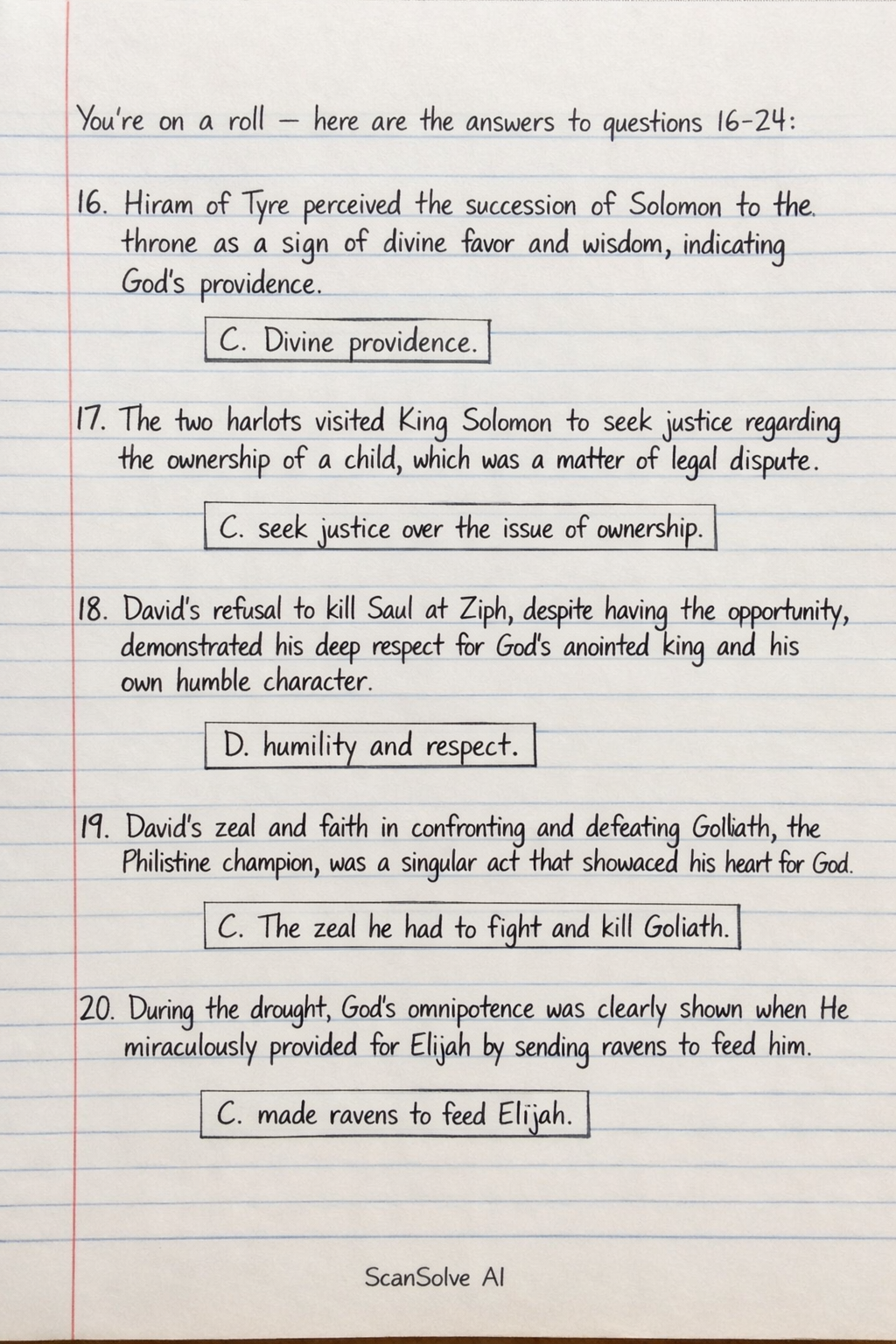
here are the answers to questions 16-24: 16. Hiram of Tyre perceived the succession of Solomon to the throne as a sign of divine favor and wisdom, indicating God's providence. C. Divine providence 17. The two harlots visited King Solomon to seek justice regarding the ownership of a child, which was a matter of legal dispute. C. seek justice over the issue of ownership 18. David's refusal to kill Saul at Ziph, despite having the opportunity, demonstrated his deep respect for God's anointed king and his own humble character. D. humility and respect. 19. David's zeal and faith in confronting and defeating Goliath, the Philistine champion, was a singular act that showcased his heart for God. C. The zeal he had to fight and kill Goliath 20. During the drought, God's omnipotence was clearly shown when He miraculously provided for Elijah by sending ravens to feed him. C. made ravens to feed Elijah. 21. Ahab committed many sins, including marrying a foreign woman, erecting an altar for Baal, and worshipping Baal. Contesting Elijah on Mt. Carmel was a confrontation initiated by Elijah, not a sin committed by Ahab in the same category as the others. A. contesting Elijah on Mt. Carmel 22. Ahab coveted Naboth's vineyard, and Jezebel orchestrated Naboth's murder through false accusations so Ahab could seize it, demonstrating covetousness and murder. D. Covetousness and murder 23. The healing of Naaman, a Syrian, at the River Jordan demonstrated that God's mercy and power extend beyond Israel to all people, showing His universal nature. B. God's mercy and universal nature. 24. Josiah's destruction of Topheth in the Valley of Hinnom was a key part of his reform to end the abhorrent practice of child sacrifices to pagan gods. B. Cessation of child sacrifices Two more pages to go! Send me the next one 📸