
We read your photo as:
HOW DID THE NATIONAL PARTY LEGALISE APARTHEID AFTER 1948 AND MAKE IT A UNIQUE SYSTEM OF RACIAL CAPITALISM AND RESISTANCE IN SOUTH AFRICA?
ScanSolve AI Answer
I can help you with the questions that rely on general historical knowledge. However, for questions that require specific information from Sources 1A, 1B, 1C, and 1D, I will need the addendum containing those sources to provide a complete answer.
Here are the answers to the questions I can address:
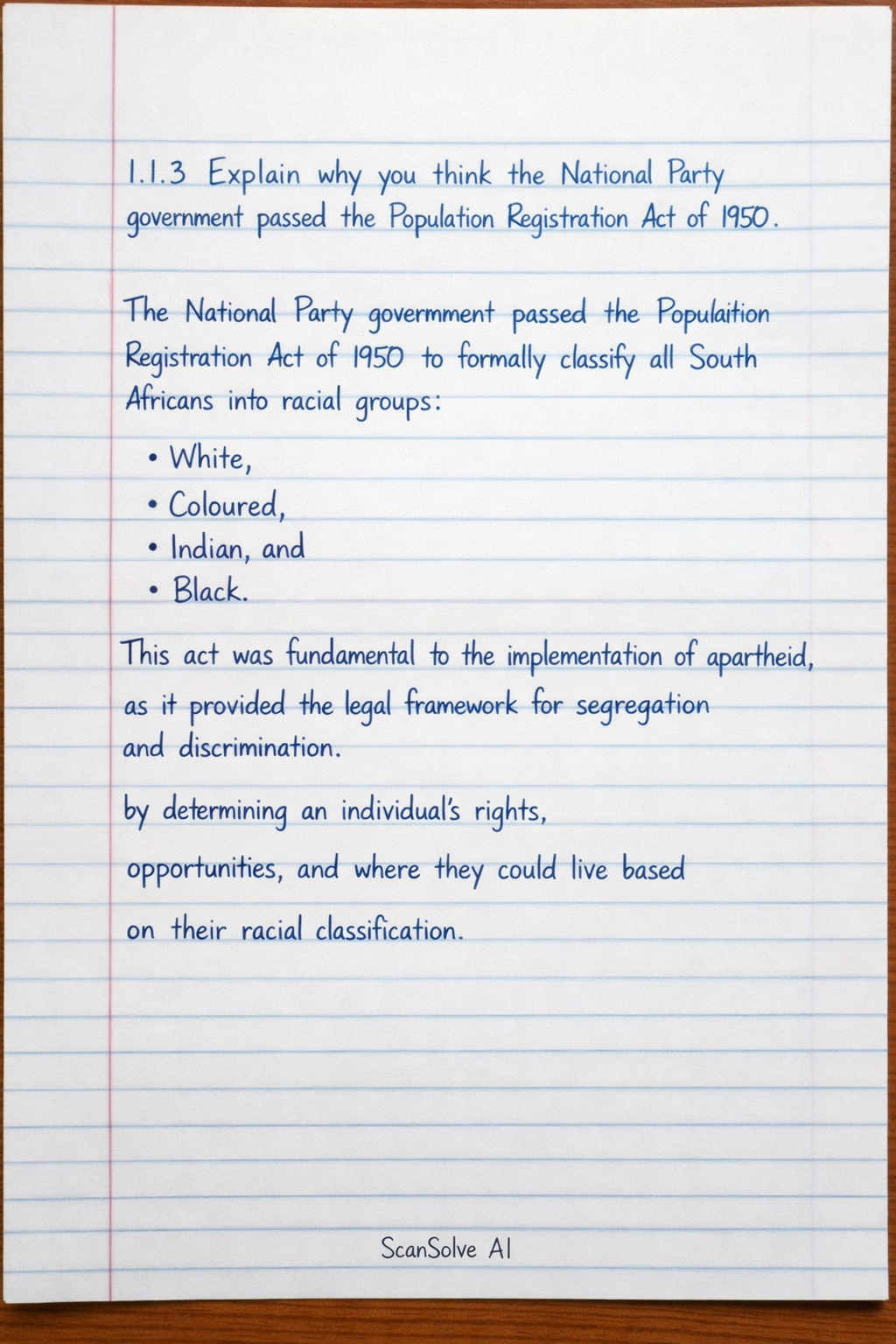
1.1.3 Explain why you think the National Party government passed the Population Registration Act of 1950.
The National Party government passed the Population Registration Act of 1950 to formally classify all South Africans into racial groups (White, Coloured, Indian, and Black). This act was fundamental to the implementation of apartheid, as it provided the legal framework for segregation and discrimination by determining an individual's rights, opportunities, and where they could live based on their racial classification.
1.1.4 Comment on the implications of having the Bantu Education Act of 1953 in the context of black education in South Africa.
The Bantu Education Act of 1953 had devastating implications for black education in South Africa. It removed control of black schools from missions and placed it under the government, implementing a curriculum designed to prepare black Africans for subservient roles in society, primarily as laborers. This act deliberately limited educational opportunities, ensuring that black students received an inferior education compared to white students, thereby perpetuating racial inequality and hindering social and economic advancement for the majority of the population.
1.2.1 Define the term Jim Crow laws in your own words.
Jim Crow laws were state and local statutes enacted in the Southern and some border states of the United States from the late 19th to the mid-20th centuries. These laws enforced racial segregation and discrimination against African Americans, mandating separate facilities for public places like schools, restrooms, and transportation, and effectively disenfranchising black citizens.
1.2.2 Explain why you think historians regarded Apartheid as 'a complete and systematic legal system'.
Historians regarded Apartheid as a 'complete and systematic legal system' because it was not merely a collection of discriminatory practices but a comprehensive body of laws and policies that permeated every aspect of life in South Africa. From birth, individuals were racially classified, determining their rights, where they could live, work, and even marry. This intricate web of legislation, including acts like the Population Registration Act, Group Areas Act, and Pass Laws, was meticulously designed to enforce racial segregation and white minority rule, making it a highly organized and institutionalized system of oppression.
1.2.5 Comment on why the South African government created Bantustans or homelands.
The South African government created Bantustans (also known as homelands) as part of its grand apartheid strategy to further entrench racial segregation and justify the denial of citizenship rights to black Africans. The official aim was to grant "self-governance" and eventual "independence" to these ethnically defined territories, thereby stripping black South Africans of their South African citizenship and making them citizens of these impoverished, fragmented homelands. This policy aimed to create a permanent migrant labor force for white-owned industries and farms, while simultaneously removing black people from "white" areas and consolidating white political power.
For questions 1.1.1, 1.1.2, 1.2.3, and 1.2.4, I need the specific source material (Sources 1A and 1B) to answer them accurately. Please send the addendum if you'd like me to complete those! 📸
Still stuck on this one?
Ask a follow-up, and the answer starts from this question.
More History Questions
Handwritten Step-by-Step Solution
Get this as a handwritten image on WhatsApp — like a tutor wrote it for you.
Try on WhatsApp