
We read your photo as:
How did the Trans-Atlantic trade lead to the eventual colonization of West Africa by Europeans in the 19th century? (8 mks)
ScanSolve AI Answer
Here are the answers to your questions:
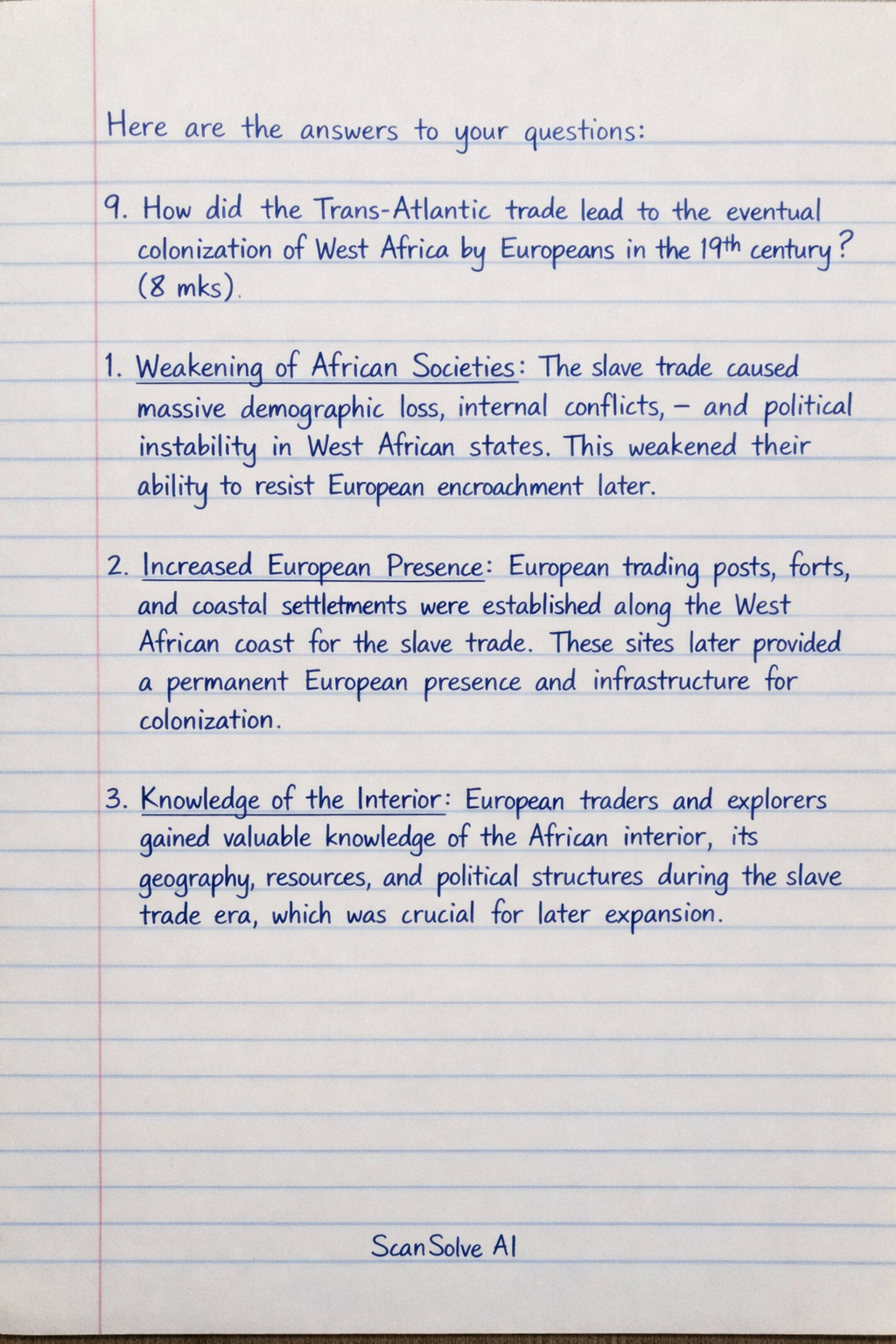
9. How did the Trans-Atlantic trade lead to the eventual colonization of West Africa by Europeans in the 19th century? (8 mks)
The Trans-Atlantic slave trade laid the groundwork for European colonization of West Africa in several ways:
- Weakening of African Societies: The slave trade caused immense demographic loss, internal conflicts, and political instability in West African states. This weakened their ability to resist European encroachment later.
- Increased European Presence: The establishment of European trading posts, forts, and coastal settlements along the West African coast for the slave trade provided a permanent European presence and infrastructure that could be repurposed for colonial administration.
- Knowledge of the Interior: European traders and explorers gained significant knowledge of the African interior, its geography, resources, and political structures during the slave trade era, which was crucial for later military and administrative expansion.
- Economic Transition: After the abolition of the slave trade, European powers sought new economic interests in Africa, shifting to "legitimate trade" in raw materials like palm oil, timber, and minerals. This required more direct control over production and trade routes, leading to annexation.
- Technological Superiority: The slave trade era saw the introduction of European firearms into Africa, but by the 19th century, European military technology had advanced significantly (e.g., Maxim gun, steamships), giving them a decisive advantage in conquest.
- Political Rivalries: European nations, having established a foothold through the slave trade, became increasingly competitive for control over African territories to secure resources, markets, and strategic advantages, culminating in the "Scramble for Africa."
10. State one advantage of the currency method of trade (1 mk)
One advantage of the currency method of trade is that it eliminates the need for a double coincidence of wants, making transactions more efficient and easier.
11. Which was the main method of trade in Africa during the pre-colonial period? (1 mk)
The main method of trade in Africa during the pre-colonial period was barter trade.
12. State three methods that were used to acquire slaves from the interior of Africa during the Trans-Atlantic trade (3 mks)
Three methods used to acquire slaves from the interior of Africa were:
- Raids and Warfare: Capturing prisoners of war from inter-community conflicts.
- Kidnapping: Individuals or small groups were seized by slave raiders.
- Judicial Processes: People were enslaved as punishment for crimes or as payment for debts.
13. Explain six reasons why the British parliament made a decision to abolish slave trade by 1807 (12 mks)
The British Parliament abolished the slave trade in 1807 due to a combination of factors:
- Humanitarian and Moral Campaigns: Influential abolitionist movements, led by figures like William Wilberforce and supported by religious groups such as the Quakers, tirelessly campaigned against the brutality and immorality of slavery, swaying public opinion and parliamentary members.
- Economic Changes and Industrial Revolution: The rise of the Industrial Revolution shifted Britain's economic focus from agricultural plantations (which relied heavily on slave labor) to industrial production. There was a growing need for raw materials from Africa and new markets for manufactured goods, which "legitimate trade" could provide more effectively than the slave trade.
- Decline in Profitability of West Indian Plantations: The profitability of sugar plantations in the British West Indies, which were the primary destination for slaves, began to decline due to soil exhaustion, competition from other sugar producers, and slave revolts, making the slave trade less economically attractive.
- Fear of Slave Revolts: The successful Haitian Revolution (1791-1804), where enslaved people overthrew French colonial rule, instilled fear among European powers of similar uprisings in their own colonies, making the continuation of the slave trade seem increasingly risky.
- Enlightenment Ideals: The spread of Enlightenment ideas emphasizing human rights, liberty, and equality challenged the moral legitimacy of slavery and influenced political thought, creating a philosophical basis for abolition.
- Strategic and Political Advantage: Abolishing the slave trade allowed Britain to project itself as a moral leader on the international stage, potentially gaining diplomatic influence and undermining the economies of rival European powers that still relied on the trade.
Still stuck on this one?
Ask a follow-up, and the answer starts from this question.
More History Questions
Handwritten Step-by-Step Solution
Get this as a handwritten image on WhatsApp — like a tutor wrote it for you.
Try on WhatsApp