
We read your photo as:
Discuss five major characteristics of missionary education in Kenya.
ScanSolve AI Answer
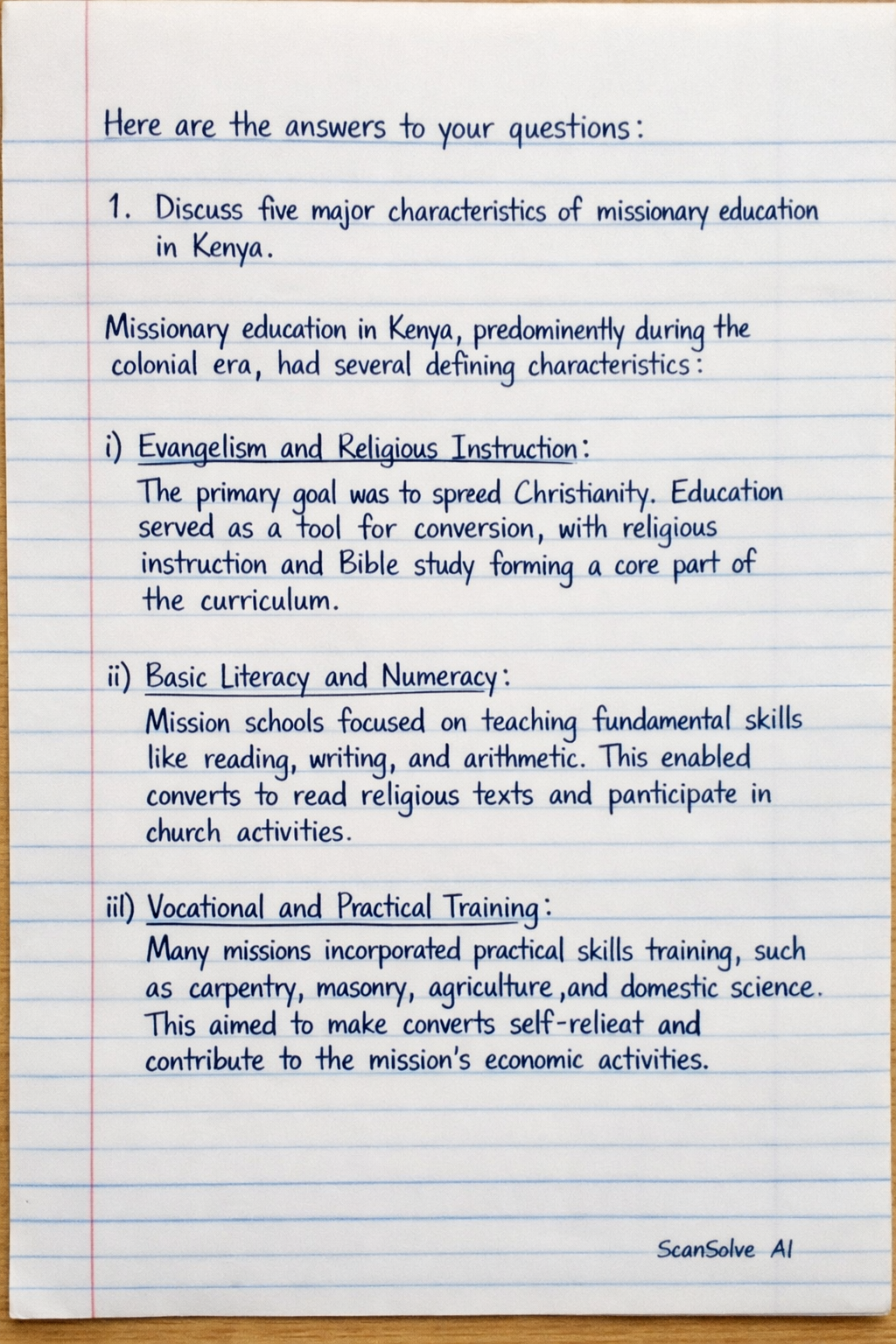
Here are the answers to your questions:
1. Discuss five major characteristics of missionary education in Kenya.
Missionary education in Kenya, predominantly during the colonial era, had several defining characteristics:
- i) Evangelism and Religious Instruction: The primary goal was to spread Christianity. Education served as a tool for conversion, with religious instruction and Bible study forming a core part of the curriculum.
- ii) Basic Literacy and Numeracy: Mission schools focused on teaching fundamental skills like reading, writing, and arithmetic. This enabled converts to read religious texts and participate in church activities.
- iii) Vocational and Practical Training: Many missions incorporated practical skills training, such as carpentry, masonry, agriculture, and domestic science. This aimed to make converts self-reliant and contribute to the mission's economic activities.
- iv) Westernization and Cultural Assimilation: Missionary education often introduced Western values, languages (primarily English), and lifestyles, sometimes leading to the suppression of indigenous cultures and traditions.
- v) Hierarchical Structure and Teacher Training: Education was often structured in tiers, from village schools to central mission schools. Missionaries also trained local teachers (catechists) to expand their educational reach and sustain their efforts.
2. Discuss the contributions of missionary education and the educational commissions in Kenya to educational development since Independence.
Contributions of Missionary Education (Legacy) since Independence:
While direct control by missionaries diminished after independence, their legacy significantly shaped Kenya's educational development:
- i) Established Infrastructure: Many of Kenya's most reputable schools, colleges, and even some universities (e.g., Alliance High School, Starehe Boys' Centre) were founded by missionaries. These institutions continued to operate and expand, forming a crucial part of the post-independence education system.
- ii) Trained Manpower: Missionaries trained the first generation of African teachers, administrators, and professionals who became instrumental in running the independent nation's education system and civil service.
- iii) Emphasis on Discipline and Values: Many mission-founded schools maintained a strong ethos of discipline, moral values, and academic excellence, which continued to influence the character development of students and the quality of education.
- iv) Pioneering Girls' Education: Missionaries were among the first to advocate for and provide formal education for girls, laying the groundwork for greater gender equality in educational access and attainment post-independence.
Contributions of Educational Commissions in Kenya since Independence:
Various educational commissions have played a pivotal role in shaping Kenya's education system through their recommendations and policy frameworks:
- i) Ominde Commission (1964): This commission recommended a unified national education system, replacing the racially segregated colonial system. It emphasized national unity and the production of skilled manpower, leading to the adoption of the 7-4-2-3 education structure.
- ii) Gachathi Commission (1976): Focused on making education more relevant to national development needs. It recommended a shift towards more practical and technical education and emphasized the need for a national philosophy of education.
- iii) Mackay Commission (1981): This commission recommended the establishment of a second public university (Moi University) and, most notably, the introduction of the 8-4-4 system of education. The 8-4-4 system aimed to make education more practical, self-reliant, and responsive to the country's manpower requirements.
- iv) Kamunge Commission (1988): Focused on issues of cost-sharing in education, quality assurance, and diversification of the curriculum. It recommended measures to improve access, retention, and the overall quality of education.
- v) Taskforce on Enhancing Access, Relevance, Transition, Equity and Quality for Effective Curriculum Reforms (CBC Taskforce, 2017 onwards): This task force led to the implementation of the Competency-Based Curriculum (CBC), a major reform aimed at shifting from content-based learning to developing skills, competencies, and values in learners, aligning education with 21st-century demands.
Still stuck on this one?
Ask a follow-up, and the answer starts from this question.
More History Questions
Handwritten Step-by-Step Solution
Get this as a handwritten image on WhatsApp — like a tutor wrote it for you.
Try on WhatsApp