
We read your photo as:
Discuss the aims, content, and methods of education in ancient Greece and Rome. (12 marks)
History
ScanSolve AI Answer
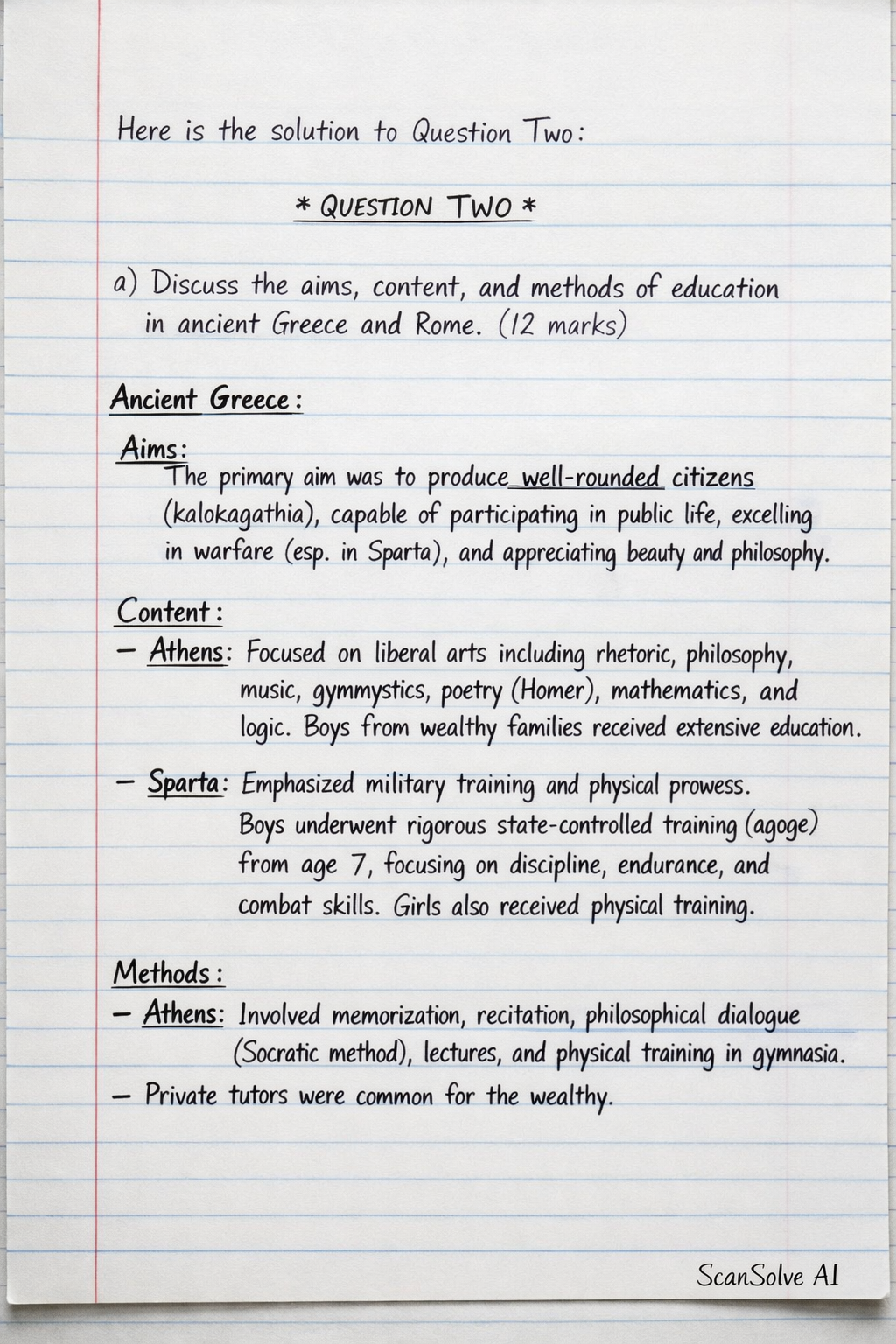
Here is the solution to Question Two:
QUESTION TWO
a) Discuss the aims, content, and methods of education in ancient Greece and Rome. (12 marks)
Ancient Greece:
- Aims: The primary aim was to produce well-rounded citizens (kalokagathia), capable of participating in public life, excelling in warfare (especially in Sparta), and appreciating beauty and philosophy. Education sought to develop both the mind and body.
- Content:
- Athens: Focused on liberal arts including rhetoric, philosophy, music, gymnastics, poetry (Homer), mathematics, and logic. Boys from wealthy families received extensive education.
- Sparta: Emphasized military training and physical prowess. Boys underwent rigorous state-controlled training (agoge) from age seven, focusing on discipline, endurance, and combat skills. Girls also received physical training.
- Methods:
- Athens: Involved memorization, recitation, philosophical dialogue (Socratic method), lectures, and physical training in gymnasia. Private tutors were common for the wealthy.
- Sparta: Strict physical drills, military exercises, communal living, and obedience to authority. Learning was largely experiential and focused on survival and warfare.
Ancient Rome:
- Aims: To produce eloquent orators and practical, virtuous citizens (virtus) capable of serving the state, managing households, and upholding Roman law and tradition. Emphasis was on practical skills and moral character.
- Content: Initially focused on reading, writing, and arithmetic. Later, influenced by Greek education, it expanded to include rhetoric, law, history, philosophy, and literature (Latin and Greek classics).
- Methods:
- Started with home-based education by parents or tutors.
- Formal schooling progressed through ludus (elementary), grammaticus (secondary, focusing on grammar and literature), and rhetor (higher education, focusing on public speaking and law).
- Methods included memorization, recitation, copying texts, public speaking exercises, and debates. Corporal punishment was common.
b) Show the influence of education in ancient Greece and Rome on modern education. (8 marks)
The educational systems of ancient Greece and Rome profoundly influenced modern education in several ways:
- Liberal Arts Curriculum: The Greek emphasis on a broad education encompassing humanities, sciences, and arts (the liberal arts) forms the basis of many university curricula today, aiming to produce well-rounded individuals.
- Rhetoric and Oratory: The Roman focus on rhetoric and public speaking continues to be valued in communication studies, law, and political science, emphasizing persuasive argumentation and clear expression.
- Physical Education: The Greek ideal of developing both mind and body led to the inclusion of physical education and sports in school systems worldwide.
- Structured Schooling: The Roman progression from elementary to secondary to higher education (ludus, grammaticus, rhetor) laid the groundwork for the graded school system prevalent in many countries today.
- Philosophical Inquiry: The Socratic method of questioning and critical thinking, originating in Greece, remains a cornerstone of pedagogical approaches that encourage independent thought and analytical skills.
- Importance of Classics: The study of classical literature, history, and philosophy from Greece and Rome continues to be a significant component of humanities education, providing foundational knowledge and cultural understanding.
Was this helpful?
Still stuck on this one?
Ask a follow-up, and the answer starts from this question.
Got a different question?Ask your own question
More History Questions
QA) Compare and contrast the systems of education in ancient Sparta and Athens and point out the…QElaborate extensively on the topic of education in the Plato's republic. Also narrate the myth of…QExplain into detail how Plato views education in the republic and the laws and contrast them and…QDo you agree with how education is viewed by Plato in the republic. Give elaborate reasons for your…QQUESTION 5: In a Development Studies seminar, students are examining different theories that explain…
Browse by topic:World History
Handwritten Step-by-Step Solution
Get this as a handwritten image on WhatsApp — like a tutor wrote it for you.
Try on WhatsApp