
We read your photo as:
Discuss the key causes that led to the collapse of Tanzania's Ujamaa policy, focusing on economic, political, and social factors.
ScanSolve AI Answer
Step-by-step solution
3 stepsHere are the key causes that led to the collapse of Tanzania's Ujamaa policy:
Economic Factors
The Ujamaa policy faced significant economic challenges, primarily due to low agricultural productivity. The communal farming model often lacked individual incentives, leading to reduced output. Poor infrastructure, inadequate technology, and a heavy reliance on a few cash crops made the economy vulnerable to global price fluctuations and external shocks, such as the oil crises of the 1970s.
Political Factors
Politically, the policy suffered from centralized decision-making and a lack of local autonomy. The government's top-down approach, including the forced villagization program (Operation Sogeza), alienated many citizens and local leaders. This authoritarian implementation, coupled with growing corruption and inefficiency within the state apparatus, undermined public trust and the policy's legitimacy.
Social Factors
Socially, the forced relocation of millions of people into Ujamaa villages caused widespread disruption of traditional livelihoods and social structures. Many farmers resisted moving or adapting to communal farming, leading to resentment and a decline in social cohesion. The policy also struggled to deliver promised improvements in social services, further eroding popular support.
Still stuck on this one?
Ask a follow-up, and the answer starts from this question.
More History Questions
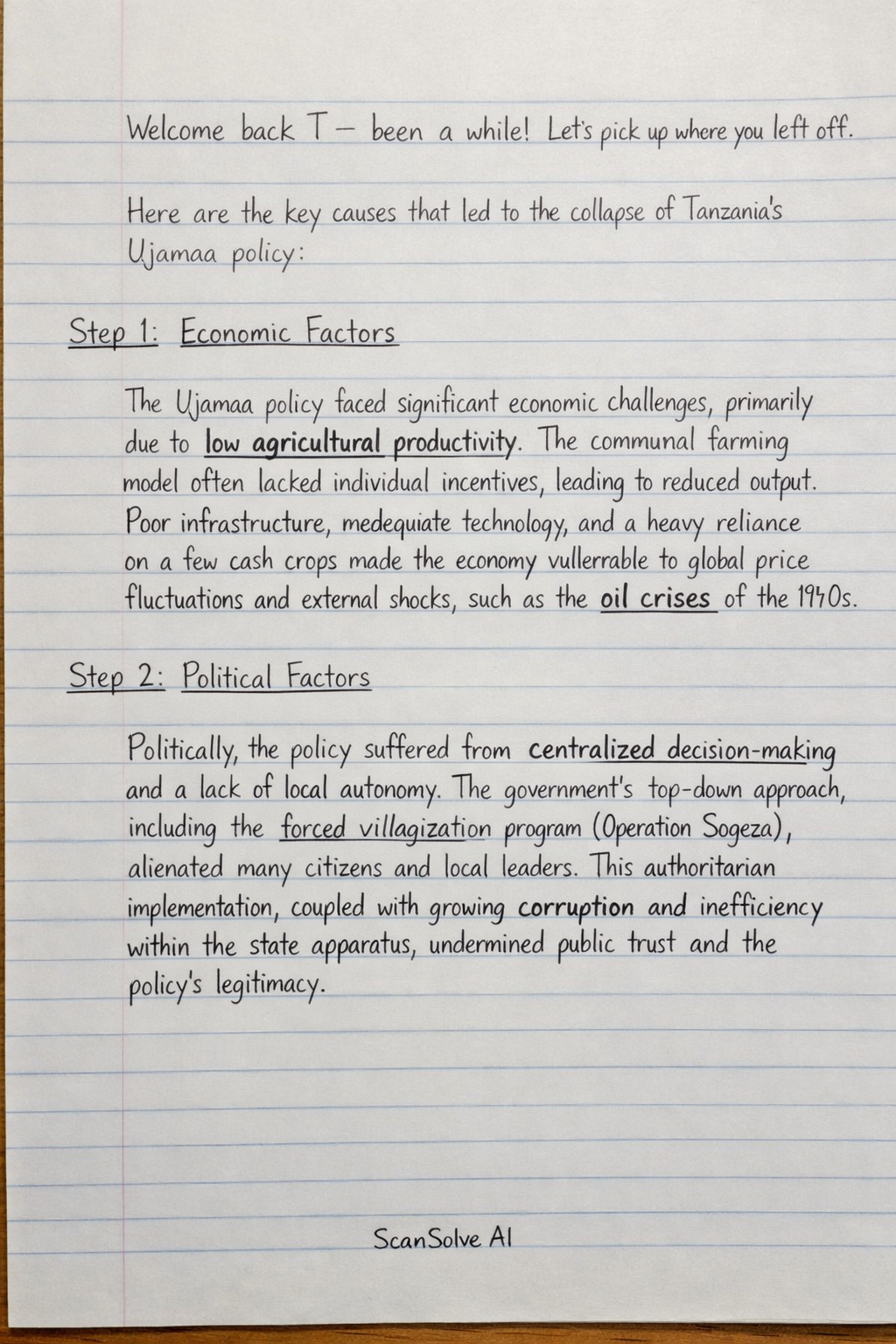
Handwritten Step-by-Step Solution
Get this as a handwritten image on WhatsApp — like a tutor wrote it for you.
Try on WhatsApp