
We read your photo as:
Examine four (4) elements of African culture that help in preserving cultural heritage and community cohesion.
History
ScanSolve AI Answer
Here are the answers to the questions:
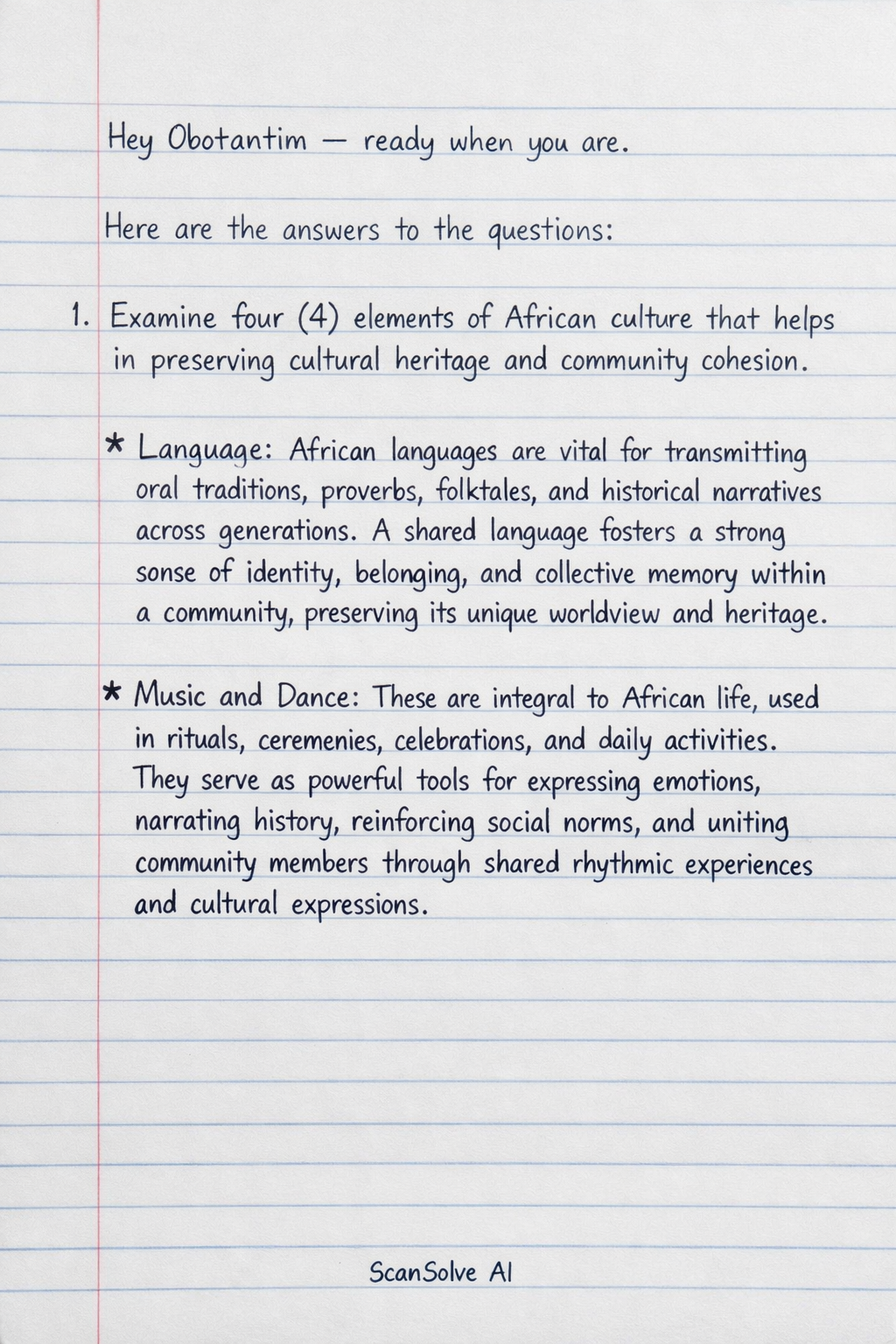
1. Examine four (4) elements of African culture that helps in preserving cultural heritage and community cohesion.
- Language: African languages are vital for transmitting oral traditions, proverbs, folktales, and historical narratives across generations. A shared language fosters a strong sense of identity, belonging, and collective memory within a community, preserving its unique worldview and heritage.
- Music and Dance: These are integral to African life, used in rituals, ceremonies, celebrations, and daily activities. They serve as powerful tools for expressing emotions, narrating history, reinforcing social norms, and uniting community members through shared rhythmic experiences and cultural expressions.
- Marriage and Family Systems: Traditional African marriage customs, such as bride price and the involvement of extended families, strengthen kinship ties and community networks. The emphasis on the extended family and communal living ensures mutual support, care for elders, and the collective upbringing of children, thereby maintaining social cohesion.
- Religion and Spirituality: Indigenous African religions, ancestor veneration, and spiritual practices provide moral frameworks, ethical guidelines, and a sense of continuity between the living and the dead. These beliefs often underpin social structures, rituals, and ceremonies, uniting communities through shared spiritual values and a common understanding of the world.
2. Examine four (4) dimensions of globalisation.
- Economic Globalisation: This dimension involves the increasing interdependence of world economies through the cross-border movement of goods, services, capital, and technology. It is characterized by multinational corporations, international trade agreements, and integrated global financial markets.
- Political Globalisation: This refers to the growing influence of international organizations, treaties, and agreements, leading to increased cooperation and interdependence among states. It involves the development of global governance structures and the spread of political ideas and systems across borders.
- Cultural Globalisation: This dimension involves the spread of ideas, values, customs, and artistic expressions across national borders, often leading to cultural homogenization or hybridization. It is facilitated by global media, communication technologies, and the movement of people.
- Technological Globalisation: This is driven by rapid advancements in communication and information technology, such as the internet and mobile phones. It facilitates the faster and wider flow of information, ideas, and capital, connecting people and economies globally.
3. Examine the four (4) phases of the contraction stage of the family.
The contraction stage of the family life cycle refers to the period when the family unit begins to shrink as children grow up and leave home.
- Launching Stage: This phase begins when the first child leaves home for education, work, or marriage, and continues until the last child has departed. Parents transition from active child-rearing to supporting their adult children's independence, and the family unit starts to contract in size.
- Post-Parental Stage (Empty Nest): Once all children have left home, parents enter this stage. The focus shifts back to the marital relationship, personal interests, and possibly new careers or hobbies. The family unit consists solely of the original couple, experiencing a significant reduction in household members.
- Retirement Stage: This phase begins when one or both parents retire from their primary careers. It involves adjustments to lifestyle, finances, and social roles. The couple may engage in new activities, travel, or spend more time with grandchildren, further defining their contracted family unit.
- Aging Stage/Widowhood: This final phase of contraction occurs as one spouse passes away, leaving the surviving spouse to live alone. The family unit, in its most contracted form, now consists of a single individual, often relying on support from adult children or other family members.
Was this helpful?
Still stuck on this one?
Ask a follow-up, and the answer starts from this question.
Got a different question?Ask your own question
More History Questions
QDiscuss 5 ways of promoting National identity, 5 factors that have caused a cultural change in…QAs a student of African Studies, how would you characterize African traditional religion to portray…QANNEXURE F: EXEMPLAR GRADE 10 HERITAGE PROJECT Question: WHAT FACTORS CONTRIBUTED TO SOUTH AFRICA'S…QIdentify a common cultural element.QDescribe the role of culture and gender in family matters, list five ethnic groups in East Africa…
Handwritten Step-by-Step Solution
Get this as a handwritten image on WhatsApp — like a tutor wrote it for you.
Try on WhatsApp