
We read your photo as:
Examine the impacts of the British administration policy of indirect rule in Southern Cameroon during the Mandate period.
ScanSolve AI Answer
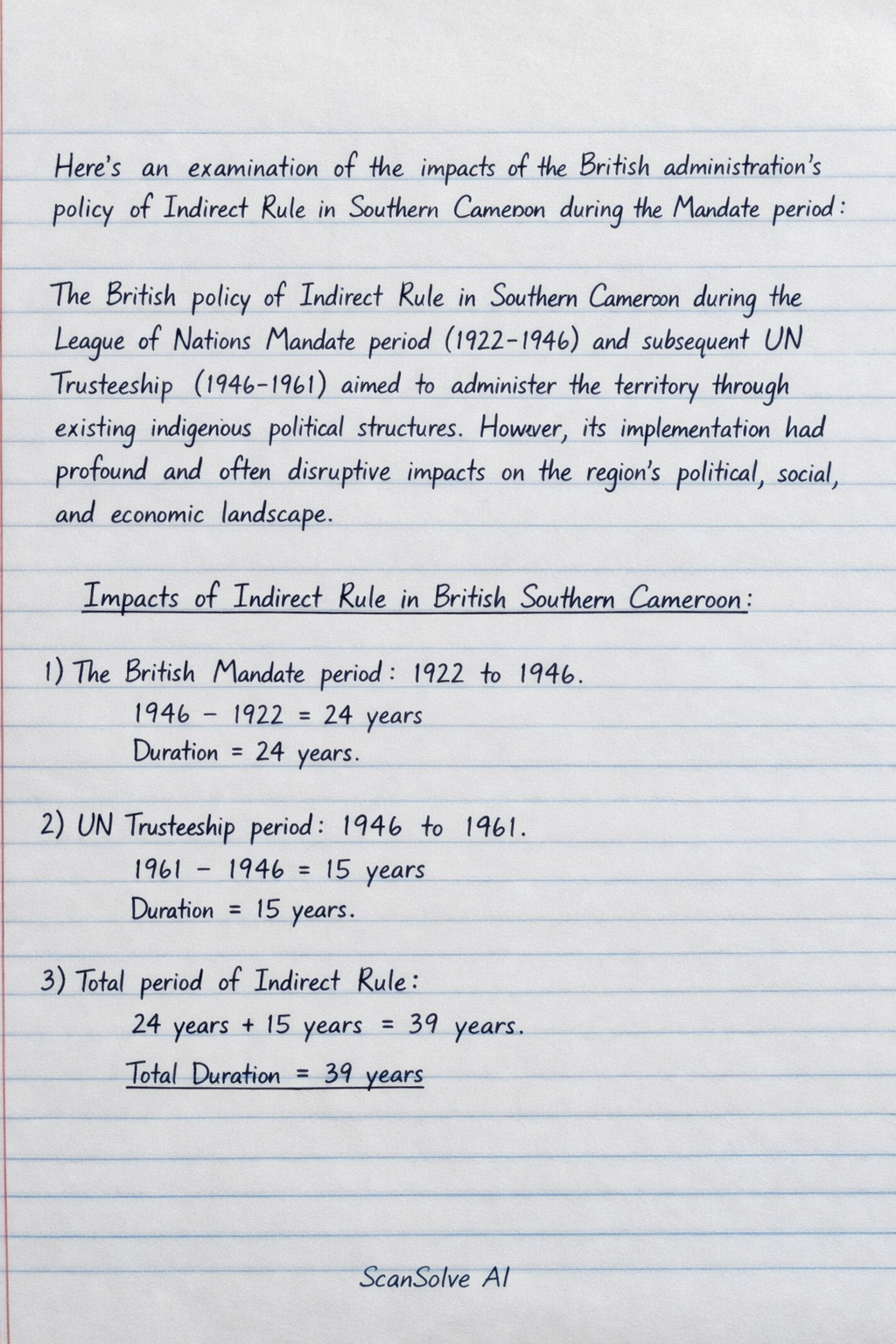
Here's an examination of the impacts of the British administration's policy of Indirect Rule in Southern Cameroon during the Mandate period:
The British policy of Indirect Rule in Southern Cameroon during the League of Nations Mandate period (1922-1946) and subsequent UN Trusteeship (1946-1961) aimed to administer the territory through existing indigenous political structures. However, its implementation had profound and often disruptive impacts on the region's political, social, and economic landscape.
Impacts of Indirect Rule in British Southern Cameroon:
-
Disruption and Distortion of Traditional Political Structures:
- In many parts of Southern Cameroon, particularly among the decentralized societies of the Grassfields and the forest regions, there were no pre-existing centralized chieftaincies that fit the British model. The British often created "Warrant Chiefs" or empowered minor headmen, granting them powers they traditionally did not possess. This undermined genuine traditional leadership and created artificial hierarchies, leading to internal conflicts and a loss of legitimacy for the appointed chiefs.
- Existing traditional institutions were either ignored, modified, or strengthened to serve colonial administrative purposes, rather than being genuinely preserved.
-
Inconsistency and Lack of Uniformity in Administration:
- Due to the diverse political structures across Southern Cameroon, the application of Indirect Rule was highly inconsistent. It worked with varying degrees of success in areas with more centralized authority (e.g., some parts of the Grassfields) but caused significant disruption and resistance in segmentary societies. This led to an uneven administrative landscape and different experiences of colonial rule across the territory.
-
Exploitation and Increased Oppression:
- The "Native Authorities" (chiefs) were primarily used as instruments of colonial administration to collect taxes, recruit forced labor for public works (such as road and railway construction) and plantations, and enforce colonial laws. This often led to chiefs becoming agents of colonial oppression, alienating them from their own people and fueling resentment against both the colonial power and the local leadership.
- The system facilitated the extraction of resources and labor with minimal British oversight.
-
Limited Development and Neglect:
- British Southern Cameroon was administered as part of the larger Nigerian protectorate, and its development was often secondary to that of Nigeria proper. The focus of Indirect Rule was on maintaining order and extracting resources, with limited investment in education, infrastructure, or healthcare. This resulted in a slower pace of modernization and development compared to French Cameroon.
-
Emergence of an Educated Elite's Frustration:
- The growing number of educated Southern Cameroonians, who understood Western administrative practices, were largely excluded from positions of power within the Native Authorities, which were reserved for traditional rulers (or those appointed as such). This exclusion fostered a sense of grievance among the elite, who felt marginalized and believed they could offer more effective governance, contributing to the rise of nationalist movements later on.
-
Administrative and Political Integration with Nigeria:
- A significant impact was the deep administrative and political integration of British Southern Cameroon into the larger Nigerian protectorate. This meant that Southern Cameroonians were subject to Nigerian laws and policies, and their political development was tied to Nigeria's. This integration later became a major point of contention regarding their future, leading to the 1961 plebiscite.
-
Foundation for Future Political Instability and Identity Issues:
- By creating artificial political structures, empowering individuals who lacked traditional legitimacy, and fostering divisions, Indirect Rule sowed seeds of discord. These issues contributed to post-independence challenges in governance, national cohesion, and the ongoing debate about the identity and status of the Anglophone regions within Cameroon.
In conclusion, while Indirect Rule was a cost-effective administrative strategy for the British, its application in Southern Cameroon during the Mandate period had a transformative and often negative impact. It fundamentally altered indigenous political systems, created new forms of exploitation, hindered development, and laid the groundwork for future political and identity struggles that continue to resonate in contemporary Cameroon.
Still stuck on this one?
Ask a follow-up, and the answer starts from this question.
More History Questions
Handwritten Step-by-Step Solution
Get this as a handwritten image on WhatsApp — like a tutor wrote it for you.
Try on WhatsApp