
We read your photo as:
FACE OF A NATION TEXTBOOK QS: (light green)
ScanSolve AI Answer
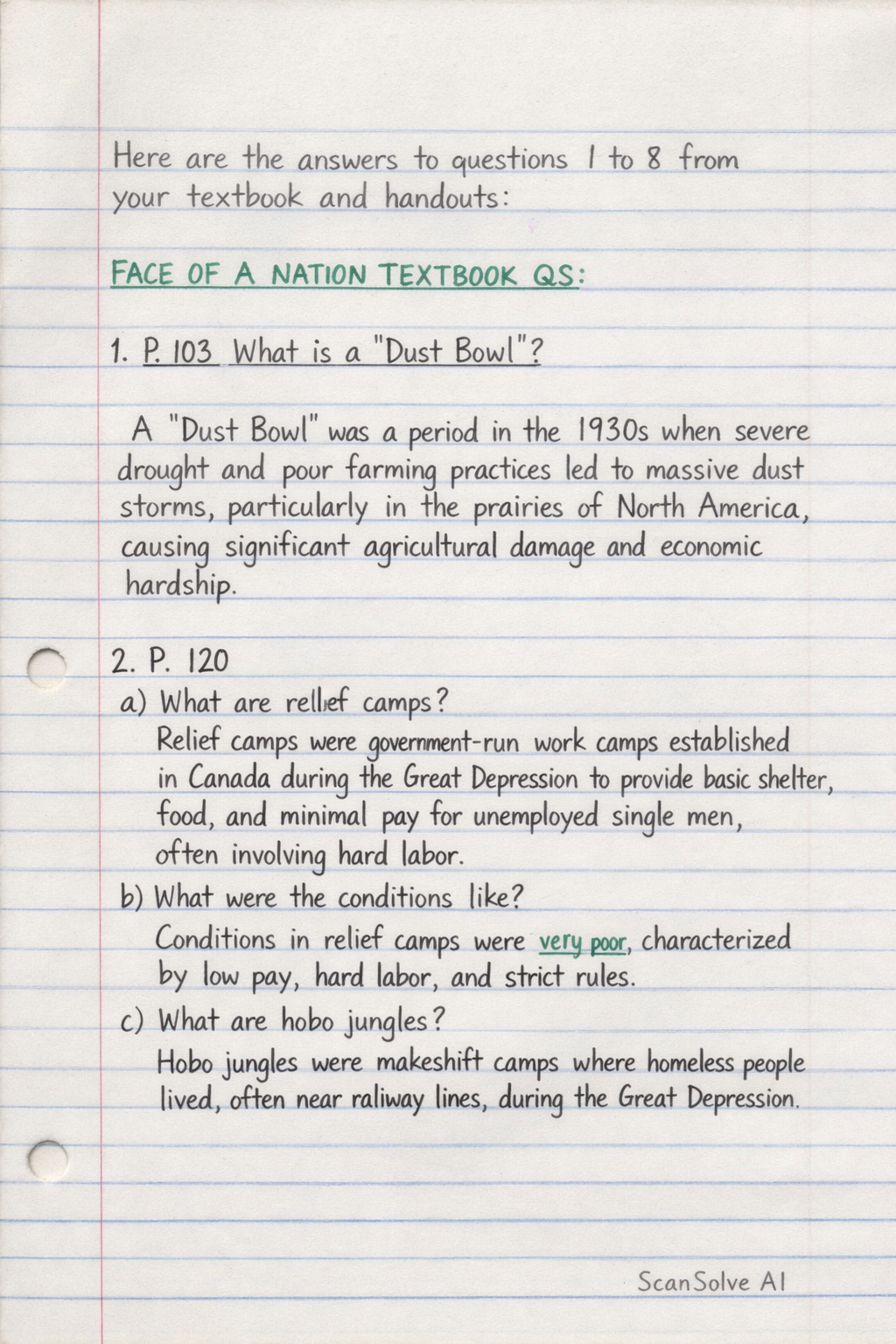
Here are the answers to questions 1 to 8 from your textbook and handouts:
FACE OF A NATION TEXTBOOK QS: (light green)
1. P. 103 What is a "Dust Bowl"?
A "Dust Bowl" was a period in the 1930s when severe drought and poor farming practices led to massive dust storms, particularly in the prairies of North America, causing significant agricultural damage and economic hardship.
2. P. 120
a) What are relief camps?
Relief camps were government-run work camps established in Canada during the Great Depression to provide basic shelter, food, and minimal pay for unemployed single men, often involving hard labor.
b) What were the conditions like?
Conditions in relief camps were very poor, characterized by low pay, hard labor, and strict rules.
c) What are hobo jungles?
Hobo jungles were makeshift camps where homeless people lived, often near railway lines, during the Great Depression.
P. 104 Copy and label the economic cycle of the 1930s
The economic cycle of the 1930s:
- Factories produce too many goods (overproduction).
- People can't afford to buy them (due to low wages and buying on credit).
- Goods don't sell, leading to businesses losing money.
- Factories cut production and lay off workers.
- Unemployment rises.
- People have even less money to spend.
- Demand drops even more, and the cycle repeats.
P. 104 Checkpoint Summarize the problems with the Canadian economy in the 1920s: (add the missing word)
Problems with the Canadian economy in the 1920s:
- Buying on credit.
- Overproduction of goods.
- Raising (higher) tariffs.
- Low wages & high cost of living.
- Pay off workers (this is a consequence, not a problem in the 1920s, but rather a result of the other problems).
CANADIANA SCRAPBOOK Qs: (brown)
1. Describe the 5W's of the On-To-Ottawa Trek
| WHO? | Unemployed workers from relief camps |
| WHAT? | A protest where workers traveled to Ottawa |
| WHERE? | Started in Vancouver and headed toward Ottawa |
| WHEN? | 1935 |
| WHY? | To protest poor relief camp conditions and demand jobs |
TEACHER HANDOUTS and D2L Slides and lessons:
13. Who lost the election in 1930?
In the Canadian federal election of 1930, William Lyon Mackenzie King lost to R.B. Bennett. (If referring to the US, Herbert Hoover lost the 1932 election).
What was a strange fact about him?
A strange fact about Herbert Hoover (US President) was that shantytowns built by the homeless during the Depression were mockingly called "Hoovervilles," and newspapers used as blankets were called "Hoover blankets," reflecting public blame for the economic crisis.
Who won the election partly because of his "New Deal"?
Franklin D. Roosevelt won the election partly because of his "New Deal."
What promises in the New Deal are still around today?
Promises in the New Deal that are still around today include programs like Social Security, minimum wage laws, and government support for the unemployed.
14. Explain why the 1930s is literally referred to as "The Dirty Thirties":
The 1930s is referred to as "The Dirty Thirties" due to:
- Massive dust storms (the Dust Bowl).
- Severe drought across the prairies.
- Farms and crops were destroyed.
- Dirt and dust covered homes, towns, and land, making living conditions extremely difficult.
Still stuck on this one?
Ask a follow-up, and the answer starts from this question.
More History Questions
Handwritten Step-by-Step Solution
Get this as a handwritten image on WhatsApp — like a tutor wrote it for you.
Try on WhatsApp