

This history question requires analysis of historical events, causes, and consequences. The detailed answer below provides context, evidence, and a well-structured explanation.
ScanSolve AI Answer
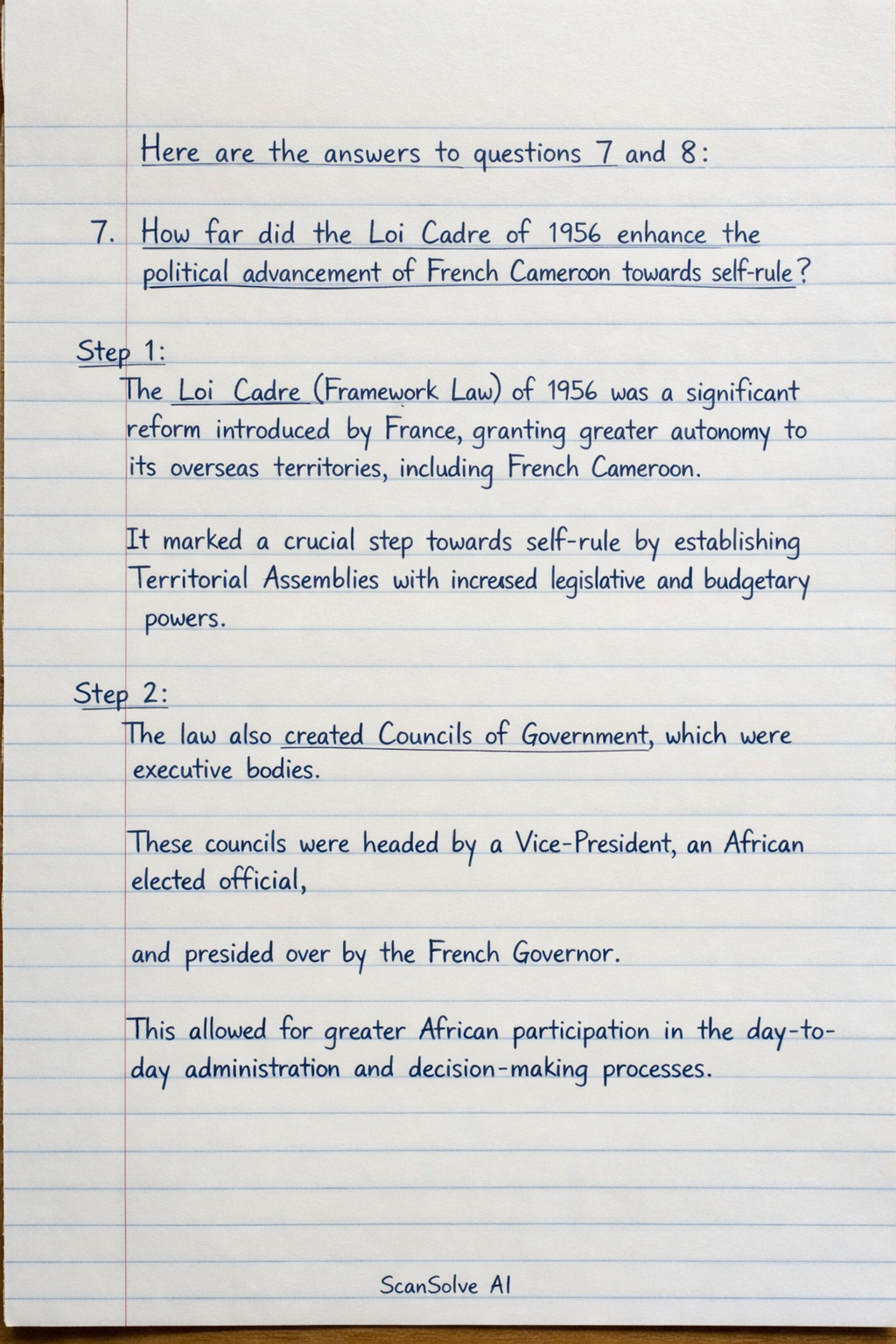
Here are the answers to questions 7 and 8: 7. How far did the Loi Cadre of 1956 enhance the political advancement of French Cameroon towards self-rule? Step 1: The Loi Cadre (Framework Law) of 1956 was a significant reform introduced by France, granting greater autonomy to its overseas territories, including French Cameroon. It marked a crucial step towards self-rule by establishing Territorial Assemblies with increased legislative and budgetary powers. Step 2: The law also created Councils of Government, which were executive bodies. These councils were headed by a Vice-President, an African elected official, and presided over by the French Governor. This allowed for greater African participation in the day-to-day administration and decision-making processes. Step 3: While the Loi Cadre significantly enhanced internal self-government by transferring some administrative and financial powers to local institutions and increasing African representation, it did not grant full sovereignty. Key areas like defense, foreign affairs, justice, and public order remained under the control of the French Governor. Step 4: Therefore, the Loi Cadre provided a substantial degree of internal autonomy and laid the groundwork for future independence, but it did not constitute complete self-rule. French Cameroon remained part of the French Union/Community, and ultimate authority still rested with France. It was a transitional phase rather than full independence. 8. Discuss the reasons for and the impact of the UN-organised plebiscite in the Southern Cameroons in 1961. Step 1: The primary reason for the UN-organised plebiscite in Southern Cameroons in 1961 was the impending independence of Nigeria in 1960. As a UN Trust Territory administered by the UK, Southern Cameroons could not simply remain part of an independent Nigeria without an act of self-determination. The UN mandated a plebiscite to allow the people to choose their future. Step 2: There were two main political aspirations within Southern Cameroons: one faction, led by the KNDP, advocated for reunification with the independent Republic of Cameroon (formerly French Cameroon), while another, less dominant view, favored integration with Nigeria. The UN General Assembly passed resolutions to ensure the people's will was democratically expressed. Step 3: The plebiscite offered two choices: joining the independent Federation of Nigeria or joining the independent Republic of Cameroon. The Southern Cameroons voted to join the Republic of Cameroon, while the Northern Cameroons voted to join Nigeria. Step 4: The immediate impact was the formation of the Federal Republic of Cameroon in October 1961, with Southern Cameroons becoming West Cameroon and federating with East Cameroon (the former French Cameroon). This union was intended to preserve the distinct Anglophone identity and institutions within a federal structure. Step 5: However, the long-term impact led to what is now known as the "Anglophone Problem." Over time, the federal structure was dismantled, leading to a more unitary state. Many Anglophones felt their distinct cultural, linguistic, and legal systems were eroded, and they were marginalized politically and economically, leading to ongoing tensions and conflict in the region. That's 2 down. 3 left today — send the next one.