
We read your photo as:
What are five possible rituals performed by Opanin Mensah on sacred days, five likely places where he performs his rituals, five items usually used, and five importance of traditional rituals to him?
History
ScanSolve AI Answer
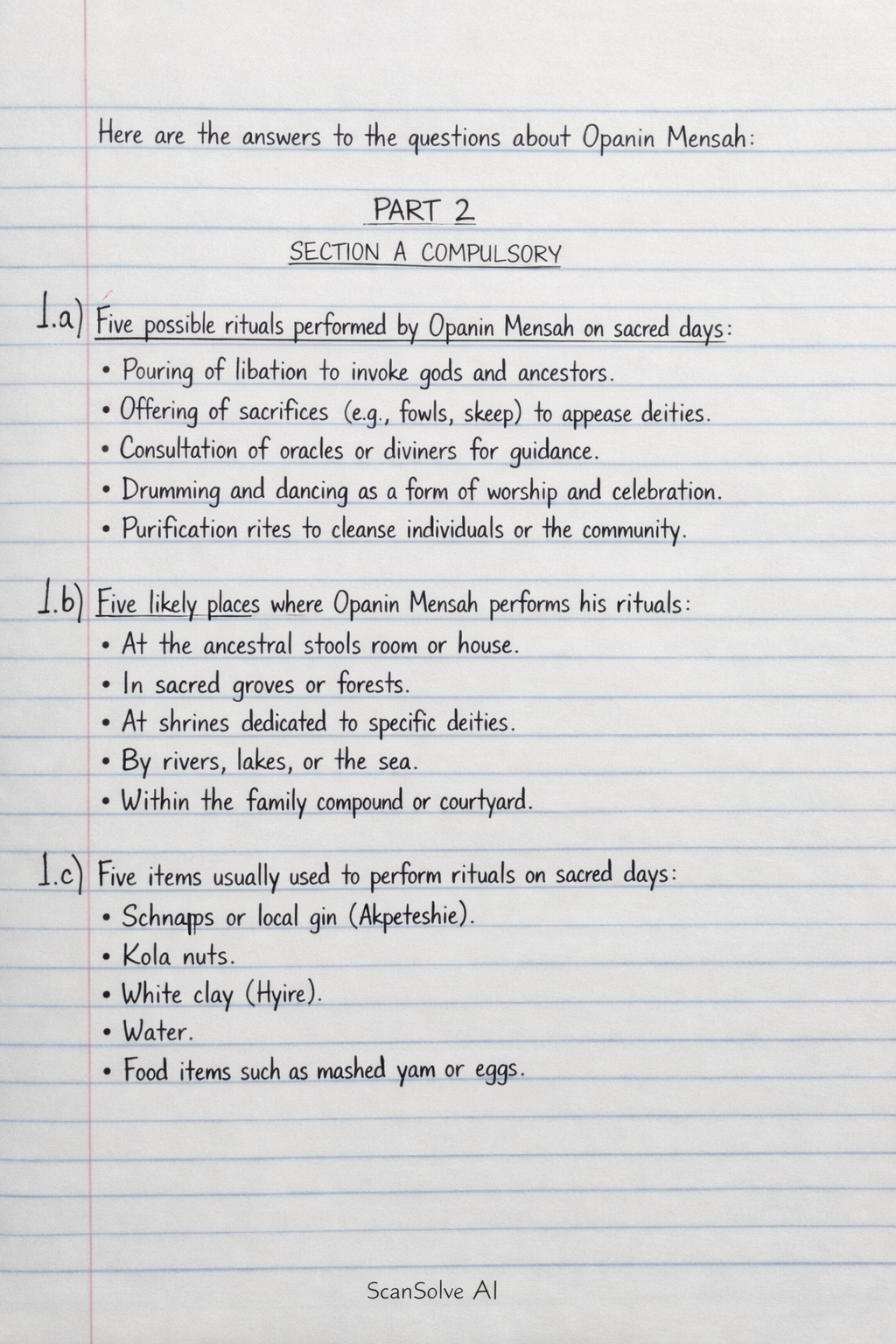
Here are the answers to the questions about Opanin Mensah:
PART 2
SECTION A COMPULSORY
1.
*a) Five possible rituals performed by Opanin Mensah on sacred days:
- Pouring of libation to invoke gods and ancestors.
- Offering of sacrifices (e.g., fowls, sheep) to appease deities.
- Consultation of oracles or diviners for guidance.
- Drumming and dancing as a form of worship and celebration.
- Purification rites to cleanse individuals or the community.
*b) Five likely places where Opanin Mensah performs his rituals:
- At the ancestral stools room or house.
- In sacred groves or forests.
- At shrines dedicated to specific deities.
- By rivers, lakes, or the sea.
- Within the family compound or courtyard.
*c) Five items usually used to perform rituals on sacred days:
- Schnapps or local gin (Akpeteshie).
- Kola nuts.
- White clay (Hyire).
- Water.
- Food items such as mashed yam or eggs.
*d) Five importance of traditional rituals to Opanin Mensah:
- They provide a spiritual connection to his gods and ancestors.
- They help in the preservation of cultural heritage and identity.
- They are a means to seek protection and blessings for himself and his community.
- They promote social cohesion and unity among the people.
- They serve as a way of expressing gratitude to the deities and ancestors.
Was this helpful?
Still stuck on this one?
Ask a follow-up, and the answer starts from this question.
Got a different question?Ask your own question
More History Questions
QWhat are five forms of worship in African communities?QWhat are four ways people spend money on funerals, four ways Ghanaians can reduce funeral expenses…QDiscuss 5 ways of promoting National identity, 5 factors that have caused a cultural change in…QWhat are Akan customs/traditions? List three types of Akan customs and taboos. Give two examples…QWhat are the key aspects of Ghanaian culture, including clothing, dances, hospitality, and concern…
Handwritten Step-by-Step Solution
Get this as a handwritten image on WhatsApp — like a tutor wrote it for you.
Try on WhatsApp