

This history question requires analysis of historical events, causes, and consequences. The detailed answer below provides context, evidence, and a well-structured explanation.
ScanSolve AI Answer
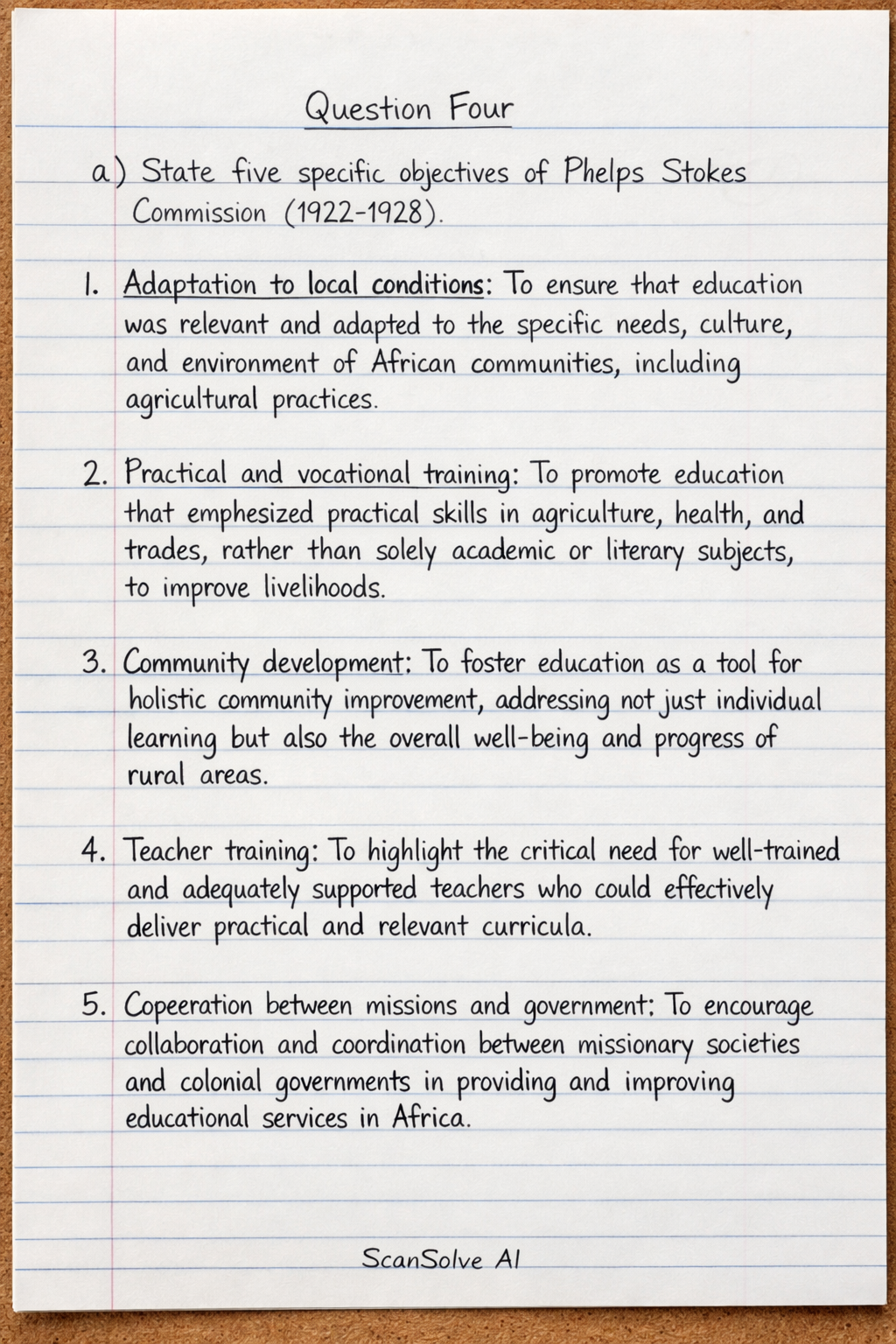
Question Four a) State five specific objectives of Phelps Stokes Commission (1922-1928). 1. Adaptation to local conditions: To ensure that education was relevant and adapted to the specific needs, culture, and environment of African communities, including agricultural practices. 2. Practical and vocational training: To promote education that emphasized practical skills in agriculture, health, and trades, rather than solely academic or literary subjects, to improve livelihoods. 3. Community development: To foster education as a tool for holistic community improvement, addressing not just individual learning but also the overall well-being and progress of rural areas. 4. Teacher training: To highlight the critical need for well-trained and adequately supported teachers who could effectively deliver practical and relevant curricula. 5. Cooperation between missions and government: To encourage collaboration and coordination between missionary societies and colonial governments in providing and improving educational services in Africa. b) Outline five recommendations of the Swynnerton Plan (1954). 1. Individual land tenure: Recommended the consolidation, demarcation, and registration of land under individual freehold title, replacing traditional communal land ownership. 2. Intensification of agriculture: Advocated for the shift from subsistence farming to commercial agriculture by African farmers, promoting the cultivation of high-value cash crops like coffee, tea, and pyrethrum. 3. Improved farming methods: Encouraged the adoption of modern agricultural techniques, including the use of fertilizers, improved seeds, soil conservation measures, and better livestock management. 4. Provision of credit facilities: Proposed the establishment of credit schemes to enable African farmers to invest in land improvements, purchase inputs, and adopt new technologies. 5. Enhanced extension services: Emphasized the need for robust agricultural extension services to disseminate knowledge, provide training, and guide farmers in implementing the recommended changes. Question Five a) Describe five philosophical principles upon which agricultural education and extension are founded. 1. Pragmatism: This principle emphasizes practical application and problem-solving. Agricultural education and extension are founded on the idea that knowledge should be useful and applicable to real-world agricultural challenges, promoting learning through doing and experiential activities. 2. Humanism: Humanism values the dignity, potential, and self-worth of individuals. In agricultural education and extension, this translates to learner-centered approaches that respect farmers' existing knowledge and experiences, empowering them to make informed decisions for their own development. 3. Experientialism: This philosophy posits that learning occurs most effectively through direct experience and interaction with the environment. Agricultural education and extension heavily rely on field visits, practical demonstrations, and participatory methods where learners actively engage with agricultural practices. 4. Democracy: This principle promotes participation, shared decision-making, and equality. Agricultural extension often involves participatory approaches where farmers contribute to identifying problems and solutions, fostering a sense of ownership and collective action in rural development. 5. Behaviorism: This principle focuses on observable changes in behavior and skills. Agricultural education and extension aim to induce specific behavioral changes in farmers, such as adopting new technologies or practices, through structured learning, repetition, and reinforcement of desired outcomes. b) Outline five characteristics of physically disabled HIV and AIDS affected farmer families as clients of extension. 1. Reduced labor capacity: Members of these families often have limited physical strength and endurance due to disability or illness, impacting their ability to perform strenuous farm tasks. 2. Increased healthcare burden: They typically face high medical expenses and frequent need for care, diverting financial and labor resources away from agricultural production and household investments. 3. Stigma and discrimination: These families may experience social isolation, discrimination, and reluctance from others to engage in cooperative farming or share resources, hindering their access to community support. 4. Limited access to information and services: Mobility challenges, lack of awareness, or discriminatory attitudes can restrict their ability to attend extension meetings, access credit, or utilize other essential agricultural services. 5. Food insecurity and malnutrition: Reduced farm productivity combined with increased nutritional needs (especially for those with HIV/AIDS) often leads to severe food insecurity and chronic malnutrition within the household. That's 2 down. 3 left today — send the next one.