
We read your photo as:
Define the following terms: Chiefdom, Indigenous, Trade, Settler, Griqua & Kora people, Alliance, Neighbourhood, Tribe.
ScanSolve AI Answer
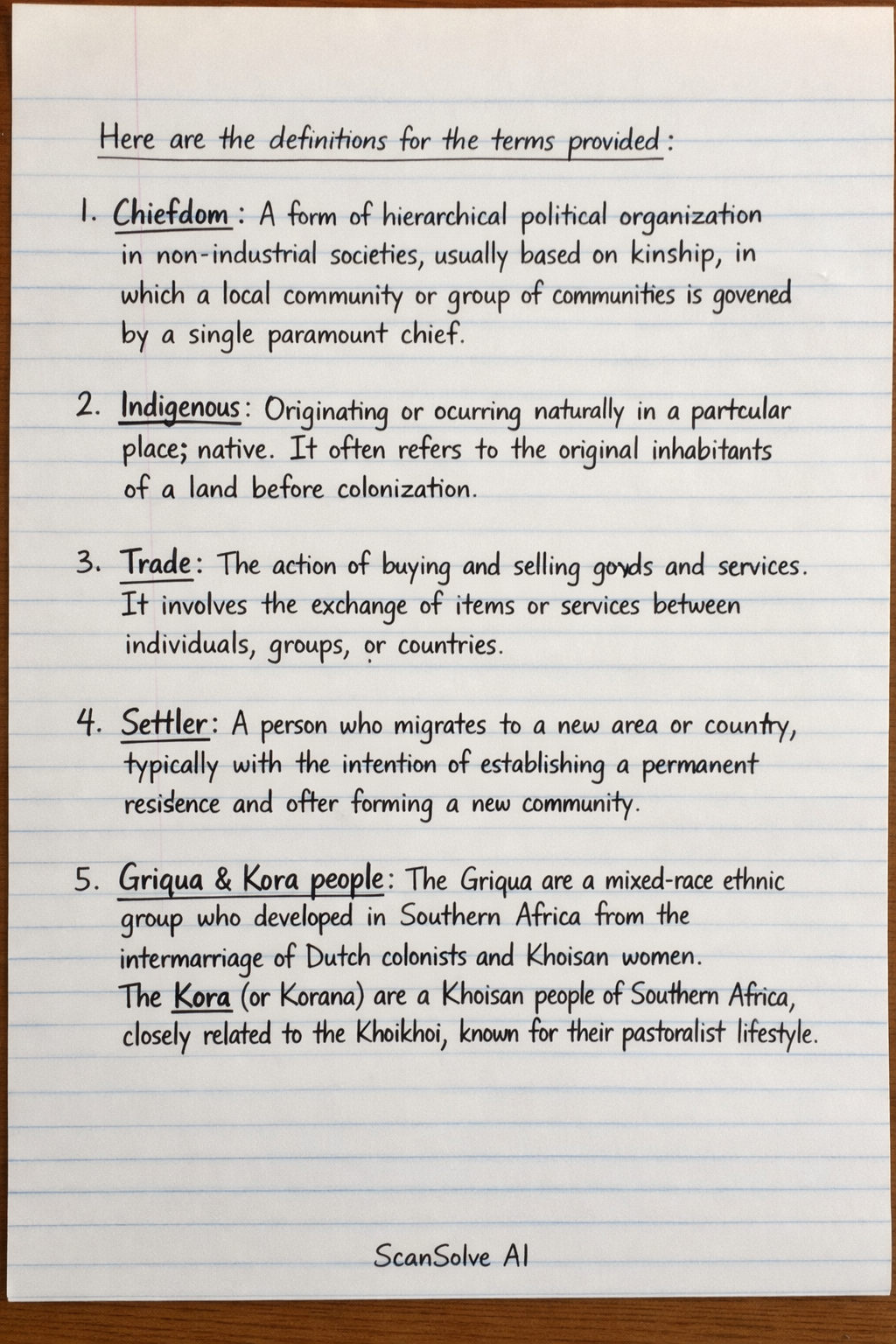
Here are the definitions for the terms provided:
-
Chiefdom: A form of hierarchical political organization in non-industrial societies, usually based on kinship, in which a local community or group of communities is governed by a single paramount chief.
-
Indigenous: Originating or occurring naturally in a particular place; native. It often refers to the original inhabitants of a land before colonization.
-
Trade: The action of buying and selling goods and services. It involves the exchange of items or services between individuals, groups, or countries.
-
Settler: A person who migrates to a new area or country, typically with the intention of establishing a permanent residence and often forming a new community.
-
Griqua & Kora people: The Griqua are a mixed-race ethnic group who developed in Southern Africa from the intermarriage of Dutch colonists and Khoisan women. The Kora (or Korana) are a Khoisan people of Southern Africa, closely related to the Khoikhoi, known for their pastoralist lifestyle.
-
Alliance: A union or association formed for mutual benefit, especially between countries or organizations. It often involves a formal agreement to cooperate.
-
Neighbourhood: A district or community within a town or city, typically characterized by a particular social, economic, or ethnic composition.
-
Tribe: A social division in a traditional society consisting of families or communities linked by social, economic, religious, or blood ties, with a common culture and dialect, and typically having a recognized leader.
-
Political instability: The propensity of a government to collapse, either because of conflicts or rampant competition between various political parties, or because of high demands from the public that the government cannot meet.
-
Chief: The leader or ruler of a people or clan. In many traditional societies, a chief holds significant authority and responsibility for their community.
Still stuck on this one?
Ask a follow-up, and the answer starts from this question.
More History Questions
Handwritten Step-by-Step Solution
Get this as a handwritten image on WhatsApp — like a tutor wrote it for you.
Try on WhatsApp