

This history question requires analysis of historical events, causes, and consequences. The detailed answer below provides context, evidence, and a well-structured explanation.
ScanSolve AI Answer
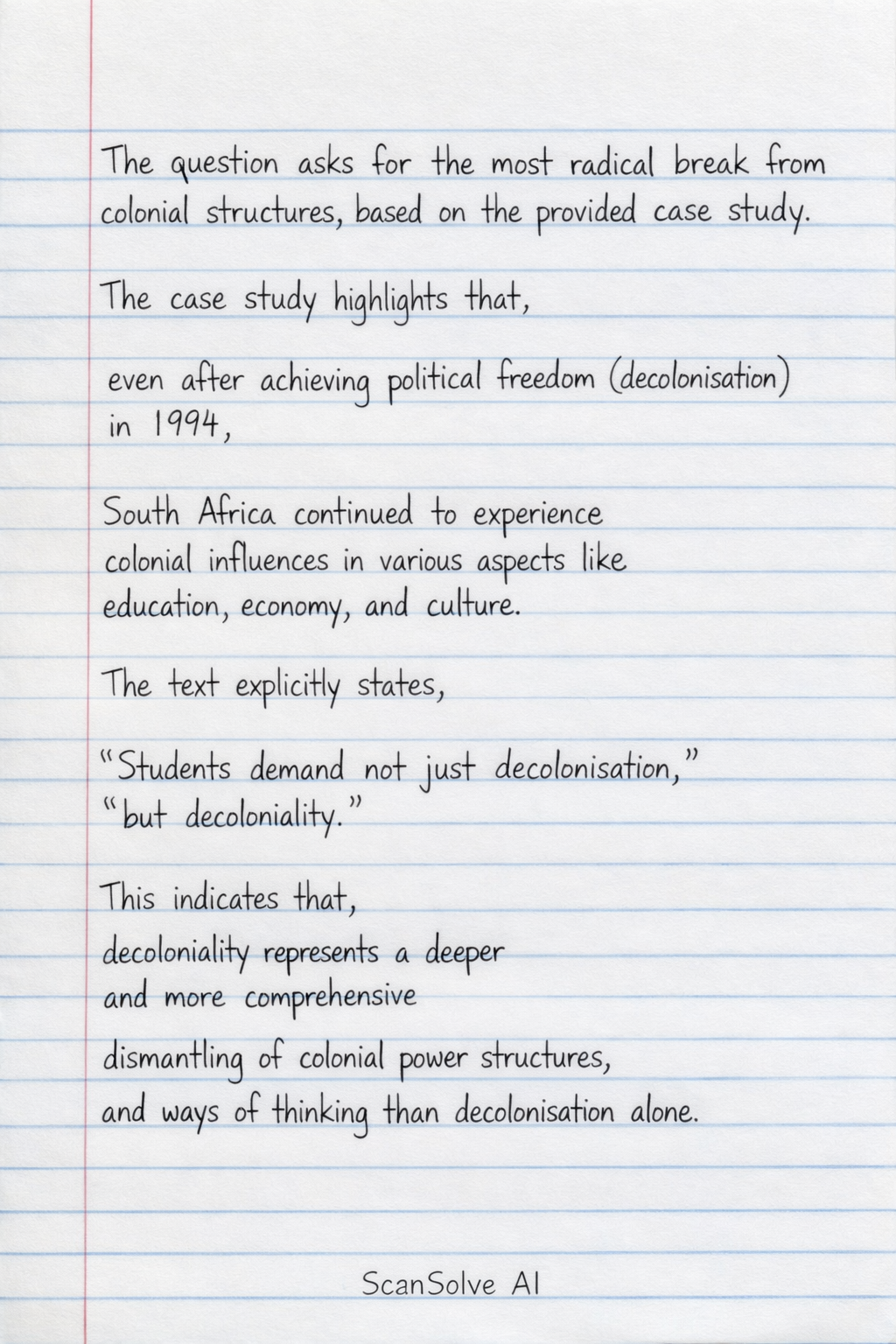
The question asks for the most radical break from colonial structures, based on the provided case study. The case study highlights that even after achieving political freedom (decolonisation) in 1994, South Africa continued to experience colonial influences in various aspects like education, economy, and culture. The text explicitly states, "Students demand not just decolonisation, but decoloniality." This indicates that decoloniality represents a deeper and more comprehensive dismantling of colonial power structures and ways of thinking than decolonisation alone. a)* Decolonisation refers primarily to the political act of gaining independence from colonial rule. The case study shows that while political freedom was achieved, colonial structures persisted. b)* Neo-colonial Trade describes a continuation of economic exploitation, not a break from colonial structures. c)* Modernisation often involves adopting Western models, which can reinforce rather than break from Eurocentric colonial structures. d)* Decoloniality is presented as the desired state beyond decolonisation, aiming to dismantle the enduring power structures, knowledge systems, and cultural norms inherited from colonialism. It represents a more profound and radical transformation. Given that students demand "not just decolonisation, but decoloniality" to address the persistent colonial structures, decoloniality is the most radical break. The final answer is d. Decoloniality.