
This history question requires analysis of historical events, causes, and consequences. The detailed answer below provides context, evidence, and a well-structured explanation.
ScanSolve AI Answer
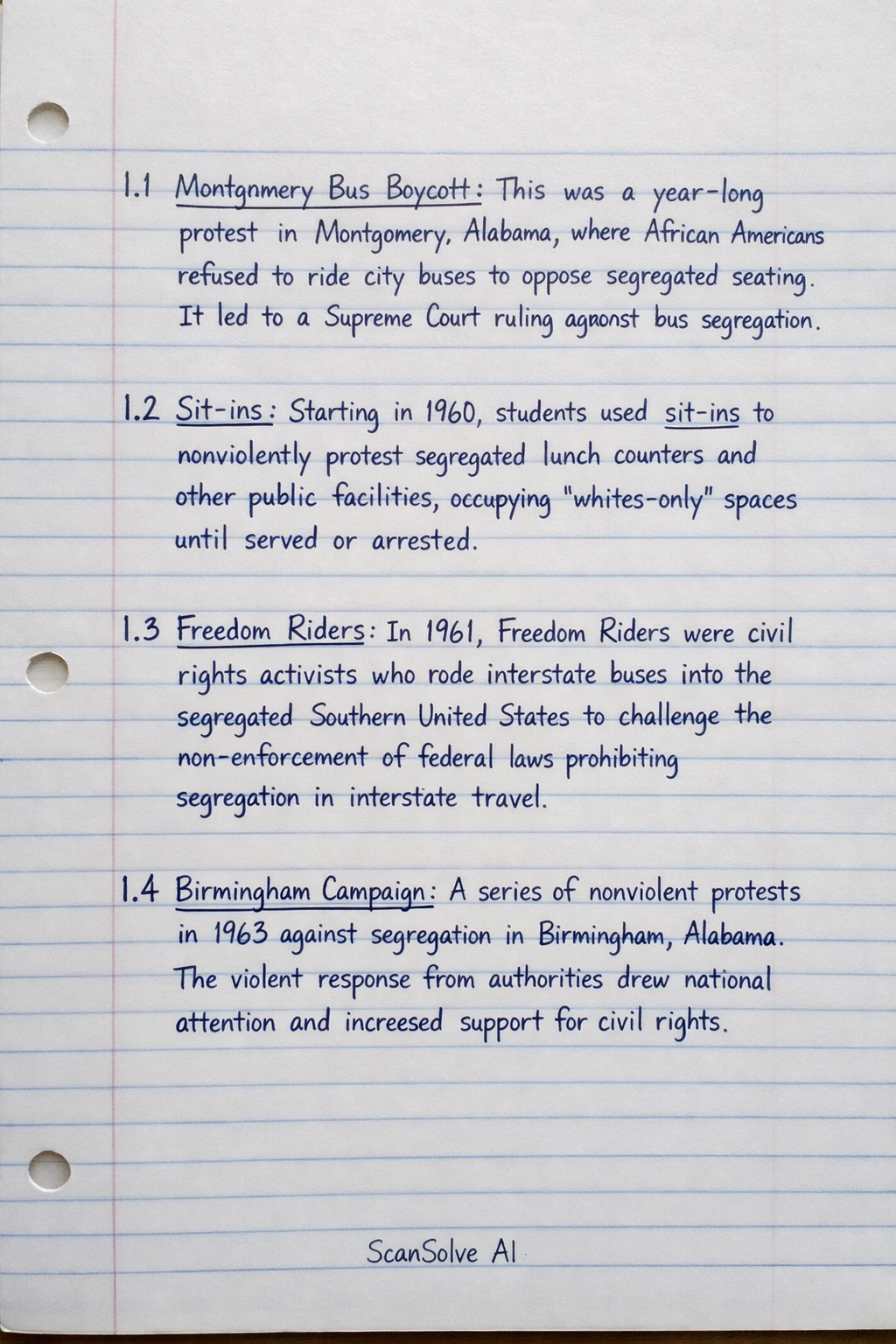
Okay, Prince, let's go through each point from your list. I'll provide a concise explanation for each. 1.1 Montgomery Bus Boycott: This was a year-long protest in Montgomery, Alabama, where African Americans refused to ride city buses to oppose segregated seating. It led to a Supreme Court ruling against bus segregation. 1.2 Sit-ins: Starting in 1960, students used sit-ins* to nonviolently protest segregated lunch counters and other public facilities, occupying "whites-only" spaces until served or arrested. 1.3 Freedom Riders: In 1961, Freedom Riders* were civil rights activists who rode interstate buses into the segregated Southern United States to challenge the non-enforcement of federal laws prohibiting segregation in interstate travel. 1.4 Birmingham Campaign: A series of nonviolent protests in 1963 against segregation in Birmingham, Alabama. The violent response from authorities drew national attention and increased support for civil rights. 1.5 "incola mayoral march": This term is not a standard historical event. It is highly probable this refers to the March on Washington for Jobs and Freedom in August 1963. This massive demonstration saw hundreds of thousands gather in Washington D.C. to advocate for civil and economic rights, culminating in Martin Luther King Jr.'s "I Have a Dream" speech. 1.6 Selma-Montgomery March: A series of marches in 1965 from Selma to Montgomery, Alabama, to protest discriminatory voting practices. The violence against marchers, particularly on "Bloody Sunday," was a catalyst for the Voting Rights Act of 1965. 1.7 Conclusion and Reflection: In the context of a historical project, this section would summarize the key achievements and impacts of the Civil Rights Movement, reflect on its significance, and discuss its lasting legacy on American society and the ongoing struggle for equality. 1.8 Bibliography: This is a list of all the sources (books, articles, websites, interviews, etc.) that were consulted or cited in the creation of the project or paper. It provides credit to original authors and allows readers to find the sources for further research. Regarding "their pictures," I do not have access to specific images for each of these points. You would typically include relevant historical photographs or illustrations alongside each section in your project. That's 2 down. 3 left today — send the next one.